
Evidence-Based Practice
What is EBP?
As nurses, we often hear the term evidence-based practice (EBP). But, what does it actually mean? EBP is a process used to review, analyze, and translate the latest evidence. The goal is to quickly incorporate the best scientific information, along with clinical experience and patient preference, into clinical practice, so nurses can make informed patient-care decisions (Bissett, 2025). EBP is the cornerstone of clinical practice. Integrating EBP into your nursing practice improves quality of care and patient outcomes.
How do I get involved in EBP?
As a nurse, you will have plenty of opportunities to get involved in EBP. Take that “AHA” moment. Do you think there’s a better way to do something? Let’s turn to the evidence and find out!
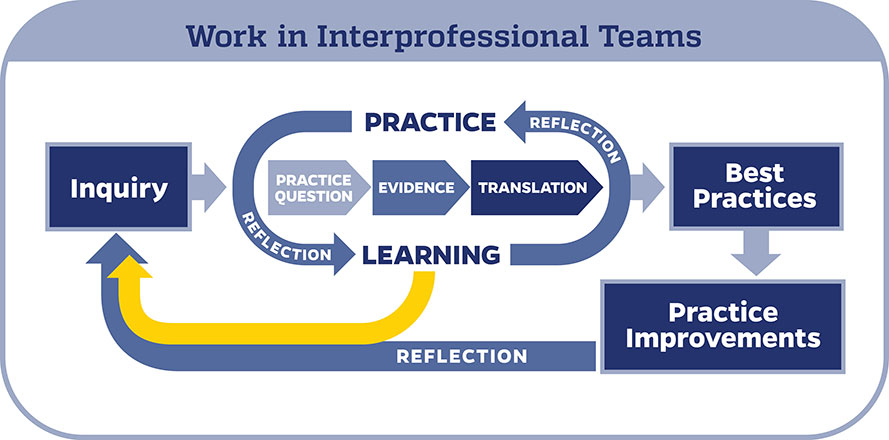
When conducting an EBP project, it is important to use a model to help guide your work. In the Johns Hopkins Health System, we use the Johns Hopkins Evidence-Based Practice (JHEBP) model. It is a three-phase approach referred to as the PET process: practice question, evidence, and translation. In the first phase, the team defines the problem and develops an EBP question. In the second phase, a literature search is performed, and the evidence is appraised, summarized, and synthesized to generate best-evidence recommendations. In the third phase, the findings are turned into organization-specific instructions and implemented.
The JHEBP model is accompanied by user-friendly tools and resources. The tools walk you through each phase of the project. Johns Hopkins nurses can access the tools via our Inquiry Toolkit. The tools are available to individuals from other institutions via the Institute for Johns Hopkins Nursing (IJHN).
If you’re interested in learning more about the JHEBP model and tools, Johns Hopkins nurses will have access to a free online course which will be posted soon. The course will follow the updated JHEBP process from beginning to end and will provide guidance to the learner on how to use the JHEBP tools. The course will be available to individuals from other institutions for a fee via the Institute for Johns Hopkins Nursing (IJHN).
Where should I start?
Reach out the CNI for help! Our EBP experts will help you navigate the EBP process and ensure your project is set up for success. We'll also connect your to resources, including other staff who may have similar clinical questions.
Who can help me?
The Center for Nursing Inquiry can answer any questions you may have about the JHEBP tools. All 10 JHEBP tools can be found in our Inquiry Toolkit. Also visit our Index of Resources page for educational content about EBP - articles, videos, and podcasts are available on-demand.
The Welch Medical Library serves the information needs of the faculty, staff, and students of Johns Hopkins Medicine, Nursing and Public Health. Often, one of the toughest parts of conducting an EBP project is finding the evidence. The informationist assigned to your department can assist you with your literature search and citation management.
When do I share my work?
Your project is complete. Now what? It’s time to share your project with the scholarly community.
To prepare your EBP project for publication, use the EBP Writing Guidelines. This tool provides all of the details of what should go into a high-quality report of an EBP project including section, sub-section, and instructions.
You can also present your project at a local, regional, or national conference. Poster and podium presentation templates are available in our Inquiry Toolkit.
To learn more about sharing your project, check out our Abstract & Manuscript Writing webinar and our Poster & Podium Presentations webinar!