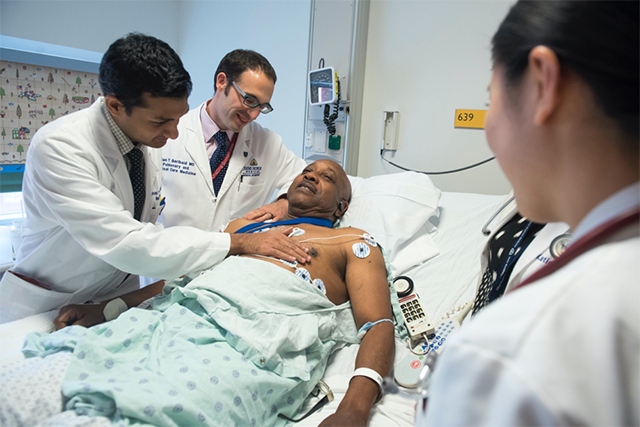
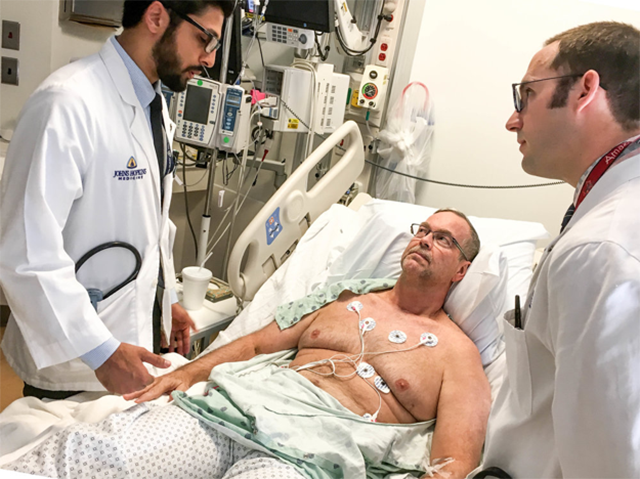
In the Osler program, we firmly believe that the patient is the most valuable source of information about their illness. Many studies have shown and confirmed that the majority of diagnostic information comes from the patient’s history. Many of physicians’ critical responsibilities can only be performed at the bedside – not only diagnostic information gathering and clinical reasoning, but also exploring patients’ values and preferences, counseling, and simply being present during difficult times.
Bedside rounds are the heart of our training program.
Despite the proven benefits of time spent directly with patients, trainees spend little time at the bedside in the modern academic hospital and often sense a decline in their physical exam skills as they matriculate through residency. We believe increased time at the bedside improves satisfaction and engagement in the educational environment and decreases burnout. Our core teaching services are structured to maximize time at the bedside. ACS rounds allot 2 hours each morning for dedicated bedside rounds on new patients for the entire team; during this time, the post-call intern presents overnight admissions at the bedside. The senior resident (SAR) provides teaching at the bedside and in short didactic form. In the afternoon, the ACS and SAR round to see and examine patients, ensure they are updated on their plan of care, and provide advanced teaching.
Dedicated physical exam teaching sessions to improve observation and physical diagnosis skills.
While rotating through the Medical Progressive Care Unit (“step-down” level care), our interns and junior residents accompany medicine and neurology faculty to the bedside 3 days per week to practice the art of observation and physical diagnosis. Learning the principles and skills of observation and the hypothesis-driven physical exam allows our learners to obtain the most information about their patients while practicing compassionate, patient-centered care.
POCUS curriculum in subspecialty environments augments bedside skills.
We have launched a novel POCUS curriculum designed to ensure that all of our housestaff rotating through our subspecialty services are competent in obtaining critical views in cardiac, pulmonary, and abdominal point-of-care ultrasound. We view POCUS as an important tool to reinforce anatomy and physiology to underscore history and physical findings, and in the right hands, as a useful diagnostic tool. These sessions are led by faculty and fellows in the divisions of Cardiology, Pulmonary and Critical Care Medicine, and Hospital Medicine.