Pheochromocytoma: An Adrenal Gland Tumor
What is a pheochromocytoma?
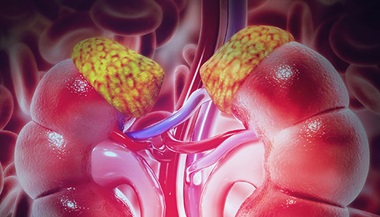
A pheochromocytoma is a rare type of tumor. It grows inside the middle part of an adrenal gland. Your body has two adrenal glands. They are found on top of each kidney. Each layer of these glands makes different hormones. The middle part of the adrenal glands makes epinephrine (adrenaline) and norepinephrine (noradrenaline). These hormones coordinate rapid adaptation to internal and external stress and help to regulate your heart rate and blood pressure levels. A pheochromocytoma causes the adrenal glands to make too much of these hormones.
What causes pheochromocytoma?
Experts don't know what causes this type of tumor. It is thought that the cause is a multi-step process by which normal, healthy cells are transformed into catecholamine-producing cells. Catecholamines are neuro-transmitters, such as epinephrine and norepinephrine.
There may be a genetic component.
Who is at risk for pheochromocytoma?
Pheochromocytomas happen equally in men and women. This tumor does not seem to be affected by environment, diet or lifestyle. They often show up when you are in your 30s, 40s or 50s.
If someone in your family has this type of tumor, you may be at a higher risk of developing it. If you have this tumor, you should think about genetic testing. About 40% of these types of tumors are now believed to run in families, and this percentage will likely increase as new genetic changes are discovered.
What are the symptoms of pheochromocytoma?
The most common sign of a pheochromocytoma is high blood pressure. It can be high all the time or high only at certain times. Some people have episodes or “spells” of high blood pressure. Sometimes the tumor can cause high blood pressure that can be life-threatening. It's a very rare cause of high blood pressure. But it must be considered when medicine is not enough to control high blood pressure, or when high blood pressure is associated with symptoms such as headache, racing heart, sweating, looking pale, and shakiness.
Other symptoms are less common. They can be brought on when you are under stress or when you change positions. Each person’s symptoms may vary. Symptoms may include:
- Very fast pulse
- Feeling that your heart is beating fast or fluttering (palpitations)
- Pounding heartbeat
- Headache
- Nausea
- Vomiting
- Clammy skin and sweating
- Shaking (tremors)
- Anxiety
- Flushing
The symptoms of a pheochromocytoma may seem like other health problems. Always see your healthcare provider for a diagnosis.
How is pheochromocytoma diagnosed?
Your healthcare provider will take your health history and give you a physical exam. You may also need tests, such as:
- Blood and urine tests. These tests measure hormone levels. Genetic tests may also be done to check if you have a genetic condition that may raise your risk.
- CT scan. This test uses X-rays and computer technology to take detailed 3-D images of your body.
- MRI. This test uses large magnets, radio waves, and a computer to also make 3-D images of organs and structures within your body.
- Radioisotope scan. This test puts radioactive substances into your body to get an image of the tumor. The radioactive substance is absorbed into tissues that make too much of the hormone epinephrine. During the scan, any area that absorbs the radioactive substance can be seen.
How is a pheochromocytoma treated?
Treatment may include:
- Surgery. This is the most common treatment. The surgeon may remove part of the adrenal gland or one or both adrenal glands. Before surgery, patients start medicine to block the effect of the adrenal hormones.
- Medicine. If you can't have surgery, you should take medicine. But this is rarely done. The tumor is mainly treated with surgery.
Living with a pheochromocytoma
Pheochromocytomas are all classified as cancers although most don’t spread or come back after they are removed. In a small number of cases, the tumor may come back or spread to other places in the body. It is important for people with a history of pheochromocytoma to have regular follow up to check for tumor recurrence or spread.
When should I call my healthcare provider?
Tell your healthcare provider if your symptoms come back or get worse. Also, tell your provider if you have any new symptoms.
Key points about pheochromocytomas
- A pheochromocytoma is a tumor in the adrenal gland. It causes the gland to make too much of the hormones epinephrine and norepinephrine.
- This tumor often occurs when you are in your 30s, 40s, or 50s. It happens to both men and women.
- Experts don't know what causes these tumors, but up to 40% are related to a genetic disease.
- The most common sign of this tumor is high blood pressure that is often in “spells.”
- Blood and urine tests can most often detect whether there is a pheochromocytoma.
- The most common treatment for pheochromocytoma is adrenal surgery.