
Century of Wilmer: 1980s–90s
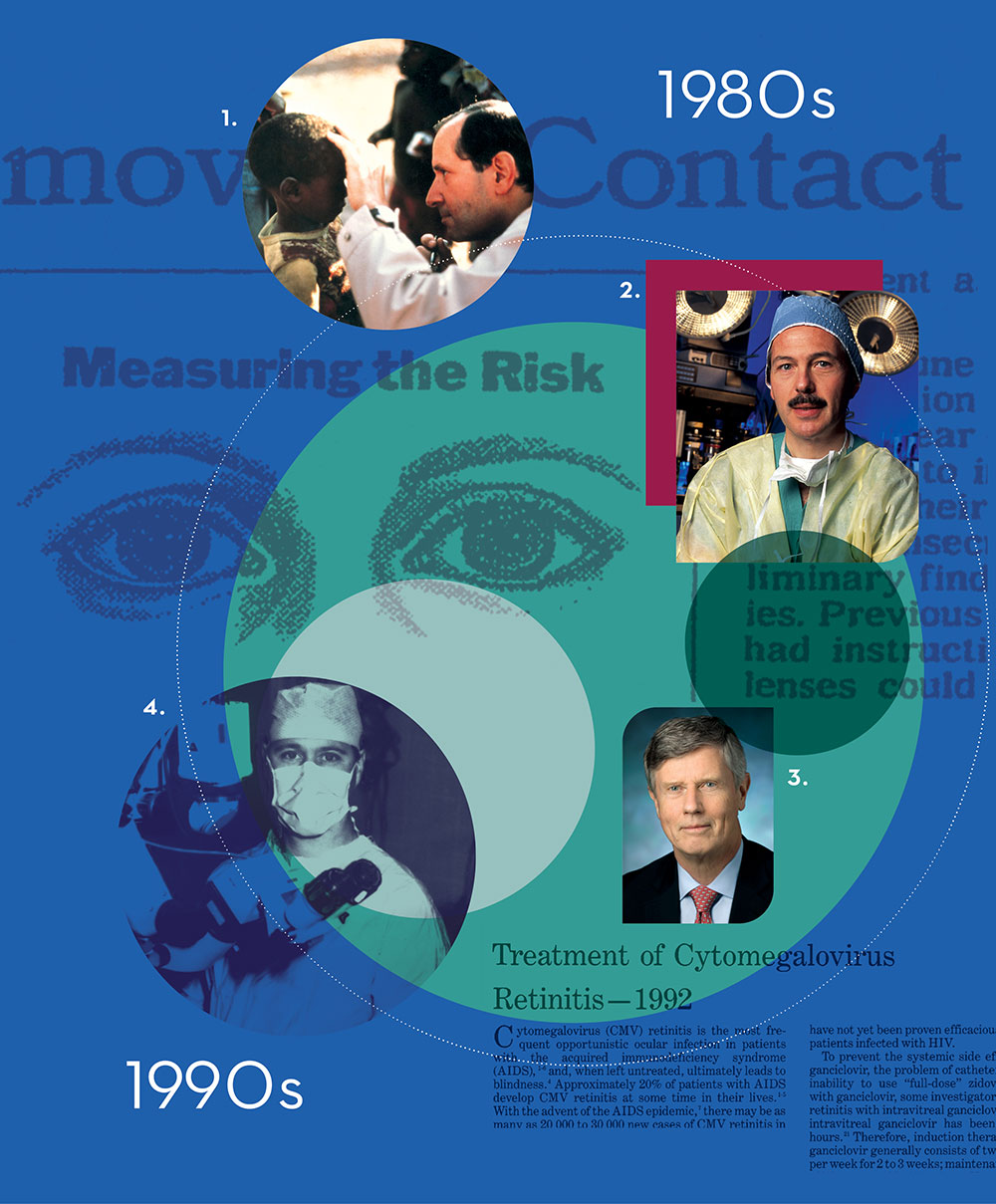 1. Alfred Sommer’s discovery that vitamin A capsules not only prevent blindness but also cut death rates in malnourished children is estimated to have saved some 6 million lives.
2. Oliver Schein’s work showing the risk of extended-wear contact lenses led to changes in FDA policy and government safety standards for contact lenses.
3. Douglas Jabs discovered that a drug that treats a vision-threatening infection in patients with AIDS also prolongs their lives.
4. The 25-gauge vitrectomy system developed by Eugene de Juan Jr. makes retinal surgery safer and becomes the new standard.
View full size (PDF)
The Wilmer Eye Institute, Johns Hopkins Medicine, is incredibly fortunate to have retained many of the books, articles, awards and artifacts resulting from Wilmer activities over the last century. These historical treasures help tell the compelling story of how one woman, Aida Breckinridge, recognized the genius of one man, ophthalmologist William Holland Wilmer, and took it upon herself to ensure that his work would live on in the generations of students that followed. They tell the story of some of the biggest breakthroughs in ophthalmology during the institute’s 100-year history — and of the exceptional dedication, discovery and innovation that remain hallmarks of Wilmer today.
In this installment, we look at the decades from the 1980s–1990s.
REDUCING CHILD MORTALITY WITH VITAMIN A
In 1983, Alfred Sommer, founding director of the Dana Center for Preventive Ophthalmology at Wilmer, discovers that vitamin A capsules, which prevent blindness from xerophthalmia, also cut death rates in malnourished children by 30%. In 1997, Sommer wins a Lasker Award for this work, which by some estimates has saved 6 million lives.
TRANSFORMING GLAUCOMA SURGERY
Irvin Pollack and Arnall Patz perform the world’s first laser iridotomies and trabeculectomies at Wilmer, launching the era of scientific medicine in the glaucoma field. These techniques remain in wide use today.
MAKING CONTACT LENSES SAFER
In 1989, Oliver Schein and colleagues demonstrate excessive risk to the cornea from extended-wear contact lenses, leading to changes in Food and Drug Administration (FDA) approval of contact lenses. Schein’s subsequent testimony before Congress, in 2005, helps craft a law strengthening safety standards for lenses purchased through the internet.
DISCOVERY OF A LIFESAVING DRUG
A study led by Douglas Jabs in 1991 finds that the drug ganciclovir not only treats cytomegalovirus, a vision-threatening infection in many patients with AIDS, but also prolongs their lives.
A NEW STANDARD FOR RETINAL SURGERY
In the late 1990s, Eugene de Juan Jr. develops the 25-gauge vitrectomy system that operates through self-sealing wounds. Use of the system, which makes retinal surgery safer and more controlled, becomes the new standard.
Century of Wilmer

Explore more Wilmer history: