
Century of Wilmer: 1960s–70s
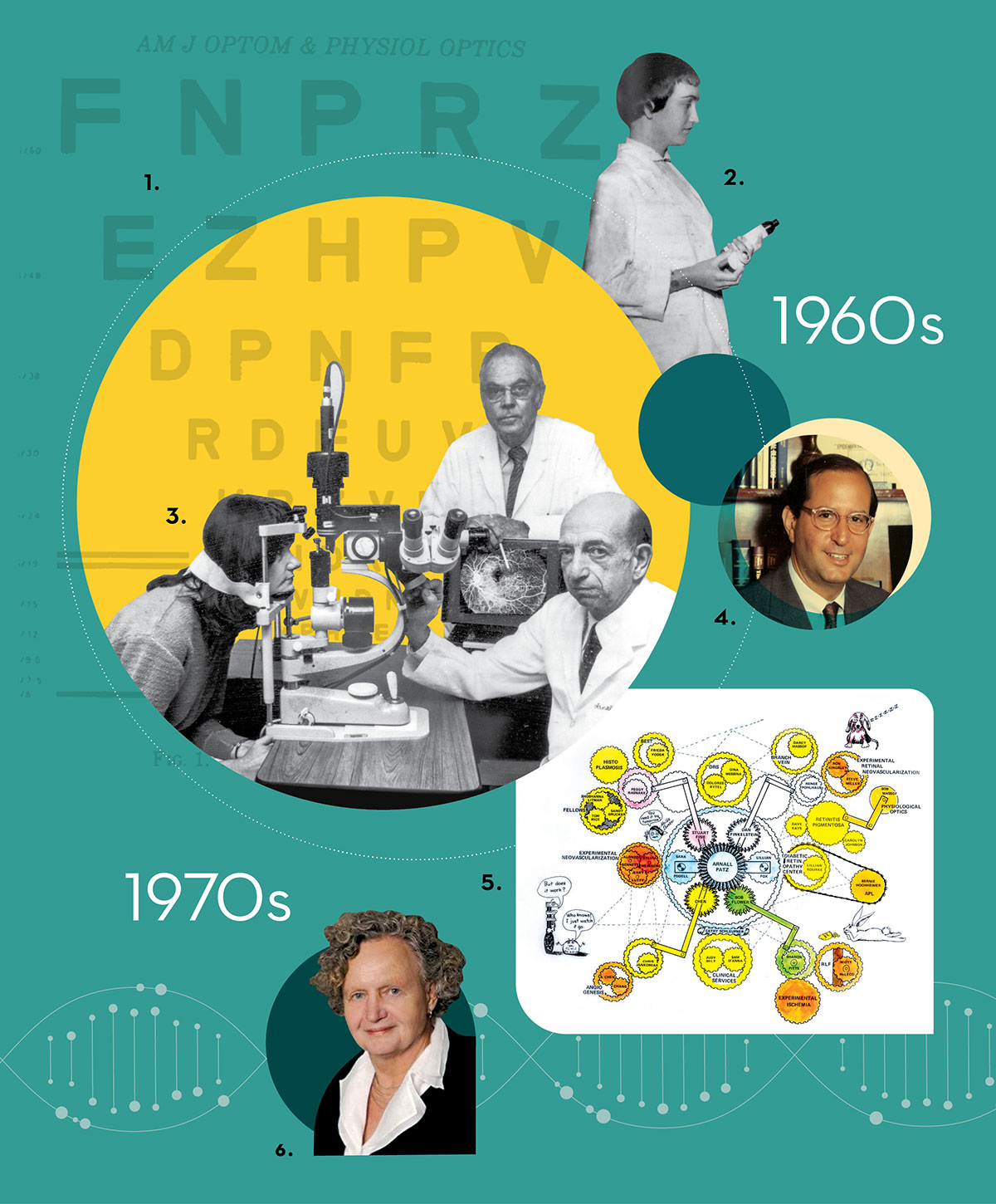 1. The Sloan letters, developed by Louise Sloan, became the standard on which today’s visual acuity charts are based.
2. Louise Sloan, a pioneer in developing methods and technology for treating low vision
3. Ed Maumenee, top, and Arnall Patz, seated, pioneered the use of fluorescein angiography as a diagnostic tool for diseases of the retina.
4. Al Sommer, founding director of the Dana Center for Preventive Ophthalmology at Wilmer
5. A diagram depicting the many facets of the Retinal Vascular Center, which was established by Arnall Patz
6. Irene Maumenee established the first center in the nation focusing on genetic eye disease.
View full size (PDF)
The Wilmer Eye Institute, Johns Hopkins Medicine, is incredibly fortunate to have retained many of the books, articles, awards and artifacts resulting from Wilmer activities over the last century. These historical treasures help tell the compelling story of how one woman, Aida Breckinridge, recognized the genius of one man, ophthalmologist William Holland Wilmer, and took it upon herself to ensure that his work would live on in the generations of students that followed. They tell the story of some of the biggest breakthroughs in ophthalmology during the institute’s 100-year history — and of the exceptional dedication, discovery and innovation that remain hallmarks of Wilmer today.
In this installment, we look at the decades from the 1960s–1970s.
PIONEERING FLUORESCEIN ANGIOGRAPHY
A. Edward Maumenee, Wilmer’s director from 1955–1979, demonstrates the significance of fluorescein angiography as a powerful diagnostic tool for diseases of the retina.
SPOTLIGHT ON LOW VISION
Louise Sloan, a pioneer in developing methods and technology for treating low vision, invents a series of magnifiers that provide greater clarity and a wider field of vision for people with low vision than do commercially available devices.
SETTING THE STANDARD FOR EYE CHARTS
From the 1950s through the 1970s, Louise Sloan develops and validates the American Medical Association standard letters for visual acuity charts. The “Sloan letters” are the standard on which today’s visual acuity charts are based. Sloan’s lifetime of work contributes to clinicians’ ability to diagnose numerous ophthalmic conditions.
RETINAL VASCULAR CENTER ESTABLISHED
In 1970, Arnall Patz founds the Retinal Vascular Center at Wilmer, which quickly becomes the world leader in studying and treating retinal diseases. Patz’s early contributions to ophthalmology also include discovery of the cause of retrolental fibroplasia, an affliction of premature infants that once was the most common reason for childhood blindness.
A FIRST FOR GENETIC EYE DISEASE
In 1972, Irene Maumenee establishes the Johns Hopkins Center for Genetic Eye Diseases — the first center in the U.S. with that focus. Today, the Wilmer Genetic Eye Disease Center continues the mission by researching stem cell therapies and gene editing to overcome some of the most challenging genetic eye diseases.
A BOOST FOR PREVENTIVE OPHTHALMOLOGY
The Dana Center for Preventive Ophthalmology, a leader in global and domestic research on blindness prevention and the only World Health Organization collaborating center in the United States, is established in 1979. Alfred Sommer is its founding director.
Century of Wilmer

Explore more Wilmer history: