
Century of Wilmer: 2000s–10s
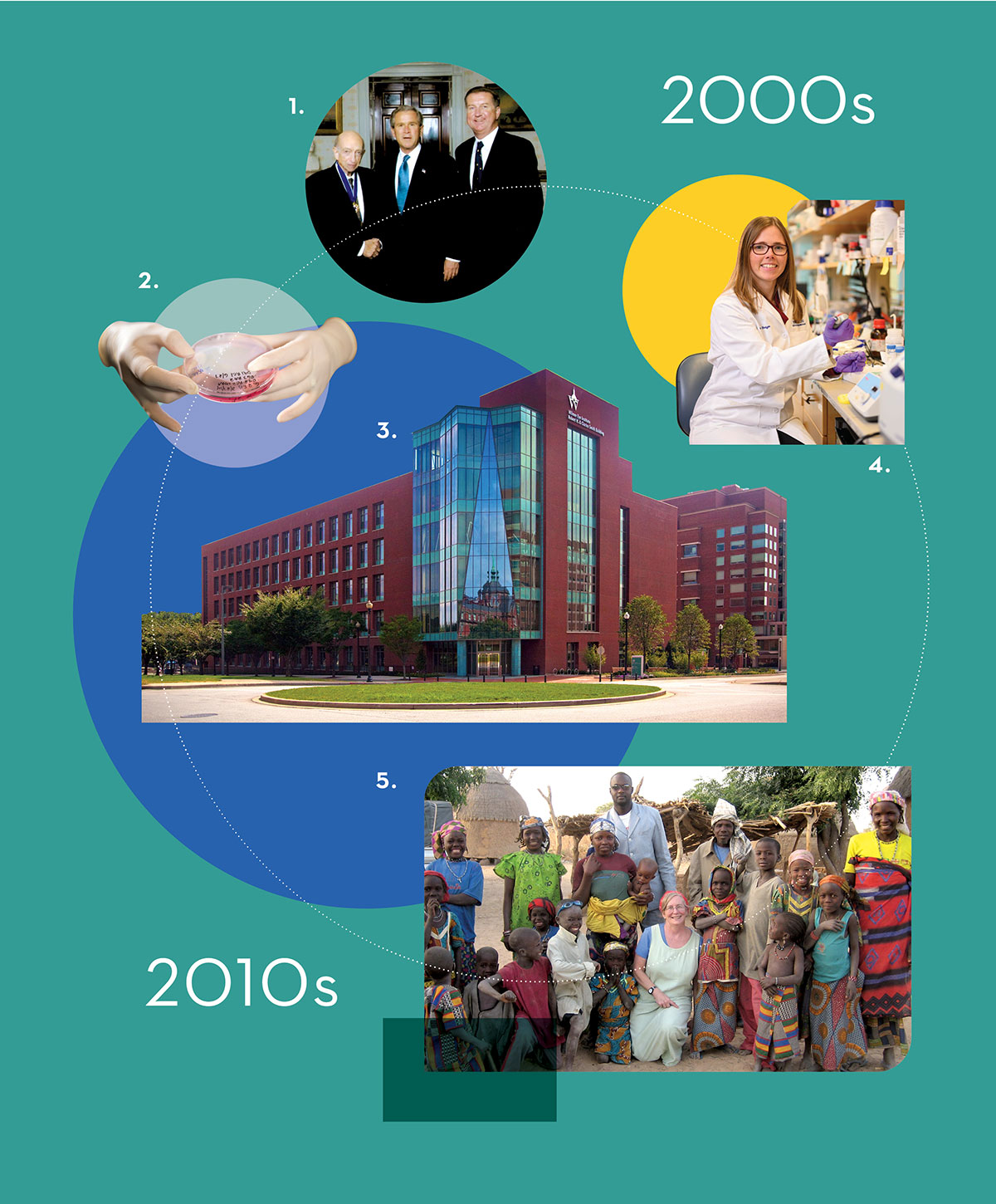 1. Arnall Patz, President George W. Bush, and Peter McDonnell. President Bush presented Patz with the Presidential Medal of Freedom for his pioneering work.
2. A Wilmer research team used human stem cells to create a “retina in a dish” and demonstrated that the retinal cells are able to detect light.
3. The Robert H. and Clarice Smith Building, reflecting the iconic Johns Hopkins dome, opened in 2009.
4. Laura Ensign, vice chair for research at Wilmer
5. Sheila West in Niger. West’s research has informed all aspects of the World Health Organization guidelines for trachoma control.
View full size (PDF)
The Wilmer Eye Institute, Johns Hopkins Medicine, is incredibly fortunate to have retained many of the books, articles, awards and artifacts resulting from Wilmer activities over the last century. These historical treasures help tell the compelling story of how one woman, Aida Breckinridge, recognized the genius of one man, ophthalmologist William Holland Wilmer, and took it upon herself to ensure that his work would live on in the generations of students that followed. They tell the story of some of the biggest breakthroughs in ophthalmology during the institute’s 100-year history — and of the exceptional dedication, discovery and innovation that remain hallmarks of Wilmer today.
In this installment, we look at the decades from the 2000s–2010s.
TOP HONORS FOR ARNALL PATZ
In 2004, President George W. Bush presents the Presidential Medal of Freedom to Arnall Patz in recognition of his pioneering work in prevention of retinopathy of prematurity and treatment of diabetic retinopathy.
ON A MISSION TO ERADICATE TRACHOMA
In 2007, following her discovery that azithromycin prevents recurrence of severe trichiasis after trichiasis surgery, Sheila West receives $10 million from the Bill & Melinda Gates Foundation to eradicate trachoma — the infectious disease that causes trichiasis. In 2020, West is honored with the Helen Keller Prize for Vision Research. Her research has informed all aspects of the present World Health Organization guidelines for trachoma control.
ROBERT H. AND CLARICE SMITH BUILDING OPENS
Funded entirely by grateful Wilmer patients, the Robert H. and Clarice Smith Building opens in 2009, making possible tremendous growth of Wilmer’s research programs and surgical practices. The 207,000-square-foot building houses seven state-of-the-art operating rooms and five floors of open and glass enclosed research labs designed to facilitate collaboration among Wilmer researchers.
SPEEDING DISCOVERIES TO PATIENTS
In the 2010s, Wilmer faculty establish 10 companies with the aim of translating laboratory discoveries into therapies to benefit patients — including novel products that more effectively deliver medication to the eyes and new therapies for systemic treatment of age-related macular degeneration (AMD) and diabetic retinopathy.
RETINAL PROSTHESIS RESTORES PARTIAL SIGHT
In 2013, the FDA approves the Argus II electronic retinal prosthesis, which is based on technology developed by Wilmer faculty. The device partially restores vision for patients who are completely blind. Wilmer becomes one of the few places where the prosthetic vision of people with these implants is studied.
“RETINA IN A DISH”
In 2014, Wilmer researchers use human stem cells to create a “retina in a dish” and show that the retinal cells are able to detect light. The research team is the first to grow advanced tissues that contain all the major cell types of the retina and that duplicate the retina’s layered structure and its gently arcing, cuplike shape.
Century of Wilmer

Explore more Wilmer history: