
Century of Wilmer: 1940s–50s
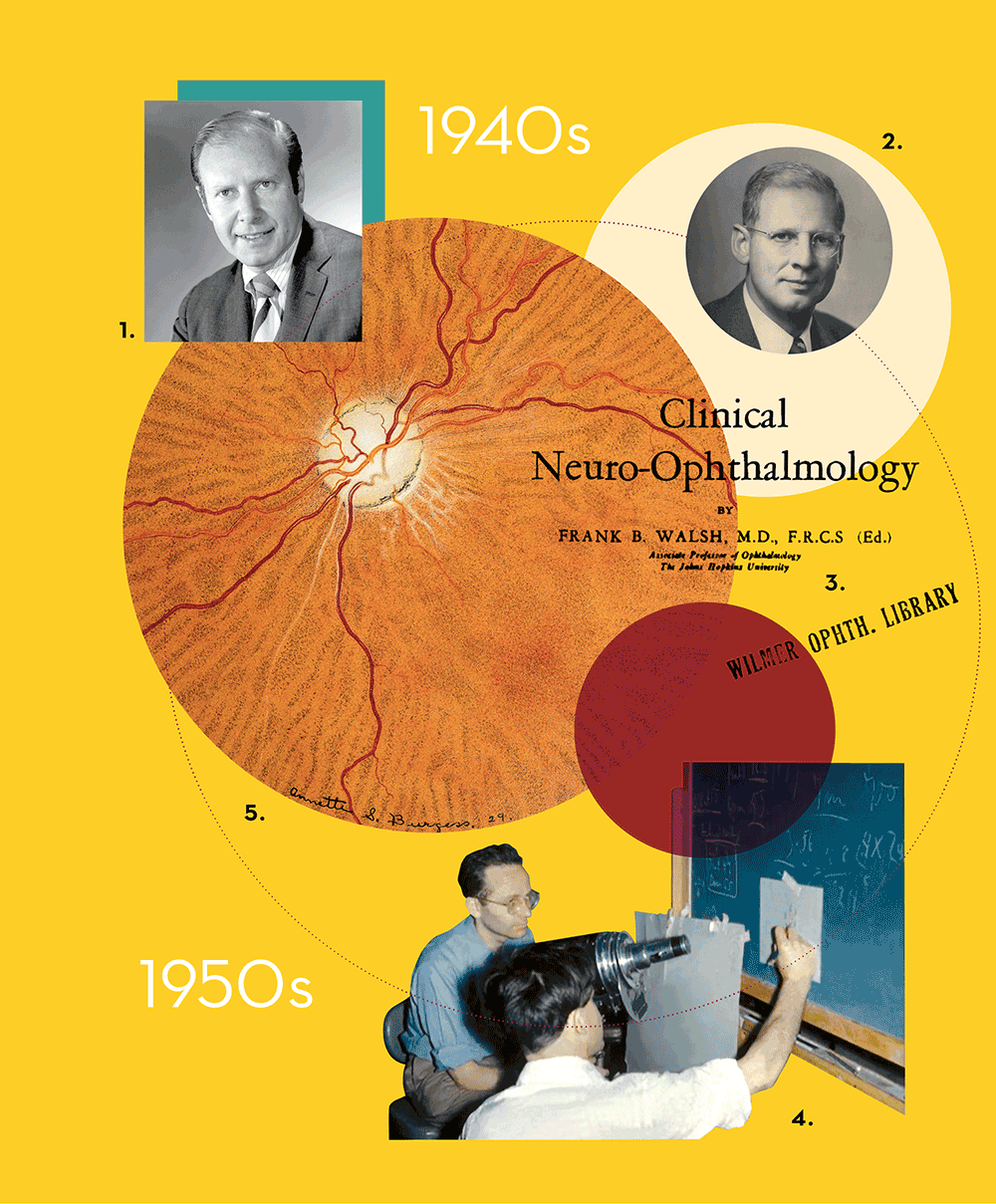 1. Carl Kupfer, who trained at Wilmer, became the first director of the National Eye Institute. Credit: Office of NIH History and Stetten Museum, National Institutes of Health
2. Wilmer trainee Charles Iliff developed beta irradiation therapy for pterygium.
3. Clinical Neuro-Ophthalmology by Frank B. Walsh remains the foremost textbook on neuro-ophthalmology.
4. David Hubel and Torsten Wiesel at the Wilmer Eye Institute. The pair would go on to share the 1981 Nobel Prize in Physiology or Medicine for their discoveries concerning information processing in the visual system.
5. Fundus image depicting optic neuropathy hand-illustrated by Annette Smith Burgess
View full size (PDF)
The Wilmer Eye Institute, Johns Hopkins Medicine, is incredibly fortunate to have retained many of the books, articles, awards and artifacts resulting from Wilmer activities over the last century. These historical treasures help tell the compelling story of how one woman, Aida Breckinridge, recognized the genius of one man, ophthalmologist William Holland Wilmer, and took it upon herself to ensure that his work would live on in the generations of students that followed. They tell the story of some of the biggest breakthroughs in ophthalmology during the institute’s 100-year history — and of the exceptional dedication, discovery and innovation that remain hallmarks of Wilmer today.
In this installment, we look at the decades from the 1940s–1950s.
DEVELOPMENT OF CORNEOSCLERAL SUTURES
In a 1940 article in Archives of Ophthalmology, Wilmer fellow John McLean describes a suture developed at Wilmer as the ideal suture for closing cataract wounds and includes a detailed description of the technique.
IRRADIATING PTERYGIUM
In 1946, Charles Iliff develops beta irradiation therapy for pterygium, a common benign growth on the conjunctiva — the clear membrane on the surface of the eye — that can grow to cover the eye’s surface and cause discomfort or vision impairment.
NEURO-OPHTHALMOLOGY — A NEW SUBSPECIALTY
In 1947, Frank B. Walsh establishes neuro-ophthalmology as a subspecialty and writes the foremost textbook on the subject, Walsh & Hoyt’s Clinical Neuro-Ophthalmology.
LAYING THE GROUNDWORK FOR A NOBEL PRIZE
Research on the visual cortex by David Hubel and Torsten Wiesel during the 1950s identifies a critical period during which the visual system develops in mammals and shows that impairment of the system during that time will affect lifelong vision. Their work will greatly impact the understanding of how a dominant eye is established in early childhood, and how ophthalmologists treat many cases of vision loss in children. The pair shares the 1981 Nobel Prize in Physiology or Medicine for their discoveries.
TREATMENT BREAKTHROUGH FOR RETINOBLASTOMA
In 1953, Carl Kupfer discovers the first pharmacological treatment for retinoblastoma — the most common type of eye cancer in children — with intravenous nitrogen mustard. Kupfer goes on to become the first director of the National Eye Institute (NEI), serving in that position from 1970–2000 — a critical time that shaped vision research in the U.S. During his time at NEI, Dr. Kupfer served under six U.S. presidents.
AN ORAL TREATMENT OPTION FOR GLAUCOMA
As a resident, Bernard Becker notices that cardiac patients given the drug acetazolamide to control fluid buildup around the heart appear to receive another benefit: It often lowers the intraocular pressure associated with glaucoma. In 1954, while working as chief resident with Jonas Friedenwald and Alan Woods, Becker establishes acetazolamide as the first effective oral treatment for glaucoma. It is still used today.
Century of Wilmer

Explore more Wilmer history: