
Century of Wilmer: 2020s
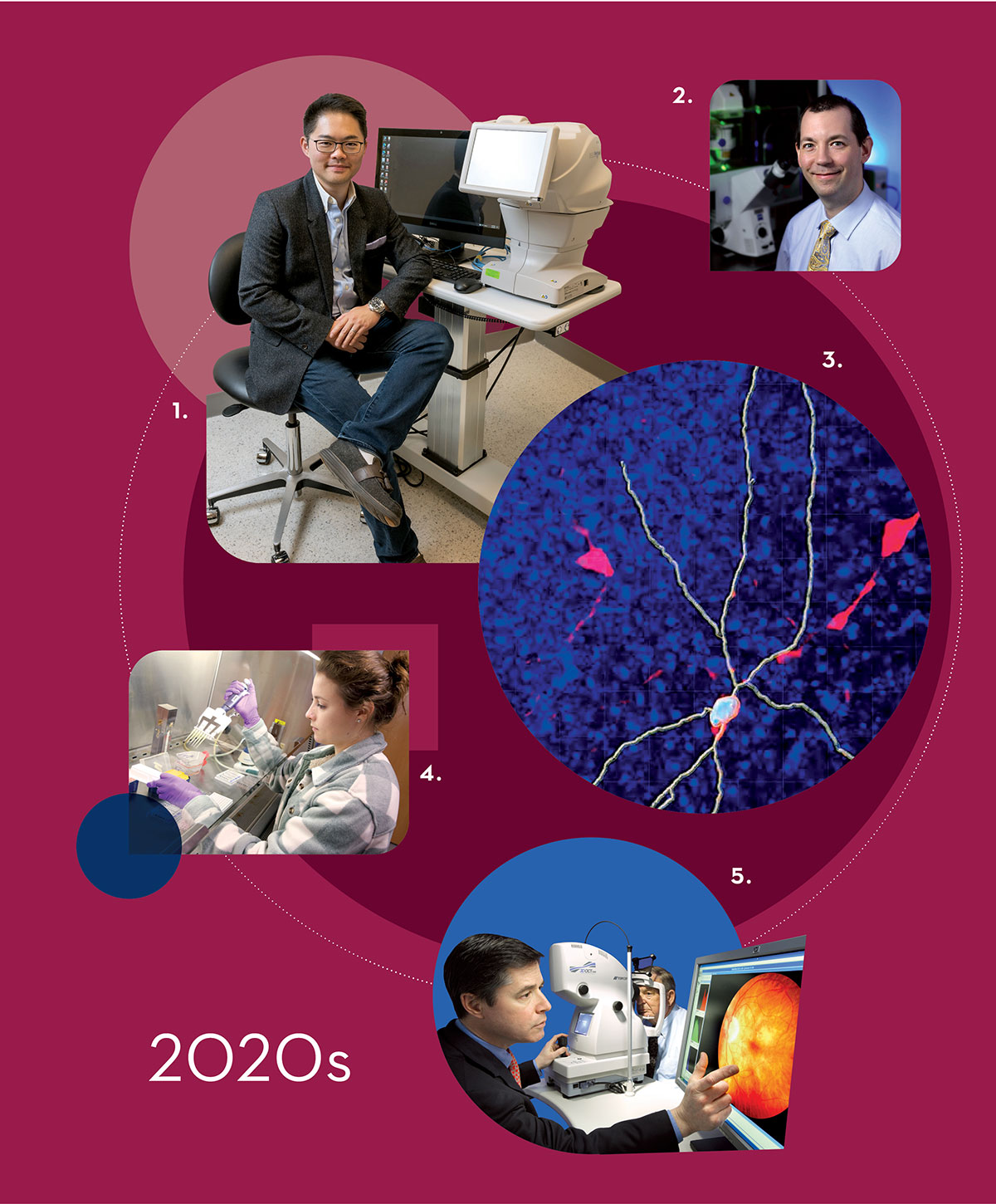 1. T.Y. Alvin Liu, inaugural director of the James P. Gills Jr., M.D., & Heather Gills Artificial Intelligence Innovation Center at Wilmer
2. Thomas V. Johnson, the Shelley and Allan Holt Rising Professor of Ophthalmology
3. A human stem cell-derived retinal ganglion cell integrated into the retina following transplantation. Produced in the laboratory of Thomas V. Johnson, the ultimate goal of the research is to restore vision lost to diseases such as glaucoma.
4. Graduate student Kimberly Bockley
5. Neil Bressler examines a fundus image of the retina for very high myopia — a condition recognized only in the past 10 years as the next global epidemic in ophthalmology.
View full size (PDF)
The Wilmer Eye Institute, Johns Hopkins Medicine, is incredibly fortunate to have retained many of the books, articles, awards and artifacts resulting from Wilmer activities over the last century. These historical treasures help tell the compelling story of how one woman, Aida Breckinridge, recognized the genius of one man, ophthalmologist William Holland Wilmer, and took it upon herself to ensure that his work would live on in the generations of students that followed. They tell the story of some of the biggest breakthroughs in ophthalmology during the institute’s 100-year history — and of the exceptional dedication, discovery and innovation that remain hallmarks of Wilmer today.
In this installment, we look at the decade of the 2020s to date.
JUMP-STARTING JUNIOR FACULTY
In 2020, Wilmer Director Peter J. McDonnell establishes the first-of-its-kind Rising Professorship Program to support the work of junior faculty who have novel ideas. The program equips early-career faculty members with up to seven years of funding to accelerate their careers and their impact on patients.
CENTER TO END BLINDNESS DEBUTS
In 2021, Wilmer establishes the Sanford and Susan Greenberg Center to End Blindness, with the goal of eliminating blinding eye diseases. The center raises funds from philanthropic contributions to support development of innovative strategies to treat and prevent blindness.
ACCELERATING ARTIFICIAL INTELLIGENCE
In 2024, having already established that AI can be used to predict risk of disease progression, estimate best-corrected visual acuity from fundus photographs and engineer peptides for improved drug delivery, Wilmer establishes the James P. Gills Jr., M.D., & Heather Gills Artificial Intelligence Innovation Center to accelerate the use of this new technology in ophthalmology. The center will bring together clinical, scientific and infrastructure resources for investigators to apply artificial intelligence in research, medical education and patient care.
Century of Wilmer

Explore more Wilmer history: