Research Lab Results
-
Theresa Shapiro Laboratory
The Theresa Shapiro Laboratory studies antiparasitic chemotherapy. On a molecular basis, we are interested in understanding the mechanism of action for existing antiparasitic agents, and in identifying vulnerable metabolic targets for much-needed, new, antiparasitic chemotherapy. Clinically, our studies are directed toward an evaluation, in humans, of the efficacy, pharmacokinetics, metabolism and safety of experimental antiparasitic drugs.
-
Samuel R. Denmeade Laboratory
The main research goals of my laboratory are: (1) to identify and study the biology of novel cancer selective targets whose enzymatic function can be exploited for therapeutic and diagnostic purposes; (2) to develop methods to target novel agents for activiation by these cancer selective targets while avoiding or minimizing systemic toxicity; (3) to develop novel agents for imaging cancer sites at earliest stages. To accomplish these objectives the lab has originally focused on the development of prodrugs or protoxins that are inactive when given systemically via the blood and only become activated by tumor or tissue specific proteases present within sites of tumor. Using this approach, we are developing therapies targeted for activation by the serine proteases prostate-specific antigen (PSA), human glandular kallikrein 2 (hK2) and fibroblast activation protein (FAP) as well as the membrane carboxypeptidase prostate-specific membrane antigen (PSMA). One such approach developed in the lab consists of a potent bacterial protoxin that we have reengineered to be selectively activated by PSA within the Prostate. This PSA-activated toxin is currently being tested clinically as treatment for men with recurrent prostate cancer following radiation therapy. In a related approach, a novel peptide-cytotoxin prodrug candidate that is activated by PSMA has been identified and is this prodrug candidate is now entering early phase clinical development. In addition, we have also identified a series of potent inhibitors of PSA that are now under study as drug targeting and imaging agents to be used in the treatment and detection of prostate cancer.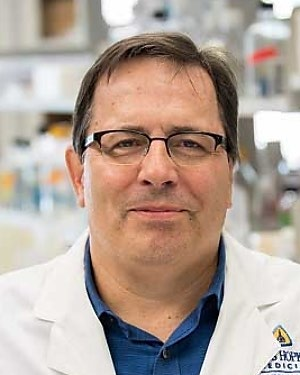
-
Robert Siliciano Laboratory
Research in the Robert Siliciano Laboratory focuses on HIV and antiretroviral therapy (ART). ART consists of combinations of three drugs that inhibit specific steps in the virus life cycle. Though linked to reduced morbidity and mortality rates, ART is not curative. Through our research related to latently infected cells, we've shown that eradicating HIV-1 infection with ART alone is impossible due to the latent reservoir for HIV-1 in resting CD4+ T cells. Our laboratory characterized the different forms of HIV-1 that persist in patients on ART. Currently, we are searching for and evaluating drugs that target the latent reservoir. We are also developing assays that can be used to monitor the elimination of this reservoir. We are also interested in the basic pharmacodynamic principles that explain how antiretroviral drugs work. We have recently discovered why certain classes of antiretroviral drugs are so effective at inhibiting viral replication. We are using this discovery along with experimental and computational approaches to develop improved therapies for HIV-1 infection and to understand and prevent drug resistance. Finally, we are studying the immunology of HIV-1 infection, and in particular, the ability of some patients to control the infection without ART.
-
Gabsang Lee Lab
Human induced pluripotent stem cells (hiPSCs) provide unprecedented opportunities for cell replacement approaches, disease modeling and drug discovery in a patient-specific manner. The Gabsang Lee Lab focuses on the neural crest lineage and skeletal muscle tissue, in terms of their fate-determination processes as well as relevant genetic disorders. Previously, we studied a human genetic disorder (familial dysautonomia, or FD) with hiPSCs and found that FD-specific neural crest cells have low levels of genes needed to make autonomous neurons--the ones needed for the ""fight-or-flight"" response. In an effort to discover novel drugs, we performed high-throughput screening with a compound library using FD patient-derived neural crest cells. We recently established a direct conversion methodology, turning patient fibroblasts into ""induced neural crest (iNC)"" that also exhibit disease-related phenotypes, just as the FD-hiPSC-derived neural crest. We're extending our research to the neural crest's neighboring cells, somite. Using multiple genetic reporter systems, we identified sufficient cues for directing hiPSCs into somite stage, followed by skeletal muscle lineages. This novel approach can straightforwardly apply to muscular dystrophies, resulting in expandable myoblasts in a patient-specific manner. -
Advanced Optics Lab
The Advanced Optics Lab uses innovative optical tools, including laser-based nanotechnologies, to understand cell motility and the regulation of cell shape. We pioneered laser-based nanotechnologies, including optical tweezers, nanotracking, and laser-tracking microrheology. Applications range from physics, pharmaceutical delivery by phagocytosis (cell and tissue engineering), bacterial pathogens important in human disease and cell division. Other projects in the lab are related to microscopy, specifically combining fluorescence and electron microscopy to view images of the subcellular structure around proteins. -
Green Group
The Green Group is the biomaterials and drug delivery laboratory in the Biomedical Engineering Department at the Johns Hopkins University School of Medicine. Our broad research interests are in cellular engineering and in nanobiotechnology. We are particularly interested in biomaterials, controlled drug delivery, stem cells, gene therapy, and immunobioengineering. We are working on the chemistry/biology/engineering interface to answer fundamental scientific questions and create innovative technologies and therapeutics that can directly benefit human health.
-
Gregory Kirk Lab
Research in the Gregory Kirk Lab examines the natural history of viral infections — particularly HIV and hepatitis viruses — in the U.S. and globally. As part of the ALIVE (AIDS Linked to the Intravenous Experience) study, our research looks at a range of pathogenetic, clinical behavioral issues, with a special focus on non-AIDS-related outcomes of HIV, including cancer and liver and lung diseases. We use imaging and clinical, genetic, epigenetic and proteomic methods to identify and learn more about people at greatest risk for clinically relevant outcomes from HIV, hepatitis B and hepatitis C infections. Our long-term goal is to translate our findings into targeted interventions that help reduce the disease burden of these infections.
-
Center for Nanomedicine
The Center for Nanomedicine engineers drug and gene delivery technologies that have significant implications for the prevention, treatment and cure of many major diseases facing the world today. Specifically, we are focusing on the eye, central nervous system, respiratory system, women's health, gastrointestinal system, cancer, and inflammation. We are a unique translational nanotechnology effort located that brings together engineers, scientists and clinicians working under one roof on translation of novel drug and gene delivery technologies -
Elizabeth M. Jaffee, M.D.
Current projects include: The evaluation of mechanisms of immune tolerance to cancer in mouse models of breast and pancreatic cancer. We have characterized the HER-2/neu transgenic mouse model of spontaneous mammary tumors. This model demonstrates immune tolerance to the HER-2/neu gene product. This model is being used to better understand the mechanisms of tolerance to tumor. In addition, this model is being used to develop vaccine strategies that can overcome this tolerance and induce immunity potent enough to prevent and treat naturally developing tumors. More recently, we are using a genetic model of pancreatic cancer developed to understand the early inflammatory changes that promote cancer development. The identification of human tumor antigens recognized by T cells. We are using a novel functional genetic approach developed in our laboratory. Human tumor specific T cells from vaccinated patients are used to identify immune relevant antigens that are chosen based on an initial genomic screen of overexpressed gene products. Several candidate targets have been identified and the prevelence of vaccine induced immunity has been assessed . This rapid screen to identify relevant antigenic targets will allow us to begin to dissect the mechanisms of tumor immunity induction and downregulation at the molecular level in cancer patients. More recently, we are using proteomics to identify proteins involved in pancreatic cancer development. We recently identified Annexin A2 as a molecule involved in metastases. The analysis of antitumor immune responses in patients enrolled on vaccine studies. The focus is on breast and pancreatic cancers. We are atttempting to identify in vitro correlates of in vivo antitumor immunity induced by vaccine strategies developed in the laboratory and currently under study in the clinics. -
Karakousis Lab
The Karakousis Lab is primarily focused on understanding the molecular basis of Mycobacterium tuberculosis persistence and antibiotic tolerance. A systems biology-based approach, including the use of several novel in vitro and animal models, in combination with transcriptional, proteomic, genetic, imaging, and computational techniques, is being used to identify host cytokine networks responsible for immunological control of M. tuberculosis growth, as well as M. tuberculosis regulatory and metabolic pathways required for bacillary growth restriction and reactivation. In particular, we are actively investigating the regulatory cascade involved in the mycobacterial stringent response. Another major focus of the lab is the development of host-directed therapies for TB, with the goal of shortening treatment and improving long-term lung function. Additional research interests include the development of novel molecular assays for the rapid diagnosis of latent TB infection and active TB disease, and for the detection of drug resistance.