
Educational Program
Our fellowship provides a dynamic, immersive and learner-centered educational experience. Through a layered curriculum, including foundational bootcamp training, structured advanced didactics, hands-on procedural training, simulation-based learning and exposure to groundbreaking research, our fellows develop the knowledge, procedural skills, teamwork mindset and leadership presence that distinguish outstanding neurocritical care physician leaders.
Educational Activities
Jump to a section below to learn more.
Summer Critical Care Bootcamp
Our intensive summer bootcamp, held in July and August, provides a comprehensive refresher in critical care medicine while developing core procedural and leadership skills essential for success in the ICU.
Goals: To strengthen foundational critical care knowledge, sharpen procedural competence, and cultivate confidence as ICU team leaders — including readiness for independent overnight call.
Key Components:
- Daily didactics on general and neurocritical care topics (shock, sepsis, vasopressors, antibiotics, management of intracranial hypertension).
- Over 20 hours of simulation-based procedural training: arterial and central line placement, bronchoscopy, airway management, endotracheal intubation, “Brain Code” intracranial pressure crisis management, and ACLS mega-code sessions.
- Simulation in communication and leadership: realistic scenarios emphasizing crisis management and family communication during critical moments.
- Hands-on monitoring and device training: EVDs, ICP devices, fluid-responsiveness assessment, hemodynamic monitoring tools.
- SCCM POCUS Ultrasound Course completion — formal training in point-of-care ultrasound fundamentals.
Outcome: Fellows emerge from the bootcamp prepared to lead multidisciplinary ICU teams confidently and effectively.
Photos From Previous Bootcamps


NCCU Fellowship Advanced Lecture Series
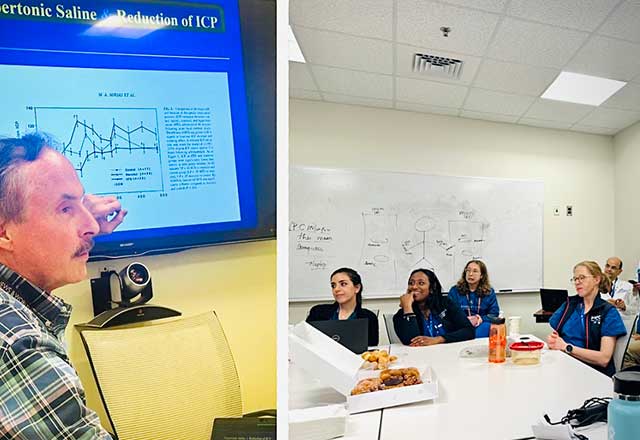
Weekly, protected-time didactics that dive into advanced neurocritical and general critical care topics. Led by faculty from neurocritical care, neurosurgery, stroke, pulmonary & critical care, SICU, CCU and internal medicine, these lectures align with the ABPN Neurocritical Care Curriculum.
Examples of topics include:
- Surgical and post-operative management of complex neurosurgical patients
- Advanced neuromonitoring and neurophysiology
- Neuroprognostication
- Pulmonary, cardiovascular, abdominal, and hematologic emergencies
Outcome: Fellows gain the depth and breadth of expertise needed for both specialized and general ICU practice.
Weekly Research Seminars
Our CME-accredited weekly research seminars bring international and national thought leaders to present emerging research in neurocritical care.
Fellows benefit from:
- Exposure to cutting-edge translational and clinical research
- Interactive discussions with experts shaping the field
- Inspiration and mentorship for scholarly projects
Journal Clubs and Case Conferences
Fellows develop critical appraisal and presentation skills through multiple journal club formats:
- Formal Monthly Journal Club & M&M Conference: Division-wide event where fellows lead in-depth discussions.
- Weekly Roundtable Journal Club: Informal, discussion-based review of recent studies emphasizing methodology, statistics, and application to practice.
Outcome:
- Stronger ability to critically appraise literature — not just what the result says, but how study design, statistical approaches and biases matter.
- Insight into the minds of leading neurocritical care investigators in our division, as these discussions are led by faculty regularly engaged in national/international research.
- A strong foundation for fellows’ own research projects and teaching activities, enhancing their academic prowess and skills.
Critical Care EEG Rounds
Held biweekly with continuous EEG faculty and epilepsy fellows, these rounds provide structured training in ICU EEG interpretation.
Focus areas:
- Detection of seizures and non-convulsive status epilepticus
- Quantitative EEG (qEEG) interpretation
- Differentiation of common ICU EEG artifacts
Outcome: Fellows develop the neurophysiology expertise necessary for high-level neurocritical care decision-making.
Hands-on Thursdays: Simulation & Bedside Hands-On Didactics
Every other Thursday fellows step out of the didactic domain into immersive, high-fidelity, interactive experiences at the Johns Hopkins Simulation Center and at the bedside. These sessions help our fellows master advanced ICU procedures, ventilator strategies, ultrasound techniques, and high-stakes communication.
Outcome: Fellows refine technical, cognitive, and interpersonal skills to confidently lead complex clinical scenarios.
Key components:
-
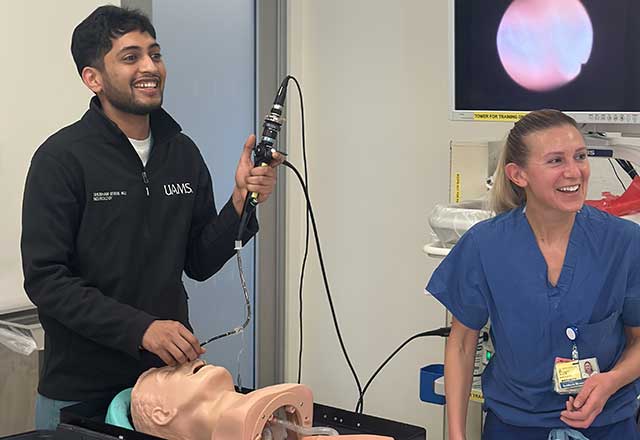
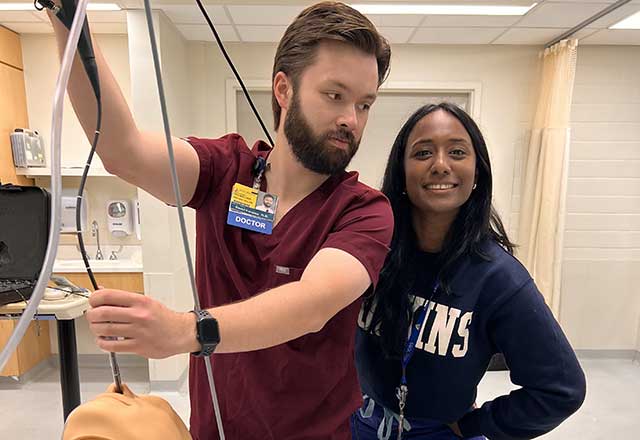
Simulation-based training in placement and interpretation of PA catheters, difficulty airway management including cricothyrotomy, nasal fiber-optic intubation, and other high‐risk interventions.
-
Over longitudinally held sessions, fellows learn advanced POCUS techniques, including cardiac output estimation (VTi, MAPSe, TAPSE), lung and abdominal ultrasound, transcranial Dopplers.

-
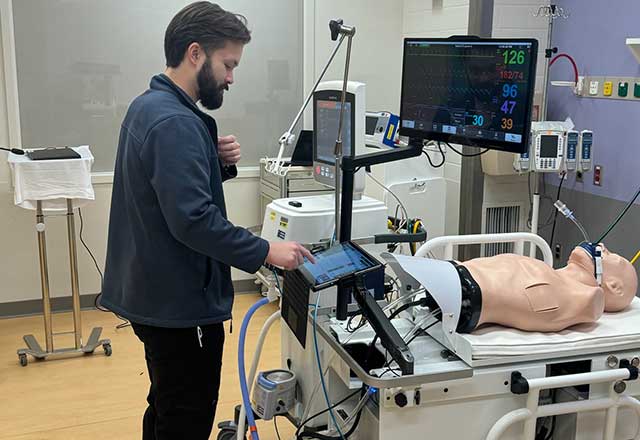
In this longitudinal ventilator simulation series, fellows learn basics of ventilator modes, troubleshooting dys-synchronies and progress to learning ventilator strategies in ARDS, COPD and other common scenarios encountered in the NCCU. Uniquely, each fellow gets an opportunity to help design the simulation scenarios, seting simulated patient respiratory parameters to generate trigger, target and cycle dysynchronies, providing an inverse perspective into how a patient’s respiratory physiology interacts with ventilator mechanics. Fellows also join the SICU program’s basic/advanced ventilation workshops held once a year.
-
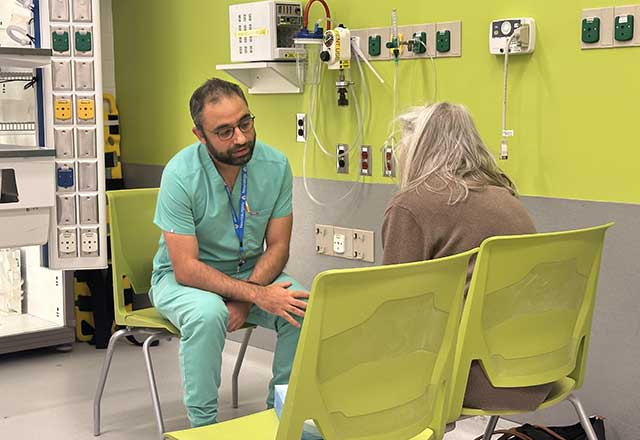
A two-day simulation where fellows lead goals-of-care conversations with standardized patients and receive real-time feedback from trained faculty and standardized patients to enhance their skills in family and patient-centered communication.
-
A one-day joint workshop with the SICU and NCCU fellowship: includes brain-death determination training PLUS a unique communications training session for breaking the diagnosis and explaining the concept of brain death to standardized patients posing as family members with faculty and SP feedback.
Monthly Board Review Sessions
Led by senior education fellows, this monthly informal session reinforces learning through collaborative board-style question review.
- Fellows work through ABPN Neurocritical Care–style questions covering key curriculum topics.
- Sessions emphasize clinical reasoning, board-style test strategies, and peer-teaching.
- Fellows assess their progress through the annual SCCM MCCKAP in-service exam, benchmarking knowledge and identifying growth areas.
Outcome: A supportive, collaborative environment that enhances test readiness and promotes mastery of core neurocritical care knowledge.
Neurocritical Care Pharmacology Didactic Elective
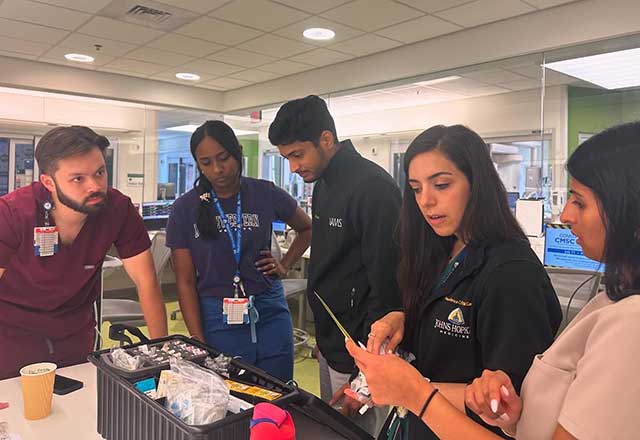
This annual two-week elective, led by our dedicated neurocritical care pharmacist, provides a deep dive into neurocritical pharmacology through lectures, journal clubs and interactive case discussions.
Topics include:
- Sedation and analgesia in neurocritical care
- Antiepileptic drug management
- Pharmacokinetics and drug interactions in CNS injury
- Antimicrobial stewardship in the neuro-ICU
Outcome: Fellows develop advanced pharmacologic reasoning and confidence in managing complex neurocritical cases.
Sample Neurocritical Care Fellowship Didactic Schedule
- Monday
- ACCM SICU/NCCU Joint Education Block | 10 a.m. – 1 p.m.
- Tuesday
- NCCU Fellowship Lecture | 7:45 – 8:45 a.m.
- NCCU Divisional Research Seminar | 1 – 2 p.m.
- Wednesday
- Critical Care EEG Rounds (Epilepsy and NCCU fellows Joint Education) | 1 – 2 p.m.
- Thursday
- Monthly Neurocritical Care Board Review | 1 – 2 p.m.
- Bimonthly Hands-On Thursdays (POCUS/MegaCodes/ Simulation Training) | 1 – 2 p.m.
- Friday
- NCCU Weekly Roundtable Journal Club | 1 – 2 p.m.