
Clinical Training: Core Rotations and Electives
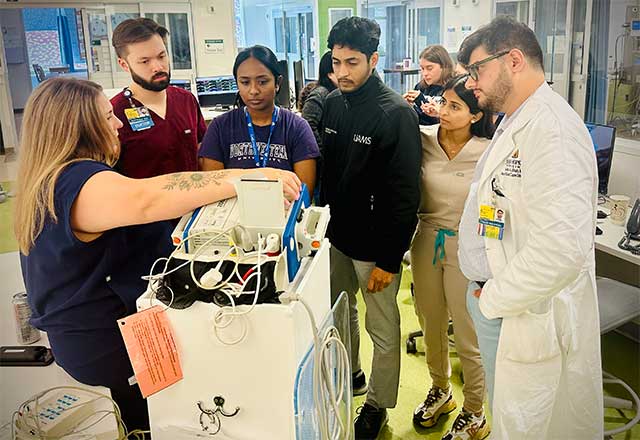
Our fellowship provides comprehensive clinical training in the management of critically ill neurological patients, as well as mastery of ICU procedures and the care of acute medical and surgical critical illness, to help our fellows develop into well-rounded intensivists. Fellows graduate prepared for a wide range of career paths, from academic physician–scientist to private practice intensivist and leadership roles in neurocritical care.
- Year 1: Fellows focus on:
- Developing and solidifying general critical care skills and knowledge as well as procedural skills
- Mastering supervision and teaching of medical students, house staff and nurses in bedside care
- Leading daily clinical rounds
- Year 2: Fellows take on greater leadership, including:
- Managing the NCCU team (with attending support)
- Providing formal teaching on neurophysiology and critical care
- Launching research projects in the critical care environment
Core Rotations
Neurocritical Care
The fellowship is based at The Johns Hopkins Hospital, with additional rotations at the Johns Hopkins Bayview Medical Center in the second year. Rotations are organized in two-week blocks to balance clinical immersion with remaining time for electives and scholarly activities.
-
Overview
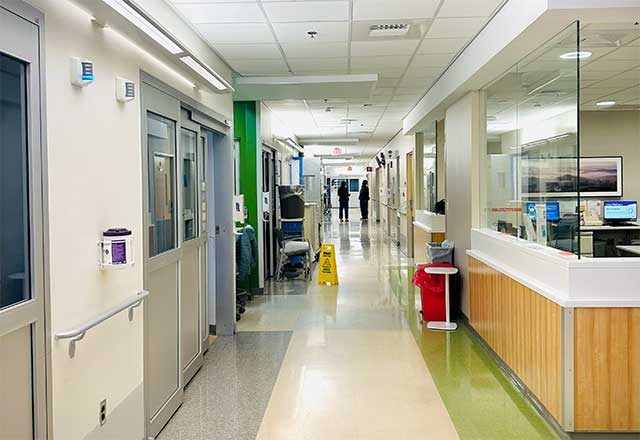
A 24-bed NCCU caring for a broad range of complex critically ill neurological and neurosurgical patients from a wide referral network extending beyond the local region to national and international centers. Fellows spend majority of their training in this unit and begin with a dedicated two-week orientation and then join one of two rounding teams, each led by an attending physician. Fellows lead rounds, supervise residents, advanced practice providers and perform basic and advanced critical care procedures under direct attending guidance.
Team Structure
Two teams comprising a mix of fellows, residents and advanced practice providers provide in-house support 24/7 with a night float system.
Patient Population
The Johns Hopkins Hospital is a high-acuity tertiary academic hospital with comprehensive stroke certification and a level 1 trauma center. We receive high volumes of aneurysmal subarachnoid hemorrhage, intracerebral hemorrhage, acute ischemic stroke, traumatic brain and spine injury, status epilepticus, acute neuromuscular diseases, encephalitis and complex post-operative neurosurgical patients, providing a broad spectrum of training in neurocritical care
-
Overview
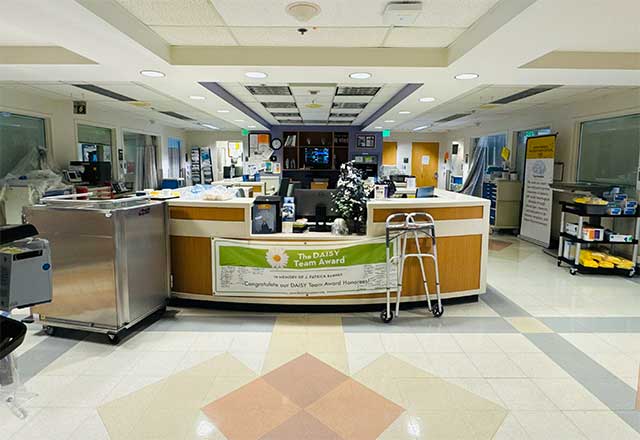
A 14-bed unit that includes an 8-bed NCCU and 6-bed Intermediate Care (IMC) Unit that mirrors the model of most community or smaller academic centers. Fellows primarily care for patients in the NCCU with oversight of care in the IMC, functioning with greater independence, serving as acting attendings (with direct attending supervision), leading rounds, managing triage and gaining experience in telemedicine while supporting residents and physician assistants overnight from home.
Team Structure
Fellow and attending round in the ICU during the day and fellow takes home call with residents and/or advanced practice providers providing in-house support 24/7.
Patient population
Johns Hopkins Bayview is a tertiary academic community hospital and thrombectomy-capable center. It receives high volumes of acute ischemic stroke patients with thrombectomy, intracerebral hemorrhage, traumatic brain and spine injury, status epilepticus, acute neuromuscular diseases and encephalitis, along with complex post-operative neurosurgical patients.
-
- Multimodal neuromonitoring including ICP, CPP, PbtO2, transcranial dopplers, pupillometry and near infrared spectroscopy
- Advanced ultrasound machines
- Continuous EEG monitoring with 24/7 EEG reading support
- Robust nursing support with rigorous training in neurocritical care nursing, pioneered at the Johns Hopkins NCCU. Patient to nursing ratio is 1:1 or 2:1 depending on acuity, with an additional resource nurse and a charge nurse present 24/7.
- SickBay platform in both units for remote viewing of patient’s bedside hemodynamic monitor and continuous waveform signals

General Critical Care
These core rotations are designed to broaden the clinical acumen of our fellows, beyond the realm of neurocritical care, and to strengthen skills and develop into well-rounded intensivists prepared for any high-acuity critical care environment. Rotations include:
-
Our fellows complete a required rotation in the world-renowned Johns Hopkins Hospital MICU Service, where they take on the role of primary ICU fellows. Working alongside pioneers in ARDS and sepsis research, they gain hands-on experience managing the full spectrum of critical illness—from shock and respiratory failure to complex multi-organ disease. Fellows also lead and teach the esteemed Osler internal medicine residents, developing the confidence and versatility to excel in any critical care setting.
-
Fellows complete a required rotation in the Johns Hopkins Bayview Surgical Trauma and Burns ICU, serving as primary fellows. As the second-busiest trauma center in Maryland, with a catchment area distinct from the R Adams Cowley Shock Trauma Center, Bayview provides extensive exposure to patients with polytrauma, motor vehicle injuries, and traumatic brain injury. The unit also houses Maryland’s only dedicated Burn Center, giving fellows a unique opportunity to gain hands-on experience in the management of complex burn injuries. This rotation equips trainees with the skills and versatility to manage the full spectrum of surgical and trauma-related critical illness.
-
Fellows complete a mandatory rotation in the Johns Hopkins Cardiac Intensive Care Unit, gaining advanced experience in the management of critically ill cardiac patients. This rotation immerses trainees in the care of patients with acute myocardial infarction, cardiogenic shock, and refractory arrhythmias, while deepening their understanding of hemodynamic monitoring, pulmonary artery catheterization, vasoactive therapy, and cardiac support devices such as intra-aortic balloon pumps (IABPs) and left ventricular assist devices (LVADs). Working alongside leading cardiologists and cardiac intensivists, fellows develop the expertise to manage complex cardiovascular emergencies and integrate this knowledge into the care of neurocritical patients with secondary cardiac complications.
-
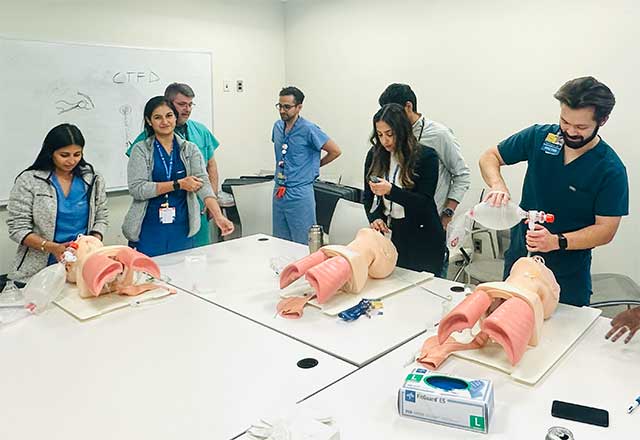
In these required rotations, our fellows receive dedicated, hands-on training in airway management in operating rooms, outpatient surgical centers, and endoscopy suites. Under direct supervision of anesthesiology faculty and airway experts, fellows gain proficiency in endotracheal intubation, bag-mask ventilation, laryngeal mask airway (LMA) placement, and moderate sedation techniques. This immersive experience ensures that fellows develop the technical skill, confidence, and clinical judgment required for managing complex airways in critically ill patients—a core competency for neurointensivists and a vital component of their comprehensive critical care training.

Electives
Fellows receive ~10 months of longitudinal protected time for clinical and research electives staggered across the entire fellowship in two-week blocks. Fellows have flexibility to use this time to design a personalized curriculum, under the guidance of program leadership and a faculty advisor, along one of two training pathways (clinician educator or research) best suited to their career interests. Available electives include (but are not limited to):
-
Fellows rotate in the JHH CVSICU and gain exposure in management of ECMO circuits, cardiac assist devices, and participate in neurological prognostication of ECMO patients.
-
Fellows rotate with the IP service to practice advanced pulmonary procedures including flexible bronchoscopy (diagnostic and therapeutic), thoracentesis, chest tube and pigtail catheter placement.
-
Fellows practice interpretation of critical care EEG monitoring, utilizing the Persyst software and interpretation of quantitative EEG monitoring trends through rotations in the EEG department with our neurophysiology experts.
-
Fellows can rotate with TCD technicians to practice performing TCDs and interpret TCD reports with faculty.
-
Fellows can rotate with the Stroke service at JHH to gain exposure in hyperacute management of acute ischemic stroke including decisions regarding IV thrombolysis and endovascular thrombectomy in addition to post-stroke secondary prevention management.
-
In this intense 2-week training elective designed by our senior neurocritical care pharmacist, senior fellows learn advanced pharmacological principles in antiepileptics, sedatives, antiplatelet and anticoagulant agents as well as antibiotics, working through complex neuropharmacological cases.
-
Clinical, translational, educational or quality improvement scholarly activities and research are strongly encouraged. Fellows choosing a research pathway can use all of the elective time for conducting their research projects with options available for securing grant funding and training in grant writing. See Research tab for additional details.
-
Fellows may work with the fellowship program director and APD to design, lead and conduct simulation sessions for NCCU fellows and neurology and ACCM residents, with the goal to design an educational research project, collect relevant outcomes and eventually publish the novel curriculum and results.
-
Fellows can do additional weeks in the MICU, SICU, CCU and airway rotations, or consultation services, such as Renal ICU consults, ID consults among others.