My Doctor Says I Have Dense Breasts: What Are Dense Breasts?
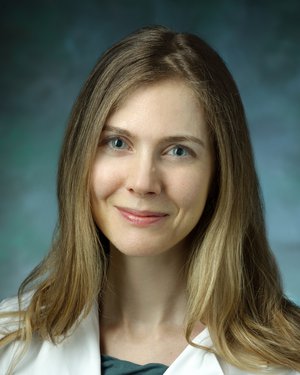
Featured Expert
Updated March 10, 2026
You might only think about your breasts by cup size, but did you know you should also be aware of your breast density? It can affect your breast cancer risk and determine the type of screening mammogram you should get.
Key Points
- Breast density refers to how much glandular vs. fatty tissue is in the breast.
- Only a mammogram can determine breast density.
- Dense breast tissue can make cancer harder to detect on mammograms and is associated with a slightly higher risk of breast cancer.
- Women with dense breasts may benefit from additional imaging options such as ultrasound or MRI.
What are dense breasts?
Johns Hopkins breast imaging specialist Kelly Myers, M.D. explains: In general, breasts have both glandular and fatty tissue. Breast density refers to the amount of glandular tissue, with dense breasts having mostly glandular tissue. A woman’s breast density can change through her life.
There are four types of breast density, from most to least dense:
- Extremely dense
- Heterogeneously dense
- Scattered fibroglandular density
- Almost entirely fatty breast tissue
Will a mammogram determine if I have dense breasts?
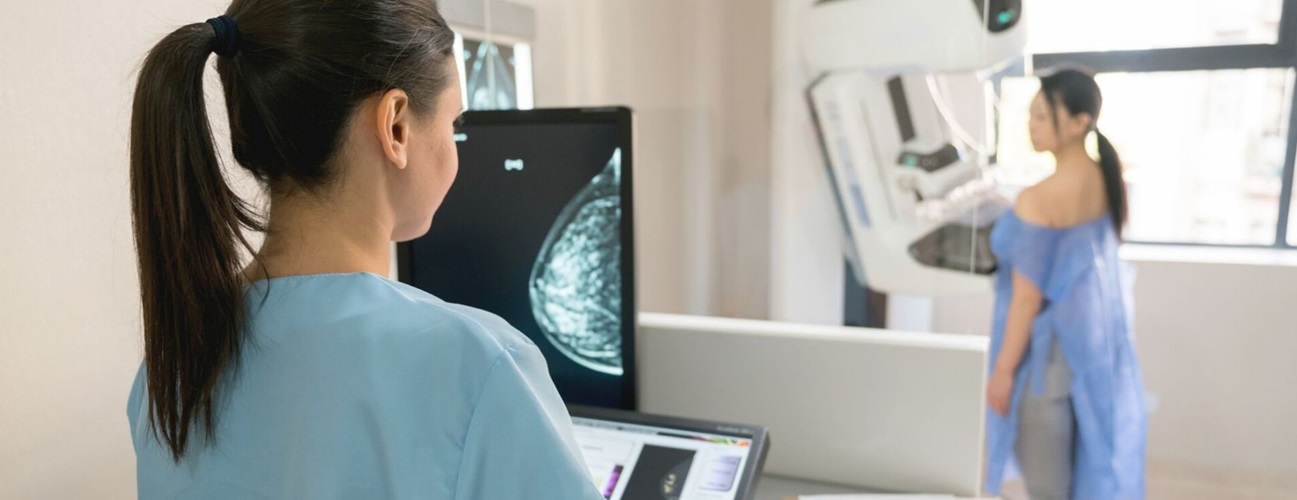
Among women, 45% have dense breasts. Breast density can only be determined through a mammogram. Federal law requires that mammogram reports include information about breast density.
After your mammogram, you will receive a written report with the radiologist’s findings. Radiologists are medical doctors who have completed a four-year residency in radiology and who specialize in diagnosing and treating conditions using medical imaging.
Breasts imaging specialists are radiologists who specialize in reading breast imaging exams. Women who are high risk for developing breast cancer should undergo breast MRI every year in addition to mammography. Women who are not high risk but have dense breasts could benefit from additional screening such as screening breast ultrasound or abbreviated (“fast”) breast MRI. These options can be discussed with your physician.
How do dense breasts affect the detection of breast cancer?
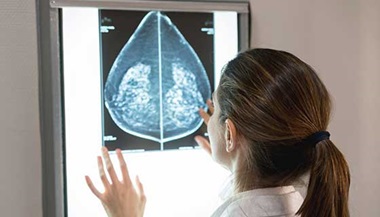
Small cancerous areas may be harder to see in dense breasts. Myers says that on a mammogram, glandular (dense) tissue “appears white, while fat tissue appears dark. Breast cancer can appear in many different ways on a mammogram, but it often appears white. On a mammogram with mostly dense tissue and therefore lots of white, it may be harder to detect a a small cancer that also appears white. “It is easier to detect a small white cancer if it is surrounded by darker fat, rather than if it is surrounded by white gland tissue. In fact, we know from many years of research that the ability of mammography to detect a breast cancer is lower in women with dense breasts compared to women with non-dense breasts,” Myers says.
Do dense breasts increase breast cancer risks?
Studies have shown that dense breasts have a slightly increased risk of developing cancer, compared to non-dense breasts.
What are the best imaging options for people with dense breasts?
While it is recommended that all women get mammograms starting at age 40, women with dense breasts could consider additional screening options. Women who are considered high risk for breast cancer should undergo breast MRI every year in addition to mammography, regardless of breast density. Women who are not high risk for breast cancer but who have dense breasts may consider optional supplemental screening methods such as screening breast ultrasound or abbreviated (“fast”) breast MRI. Talk with your doctor to make informed decisions about breast cancer screening.
3D mammogram: Also called tomosynthesis, 3D mammography uses X-rays to capture thin images of the breast, which are then combined to create a detailed three-dimensional image. 3D mammography improves breast cancer detection for all women, including those with dense breasts. 3D mammography also decreases the chance that a patient will be called back for more imaging to clarify an area of uncertainty on the mammogram. 3D mammography is now considered the standard of care.
Screening Breast ultrasound exams may be added to screen women with dense breasts.
Screening Breast MRI exams in their full traditional form are typically reserved for women at high risk for breast cancer. However, some centers now offer shortened versions of screening breast MRI (called “abbreviated” or “fast” MRI) for average risk women with dense breasts. Check with your insurance about their coverage of these exams.
Can I change my breast density?
No — breast density is determined by genetics, age, menopause status and family history. Weight changes and certain medications can also influence your breast density.
Though your breast density can’t be changed, information is power. Being aware of your breast density classification can help you and your doctor make informed choices about your care.
Medically reviewed by Kelly Myers, M.D.
Find a Location