
Translational Aging Research Training Program (T32)
Advancing the Science of Aging—from Mechanism to Meaningful Care
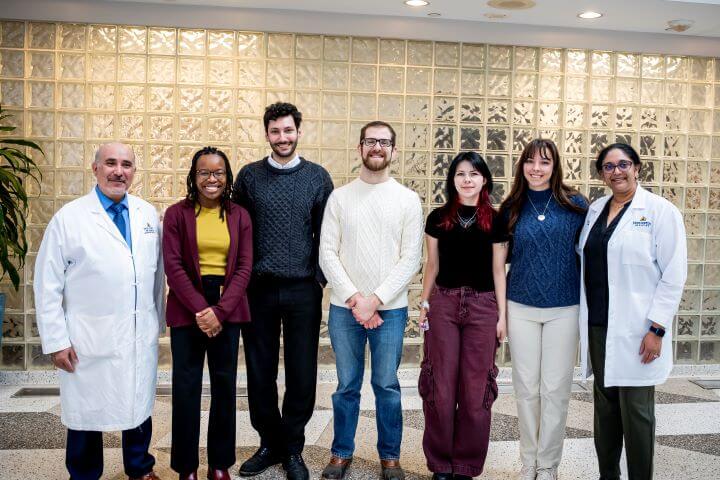
The Translational Aging Research Training Program (T32) provides a rigorous, interdisciplinary training environment designed to develop independent investigators capable of advancing the science of aging across the continuum from mechanistic discovery to clinical implementation. The population of older adults with chronic disease states and functional and cognitive decline is growing rapidly. In parallel, there has been a rapid expansion in the understanding of the aging-related biological changes that may impact these conditions. Our T32 is meant to provide individuals with an MD or PhD with a robust research postdoctoral fellowship.
Our trainees engage in a series of didactic and experiential learning opportunities leveraged from the outstanding aging-focused research and training programs that already exist at Johns Hopkins. This includes mentored research spanning basic, clinical and engineering domains, supported by a highly integrated ecosystem with the scientific leadership, infrastructure, collaborative nature and collegial environment to provide trainees with exposure to the tenets of basic aging biology as well as relevant clinical investigations. The program emphasizes translational impact, interdisciplinary collaboration and career development, equipping trainees with the skills necessary to lead innovative research programs that improve the health and independence of older adults.
Our Mission
Our mission is to train interdisciplinary scientists who translate discoveries in aging biology into innovative clinical and technological solutions that improve the lives of older adults.
Our fellows gain a deep understanding of aging biology and geriatric syndromes; training in translational research methodologies; experience across laboratory, clinical and computational settings; mentorship from leaders across disciplines; and preparation for independent funding and academic careers.
What We Offer
Individualized training: Each fellow develops a tailored training plan with a primary mentor and multidisciplinary mentorship team aligned with their research and career goals.
Mentored research: Fellows can do hands-on research across the molecular and cellular biology of aging, clinical and population-based research, or engineering and AI-driven approaches.
Career development: We teach fellows grant writing and funding strategies, leadership and academic skills, and individual development planning.
Coursework and didactics include translational aging science, clinical geriatrics, and quantitative and computational methods. Trainees participate in weekly seminars and training meetings with other scholars and training faculty. This structured program includes the following:
- A core series of required coursework and interdisciplinary scientific meetings, a weekly translational aging seminar given by relevant research experts from across Johns Hopkins medical institutions, the development of an individualized training program, and a series of leadership and career development seminars
- The provision of trainees with a primary directed translational aging research laboratory or clinically oriented research project in collaboration with an experienced mentor with research resources
- The provision of trainees with access to the robust interdisciplinary and translation-focused aging research infrastructure and collaborative research opportunities available across Johns Hopkins medical institutions
Research Ecosystem
Our research ecosystem is an advantage unique to Johns Hopkins. Fellows here are embedded in a collaborative network of leading programs:
- Biology of Healthy Aging Program (basic science and animal models)
- Center on Aging and Health (clinical and translational research)
- Artificial Intelligence and Technology Collaboratory (engineering)
- Claude D. Pepper Older Americans Independence Center (clinical and translational research)
This ecosystem enables our fellows to translate discoveries from bench to bedside, collaborate across disciplines, and access cutting-edge technologies and patient populations. It also ensures that our fellows have access to the following:
- State-of-the-art clinical and translational research facilities
- Over 80 core laboratories (imaging, genomics, proteomics, AI)
- The Healthy Aging Studies Unit
- The Geriatrics Engineering Lab and model apartment
- Cross-school collaborations across the School of Medicine, the Bloomberg School of Public Health, the School of Nursing, and the Whiting School of Engineering
Faculty and Mentorship
Our faculty represent a uniquely integrated ecosystem of clinicians, engineers, and scientists working collaboratively to advance translational aging research. Together, they provide trainees with access to diverse expertise, cutting-edge infrastructure, and mentorship across the full spectrum—from discovery to clinical application.
The program includes 25+ faculty across 16 departments, spanning biology, engineering, and clinical sciences.
-
Peter M. Abadir, MD
Director
Geriatrics | Molecular Aging | Translational Biology | Frailty | Clinical TrialsEsther S. Oh, MD, PhD
Co-Director
Delirium | Cognitive Aging | Alzheimer’s Disease | Clinical ResearchLolita Nidadavolu, MD, PhD
Associate DirectorBrandon LaCour, MBA
Program Administrator
Brandon oversees program operations, trainee coordination, and administrative management, ensuring seamless support for fellows and faculty. -
Alexis Battle, PhD
Genomics | Machine Learning | Computational BiologyNajim Dehak, PhD
AI | Speech Analysis | Digital BiomarkersJennifer Elisseeff, PhD
Regenerative Medicine | Immunoengineering | Tissue RepairNeal S. Fedarko, PhD
Biomarkers | Translational Biology | Aging MechanismsSean Xiao Leng, MD, PhD
Immunosenescence | Vaccines | Aging BiologyRoland J. Thorpe Jr., PhD
Health Disparities | Population Health | Aging EquityQian-Li Xue, PhD
Biostatistics | Frailty | Aging Phenotypes | Longitudinal Analysis