

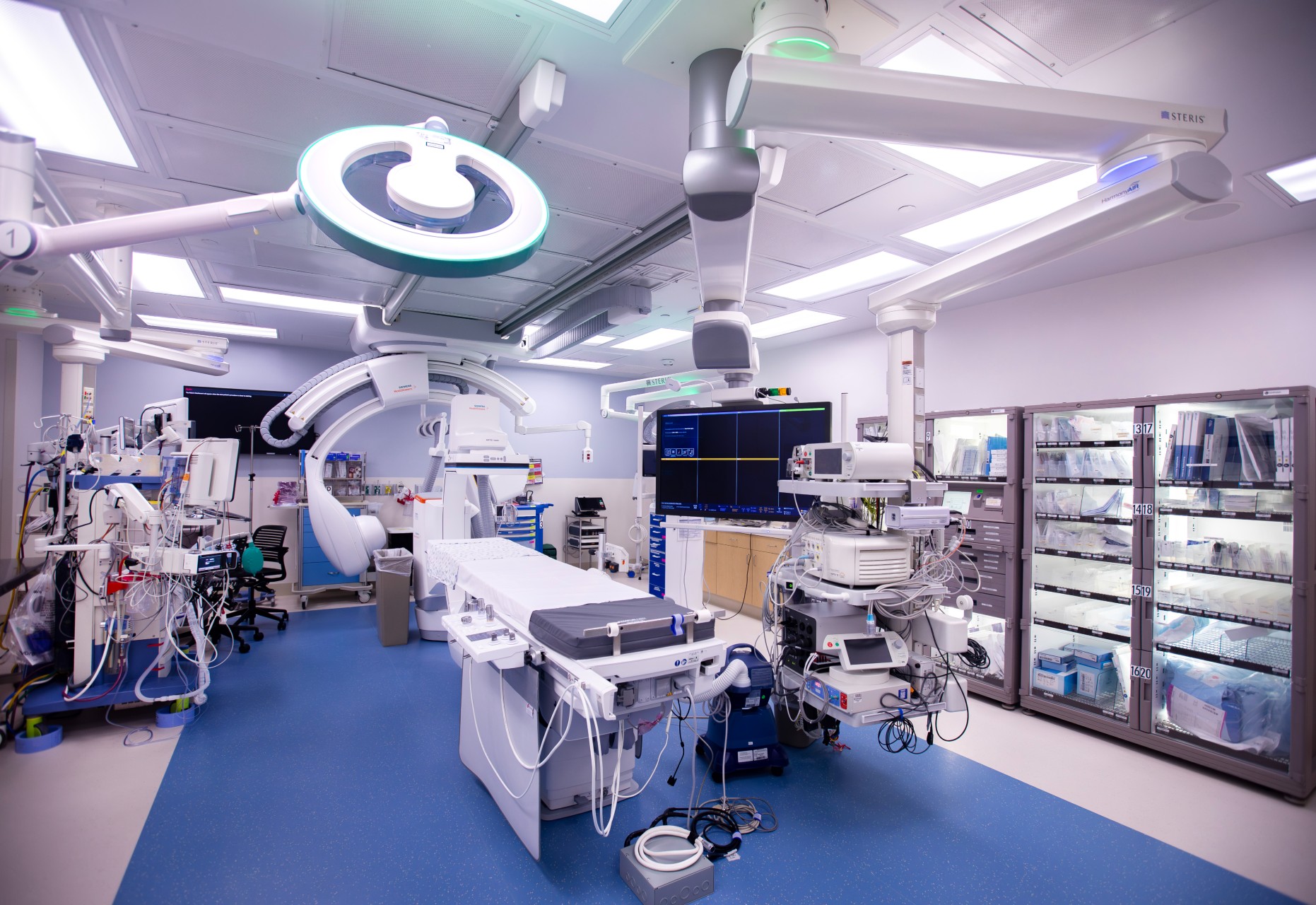
 Cardiac catheterization lab at Johns Hopkins All Children's Hospital
This procedure can be used to treat certain congenital heart defects and to measure things like blood pressure, oxygen levels, and blood flow, and examine the structure of the heart. At Johns Hopkins All Children’s Hospital in St. Petersburg, Florida, these procedures are performed in our cardiac catheterization lab.
We understand that preparing for a procedure that your child needs can be stressful and knowing what to expect can help to put you and your child at ease. The information below can help you prepare for your child’s visit.
Before Your Child’s Procedure
A week before your child’s procedure, you’ll receive a Pre-Anesthesia Testing call, during which we will thoroughly review the medical history to ensure we have all the information needed for safe anesthesia during the procedure.
We will then contact you the day before your child’s procedure with instructions on when your child should stop eating and drinking before their procedure. If your child’s procedure is on a Monday, you’ll receive this call the Friday before.
During these calls, the nurse will provide their direct phone number and the phone number for the Peri-anesthesia Care Unit should you have additional questions.
Most medications can continue to be taken before the procedure, but we will advise you if your child needs to stop taking any medications.
If your child becomes ill before the procedure (if they have a cold, fever, etc.), please contact your child’s primary cardiologist or call 727-767-3333 and we will discuss with you if your child’s procedure needs to be rescheduled.
Day of Procedure
What to Bring
Things to bring with you to your child’s procedure include:
- Identification and insurance information
- Comfort items like your child’s favorite books or small toys to help keep them occupied during wait times
- A change of clothes for your child in case they need to stay overnight in the hospital
Most patients are able to go home the same day after their procedure, and those who need to stay overnight will typically know ahead of time, but it’s helpful to prepare for an overnight stay just in case the need arises.
If the legal guardian who is bringing the child to their appointment is not the child’s biological parent, they will need to also bring paperwork that states they are the child’s legal guardian and able to sign consent forms for the patient.
Arrival and Parking
You will be given instructions ahead of time on when to arrive for your child’s appointment. This will typically be two hours before the procedure time unless otherwise discussed with you.
Parking is available in our garage located at:
651 5th Street S
St. Petersburg, Florida
The hospital can be accessed from the second level of the garage. The walkway will first bring you into the Outpatient Care Center; then cross the sky bridge into the main hospital.
Check In
You’ll check in at Surgery Registration on the second floor of the hospital. There are kiosks available to sign in and then a member of the registration team will register your child and provide any necessary information. Once registration is complete, they will call a nurse to bring you and your child to the Peri-anesthesia Care Unit.
In the Peri-anesthesia Care Unit
The nurse will take your child’s vitals, medication and health history. If your child’s physician has ordered any blood work, the nurse or a phlebotomist will complete that at this time. If your child needs an IV, it will be placed at this time as well.
The interventional cardiologist and anesthesiologist will meet with you and your child to review the procedure with you and answer any additional questions you may have. They will obtain the necessary consent from you for your child’s procedure.
Several other team members, including nurse practitioners and procedural nurses, will visit the room at various times. You may be asked similar questions by different providers. This is normal and helps ensure nothing is missed.
After the assessment and consents are complete, any questions you have are answered, and the procedural room is ready, your child will be taken into the procedural room.
Your Child’s Procedure
Most patients receive general anesthesia, though some may receive sedation depending on the procedure and their individual needs. The type of anesthesia your child receives will be discussed with you prior to the procedure.
Procedures generally take between two and five hours, with most taking between two and three hours, depending on the procedure. Families are asked to wait in the waiting room until the procedure is done.
A nurse in the procedure lab will provide families with updates via text message during the procedure. The nurse will call you when your child’s procedure is complete, and the interventional cardiologist will come to speak with you afterward as well. They will share any findings, and this information will also be available in your child’s MyChart account. You will be able to see your child once they start waking up from the anesthesia, usually within an hour after the procedure.
After Your Child’s Procedure
Recovery nurses will take you back to see your child after the procedure is complete. Patients are usually very sleepy, so we ask that families minimize noise and conversation while their child recovers. Patients typically need to lay flat for four hours after a catheter procedure. It is important that they stay still to minimize bleeding at the incision site.
Patients are usually able to go home within about four hours. If your child needs to stay overnight in the hospital, they will typically be discharged by noon the next day.
Patients should rest and avoid strenuous activity for at least 24 hours and should avoid bathing or soaking in water for four to five days while the catheter site heals. Your child’s care team will discuss these and any other post-procedure instructions with you. Most patients will take over-the-counter pain medication afterward.
If you have any questions after your child is discharged, please call 727-767-3333. This phone number is available at all hours. After 5 p.m., an on-call triage nurse will answer and contact the on-call provider. In the event of an emergency, families should go to the Emergency Department or call 911.
Contact Us
For more information, please call 727-767-3333.
