Research Lab Results
-
Brain Health Program
The Johns Hopkins Brain Health Program is a multi-specialty team of experts from the Johns Hopkins School of Medicine, Whiting School of Engineering, and the Bloomberg School of Public Health. -
Weiss Lab
The Weiss Lab, which features a multi-disciplinary team at Johns Hopkins as well as at Cedars Sinai Medical Center in Los Angeles, is dedicated to identifying the most important clinical, genetic, structural, contractile and metabolic causes of sudden cardiac death as well as the means to reverse the underlying pathology and lower risk. Current projects include research into energy metabolism in human heart failure and creatine kinase metabolism in animal models of heart failure. Robert G. Weiss, MD, is professor of medicine, Radiology and Radiological Science, at the Johns Hopkins University.
-
Karen Bandeen-Roche Lab
The Karen Bandeen-Roche Lab explores the application of underlying variable methods in epidemiologic and psychosocial research. Our team seeks to improve the ability to measure key outcomes like functional status and psychological disorders. Our other areas of statistical research include the study of classification and variance structure and multivariate survival analysis. We are deeply invested in the field of gerontology as well as ophthalmology and neurology.
-
Laboratory for Integrated NanoDiagnostics (LIND)
The Laboratory for Integrated NanoDiagnostics (LIND) is developing innovative technologies for accurate, fast, compact, portable, manufacturable, low-cost diagnostics for a wide variety of applications. Our current focus is a large-scale collaboration with imec, a leading microelectronics company in Leuven, Belgium, where our silicon is designed and manufactured. With major funding from miDiagnostics we are inventing solutions that are opening new avenues.
-
Neuroengineering and Biomedical Instrumentation Lab
The mission and interest of the neuroengineering and Biomedical Instrumentation Lab is to develop novel instrumentation and technologies to study the brain at several levels--from single cell to the whole brain--with the goal of translating the work into practical research and clinical applications. Our personnel include diverse, independent-minded and entrepreneurial students, post docs, and research faculty who base their research on modern microfabrication, stem cell biology, electrophysiology, signal processing, image processing, and integrated circuit design technologies. -
Quantitative Intelligence Lab
Our mission is to reveal the molecular logic of our intelligence in health and disease. We use advanced molecular biological tools and state-of-the-art neuroscience to test the role of synaptic and neuronal molecules in the dynamics of the living brain.
Artificial neural networks have been heavily inspired by the brain’s architecture, guiding our journey to discovering the keys to intelligence. We now find ourselves at a pivotal moment: today's AI systems surpass biological circuits in certain tasks, yet we still lack a fundamental understanding of the mechanisms behind the brain’s superior cognitive flexibility and efficiency. At Ingie Hong’s Quantitative Intelligence Lab, we are dedicated to unraveling the principles that enable the mammalian cortex to achieve remarkable feats of intelligence, including rapid learning, generalization, and inference across vast stores of memory.
A single neuron’s response depends on its synaptic connections and intrinsic properties, which are dictated by the expression of neuronal genes. However, the role of these molecules in brain computations remains largely uncharted territory. Focusing on the mouse visual cortex as a starting point for broader generalization, and using large-scale electrophysiology, advanced microscopy, and machine learning, we have begun to uncover the impact of key synaptic genes on cortical processing and their role in the brain’s “working algorithm” (Hong et al., Nature, 2024). Our molecular tools, including gene therapy vectors and antisense oligonucleotides, show promise as effective therapeutic candidates.
Our research will advance the nascent field of 'neurocomputational therapeutics'—innovative genetic and pharmacological tools that address biases in neural activity. These tools will not only facilitate the development of novel mechanism-based treatments for brain disorders but also inspire the next generation of intelligent artificial neural networks.
-
Frueh Laboratory
The Frueh Laboratory uses nuclear magnetic resonance (NMR) to study how protein dynamics can be modulated and how active enzymatic systems can be conformed. Non-ribosomal peptide synthetases (NRPS) are large enzymatic systems that biosynthesize secondary metabolites, many of which are used by pharmaceutical scientists to produce drugs such as antibiotics or anticancer agents. Dr. Frueh's laboratory uses NMR to study inter- and intra-domain modifications that occur during the catalytic steps of NRPS. Dr. Frueh and his team are constantly developing new NMR techniques to study these complicated enzymatic systems. -
The Arking Lab
The Arking Lab studies the genomics of complex human disease, with the primary goal of identifying and characterizing genetics variants that modify risk for human disease. The group has pioneered the use of genome-wide association studies (GWAS), which allow for an unbiased screen of virtually all common genetic variants in the genome. The lab is currently developing improved GWAS methodology, as well as exploring the integration of additional genome level data (RNA expression, DNA methylation, protein expression) to improve the power to identify specific genetic influences of disease. The Arking Lab is actively involved in researching: • autism, a childhood neuropsychiatric disorder • cardiovascular genomics, with a focus on electrophysiology and sudden cardiac death (SCD) • electrophysiology is the study of the flow of ions in biological tissues Dan E. Arking, PhD, is an associate professor at the McKusick-Nathans Institute of Genetic Medicine and Department of Medicine, Division of Cardiology, Johns Hopkins University.
-
Andrew Laboratory: Center for Cell Dynamics
Researchers in the Center for Cell Dynamics study spatially and temporally regulated molecular events in living cells, tissues and organisms. The team develops and applies innovative biosensors and imaging techniques to monitor dozens of critical signaling pathways in real time. The new tools help them investigate the fundamental cellular behaviors that underlie embryonic development, wound healing, cancer progression, and functions of the immune and nervous systems. -
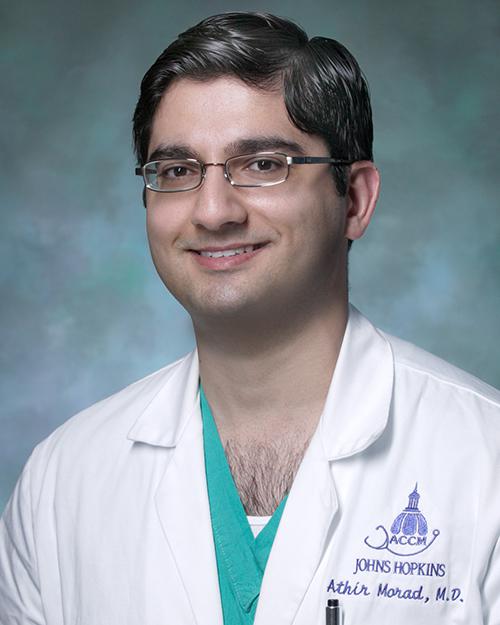
Athir Morad Lab
Research in the Athir Morad Lab primarily focuses on perioperative pain management for neurosurgery patients. Our team has conducted two randomized controlled trials to assess the efficacy of patient-controlled analgesia (PCA) following craniotomy. Our current research includes studies on the safety of opioid administration following craniotomy through the use of end-tidal CO2 detection, as well as research into the use of transcortical magnetic stimulation (TMS) for managing pain after spine surgery.