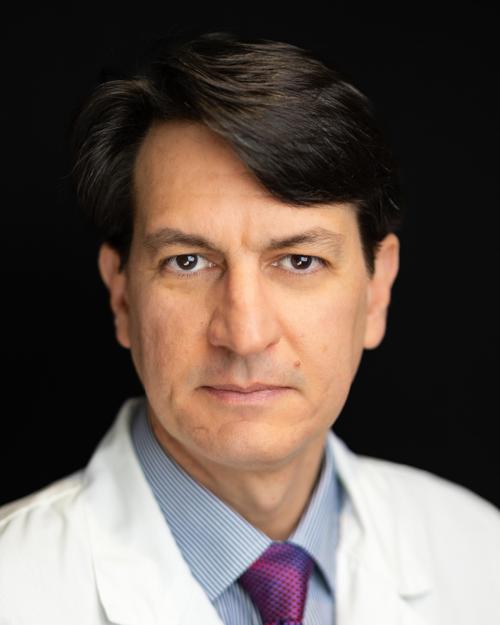
Laura M. Fayad, MD MS

- Chief of Musculoskeletal Imaging
Expertise: Diagnostic Radiology
Primary Location: The Johns Hopkins Hospital, Baltimore, MD
Our team of musculoskeletal radiologists at the Johns Hopkins Musculoskeletal Radiology Section work very closely with other specialists, including orthopaedic surgeons, neurologists, neurosurgeons, rheumatologists and oncologists, to provide a coordinated, multidisciplinary approach to the evaluation and treatment of patients.
In addition to being recognized for excellence in routine evaluation of patients with common sports injuries, the Musculoskeletal Radiology Section is also recognized nationally and internationally for specialized diagnostic imaging studies and interventional procedures.
We perform image-guided joint aspirations, biopsies and therapeutic procedures. When deemed necessary, we utilize MRI to take advantage of advanced imaging techniques to target disease processes. Our procedures include:
Metal implants can create distortion on MRI scans, limiting the ability to accurately assess surrounding anatomy. In order to reduce this distortion, often called metal artifacts, the Musculoskeletal Division at Johns Hopkins Radiology offers advanced imaging through Metal Artifact Reduction Sequence (MARS) technology, enhanced by a proprietary approach known as SMART Imaging.
SMART Imaging builds further upon standard MARS protocols by incorporating advanced MRI techniques developed and trademarked by Johns Hopkins radiologists who are subspecialized in musculoskeletal radiology. By using multiple specialized imaging sequences, this approach significantly reduces metal artifacts and improves visualization of tissues both immediately surrounding and more distant from orthopedic implants. This enhanced visibility helps Johns Hopkins radiologists detect important findings that may otherwise be difficult to see, including tumor recurrence, infection, fractures, and other post-surgical abnormalities.
The SMART protocol is particularly valuable in evaluating patients with joint replacements and complex orthopedic reconstructions, where high-quality imaging is essential for accurate diagnosis and treatment planning. This approach to imaging is valuable for the care of patients who are treated by orthopedic surgeons, orthopedic oncologists, and other clinicians managing complex cases near metal implants.
Johns Hopkins musculoskeletal faculty members have received international recognition for their work with the SMART protocol at the International Skeletal Society. They have produced numerous research publications in the areas of prosthetic joints, tumor reconstructive surgery and trauma, highlighting the impact of these advanced techniques in improving diagnostic accuracy in these settings.
Developed and refined at Johns Hopkins, SMART imaging is another example of the department’s continued leadership in advancing musculoskeletal imaging and improving diagnostic accuracy in complex cases.
Expertise: Diagnostic Radiology
Primary Location: The Johns Hopkins Hospital, Baltimore, MD


Research pursuits in the Johns Hopkins Musculoskeletal Radiology Section occur through the Subspecialty Centers of Excellence. Our musculoskeletal imaging researchers develop novel imaging techniques and treatments for a variety of musculoskeletal diseases and conditions. Examples of research interests include:
Our division offers a 12-month dedicated musculoskeletal imaging fellowship, which provides superior clinical training in CT, ultrasound and MRI, and in the performance of musculoskeletal interventions. We also offer a research fellowship in musculoskeletal radiology for scientists, physicians or medical trainees to study the applications of musculoskeletal imaging.