
Urban Health Internal Medicine Primary Care Leadership Concentration
Program Mission (as written by our residents)
Our mission is to produce physician primary care leaders who provide exceptional primary care in urban, under-resourced communities and who reduce social inequities in our healthcare system through health promotion, advocacy, and/or research.
Overview
The Urban Health Concentration of the Osler Primary Care Track (UH IM), produces primary care leaders who improve the health of vulnerable, urban populations. Caring for vulnerable patients who live in urban settings requires a willingness to pioneer alternative care delivery models and a desire to master additional patient care, medical knowledge (including a nuanced understanding of the social determinants of health), communication, practice-based learning, professionalism, and inter-professional teamwork skills--including collaboration with community health workers, and community outreach and advocacy.
Overall, the UH IM curriculum equips residents with the skills to tackle the variety of ambulatory problems that we encounter in our East Baltimore community both on a patient and systems level. UH IM produces graduates who are experts in enhancing patients' self-management and care-seeking skills. Johns Hopkins offers residents training in internal medicine, public health, adolescent medicine, and psychiatry that are unmatched. In addition, Hopkins affords rich resources for training resident physicians to care for patients with substance use disorders, homelessness, sexually transmitted diseases, domestic violence, HIV, Hepatitis C, behavioral and mental health issues. These resources, coupled with its outstanding research opportunities in health disparities, public health, and general internal medicine, makes Johns Hopkins uniquely positioned to train future primary care leaders in urban health. Combining the core internal medicine curriculum with specialized training in urban health produces exceptionally well-trained urban primary care practitioners.
In addition, our Tuesday urban health noon conference series and academic half-days emphasizes clinical primary care, health disparities, implicit bias, social determinants of health, policy, advocacy, high value care, quality improvement/patient safety, evidence-based practice, palliative care, immigrant health, and practice management topics to name a few. Our residents receive essential training in cultural humility, motivational interviewing, and trauma-informed care. Residents lead our academic half days. Residents teach each other about urban health topics for which they have a passion.
Program Characteristics
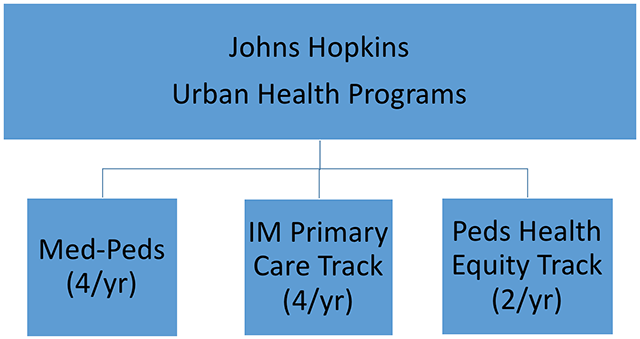
- Four residents per year for a total of 12 resident physicians
- Residents are board-eligible in Internal Medicine after three years
- Residents practice in a federally qualified health center look-alike continuity clinic with IM faculty preceptors
- X+Y (6+2) schedule
- Core UH rotations start in the first year of residency - Health Care for the Homeless, Refugee Medicine, and Urban Community Medicine
- We maximize outpatient training opportunities and time in continuity clinic
- All residents complete our 12 core urban health rotations and still have time for 4 two-week non-UH electives/research
- All residents complete buprenorphine X waiver training and care for patients with substance use disorders in clinic
- All residents can receive funding to pay for their individual medical license and DEA number if they plan to prescribe buprenorphine during residency
- Weekly UH noon conferences
- Every other week UH academic half days
- Triannual UH book clubs/reflection nights
- Frequent social events for the concentration and the categorical program
- Full integration into the categorical programs
- Residents are part of our larger urban health community (including the Med-Peds program and the pediatrics health equity pathway) and have colleagues that share similar values and aspirations
Leaders in Urban Health Primary Care
The goal of the concentration is to create leaders in urban health primary care. We imagine our graduates following many different leadership paths. Among these are, in random order:
- Office medical director of a primary care clinic
- Chief medical office of a federally qualified health center (FQHC)
- Clinician-Educator for future primary care providers
- Primary care researcher (research in health disparities, health services, education, etc.)
- Policy maker on local, state, or national levels
- Director of non-governmental advocacy organization
- Community-based participatory researcher
- Other primary care careers and leadership aspirations.
Mentorship
Facilitating longitudinal mentorship for our residents is of our top priorities. The world-class mentorship found at Johns Hopkins and Baltimore City is ready to serve you. Mentors include our GIM clinician-investigators, GIM clinician-educators, School of Public Health professors, Johns Hopkins Community Physicians leaders, and members of the Urban Health Institute. The city and state boast top-notch policy makers, and the program has many friends and alumni in Washington, DC. The CEOs and CMOs at our FQHC collaborators are eager and willing to take you under their wing. We work with you to understand your career goals and to match you with like-minded mentors.
We assign you program leadership advisors and help you pick a mentor from among our UH graduates and friends of the program.
Life after Residency
As residents near completion of the three-year residency, we are delighted to support them as they enter the next phase of their careers. Finding a career mentor is the first step. The next step can include, for example, supporting you to find a primary care job at a FQHC or an academic center like Hopkins, obtain a position in a health department, or provide care at Health Care for the Homeless. We also support our research-oriented residents to match to GIM, Adolescent, Addiction, and NCSP fellowship positions. Our goal is to develop leaders in urban health primary care, in whatever form that may take.