

Hospital Medicine Fellowship Core Clinical Curriculum
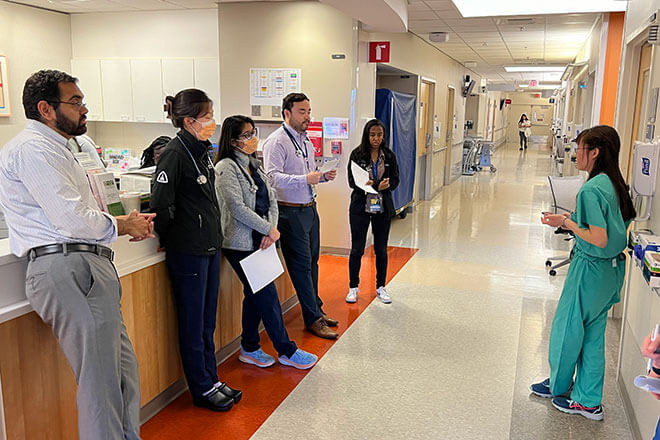
As part of teams named after influential former faculty Catherine Neill, M.D. and William Zinkham, M.D., fellows will supervise a team of residents under many categories:
- Categorical Pediatric
- Pediatric Neurology
- Pediatric Medicine
- Pediatric Anesthesia
- Pediatrics - Genetics
- Pediatrics - Internal medicine
- Medical students (Cores and Subinterns)
- Neil
- Zinkham
- Consults
- Bayview
Fellows will care for general pediatric and complex care patients admitted from the emergency department, transferred from other services in the hospital or transferred from other hospitals.
On the complex care and surgical consults rotation, fellows will consult on complex care patients on both medical and surgical services and on patients on surgical services for whom there is a general pediatrics concern.
The fellows’ community hospital rotation experiences will occur at Johns Hopkins Bayview Medical Center. At this site, the fellows will work in the combined emergency department/inpatient ward unit, as well as in the newborn nursery, overseen by pediatric hospitalists.
Individualized Curriculum
Fellows have eight weeks of individualized clinical curricular time with 24 weeks of individualized curriculum time in any area. Fellows meet with the program director regularly to discuss their fellowship and career goals and to select/design their individualized curricular experiences. Fellows may create their own elective experiences, if not already available, or may use individualized curricular time for additional scholarship experiences.
Rotations done by previous fellows:
- As a member of the palliative care team, fellows completed outpatient visits and consults on admitted patients.
- During the sedation rotation, fellows completed the Society for Pediatric Sedation Provider course course and gained practical experience managing airways and procedural sedation in the operating rooms and procedural suites.
- Acute pain service
- Administrative rotation
- Adult medicine (if med-peds trained)
- Anesthesia
- Cardiology
- Child abuse
- Child psychiatry
- Dermatology
- Emergency medicine
- Endocrinology
- Gastroenterology
- Genetics
- Global health
- Infectious diseases
- Lactation
- Medical billing and coding
- Medical education
- Nephrology
- Neurology
- Operational leadership
- Pain team
- Palliative care
- Pediatric surgery
- Physical medicine and rehabilitation
- Procedures
- Pulmonology
- Respiratory therapy
- Rheumatology
- Speech language pathology
- Wound care
Scholarship
Fellows in our program pursue meaningful, mentored scholarship aligned with their professional interests and career goals. Scholarship may take the form of quality improvement (QI) or traditional pediatric hospital medicine research, including retrospective or prospective studies across the full breadth of PHM (clinical care, health services, equity, education, safety, and systems improvement).
All fellows are supported by a dedicated Scholarship Oversight Committee, which meets regularly to guide project development, ensure methodological rigor, and support progress toward dissemination. Fellows receive comprehensive education and hands-on support in statistics and study design, applicable to both QI and research projects, with access to institutional expertise for data management, analysis, and interpretation.
Fellows may also engage institutional resources such as the Johns Hopkins Armstrong Institute for Patient Safety and Quality, including formal training pathways (e.g., QI methodology or Lean Sigma coursework), as appropriate to their project. In addition to committee meetings, fellows present their work at divisional research-in-progress sessions, fostering a collaborative scholarly environment and preparing fellows for regional and national dissemination.
Example Fellow Project
A recent fellow-led project used a retrospective, multi-center pediatric database to examine variation in hospital outcomes for children hospitalized with a common PHM diagnosis, focusing on factors such as length of stay and resource utilization. This hypothesis-driven study, supported by rigorous statistical mentorship, resulted in publication in a peer-reviewed journal: “Variation in Outcomes of Pediatric Hospitalizations”. See the full article.
Schedule
The below schedule is an example.
Year 1
- General Pediatric Hospital Medicine Teams (10 weeks)
- Complex care and surgical consults (four weeks)
- Community hospital medicine service (two weeks)
- Palliative care (two weeks)
- Sedation (two weeks)
- Individualized curriculum (12 weeks)
- Scholarship (16 weeks)
- Vacation (four weeks)
Year 2
- General Pediatric Hospital Medicine Teams (10 weeks)
- Community hospital medicine service (two weeks)
- Individualized curriculum (24 weeks)
- Scholarship (16 weeks)
- Vacation (four weeks)
During the second year of training, fellows have the opportunity to individualize their inpatient ward experience based on their career goals. They may elect how they would like to divide this time between the primary site (Johns Hopkins Children’s Center) and the community site (Johns Hopkins Bayview Medical Center), and between the general pediatrics service and the complex care/surgical consult service.