Soccer Warmups to Prepare for Your Game
Featured Experts


Updated June 10, 2026
Preparing your body to play soccer is important, whether you are just starting out or you have been playing for a while. Jimmy Hoyt and John Shipley, board-certified sports physical therapists who specialize in soccer rehabilitation, share options for a dynamic warmup that soccer coaches and players 13 and older can use to warm up before a practice or a game.
Why Warming Up Before Soccer Is Important
A warmup is important before any major physical activity. “An abundance of research supports that a dynamic warmup that incorporates active movement, strengthening and plyometrics can help reduce the risk of injuries in soccer players,” says Shipley. For soccer players, a warmup helps prepare both the body and mind for an upcoming practice or game. The main goals are to reduce the risk of injury and increase the soccer player’s readiness to practice or compete by improving muscle flexibility and muscle activation so the body and mind are ready for the demands of playing soccer.
Warmup exercises should focus on:
- Improving blood flow to the muscles.
- Improving muscle and joint flexibility.
- Improving muscular control and strength of trunk, hip, knee and ankle muscles.
- Performing sport-specific movements, such as jumping and change-of-direction maneuvers.
- Gradually ramping up sprinting speed needed for the practice or game.
What to Include in a Soccer Warmup
Johns Hopkins soccer rehabilitation experts identified several categories of exercises that help create a well-rounded soccer warmup program. These exercises are appropriate for athletes 13 or older, and they can be completed with minimal equipment on a small section of about 15–20 yards on the field or sideline.
Blood Flow Activity
These activities focus on increasing your heart rate and increasing blood flow to your muscles. Increasing blood flow through dynamic movement can help improve muscular soreness from previous games or practices, and can help prepare your muscles for another soccer training session or game.
How to do it: Complete the exercises from the list below to make sure you increase your heart rate prior to stretching and strengthening.
Regular jogging
Start with a short jog forward across the warmup area. Once you reach the other side, turn around and jog back to where you started.

Butt kicks
A jogging motion bringing your heel back as far as you can, making contact with your glute.

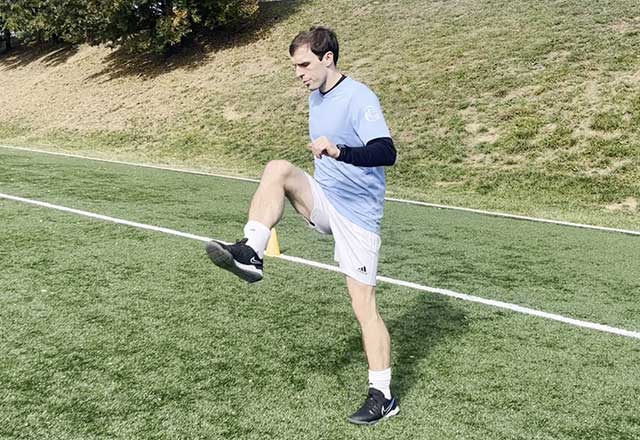
High knees
A jogging motion bringing your knee perpendicular to your hip.

Shuffling
Start in an athletic stance and move sideways to the left without crossing your feet. Repeat in the opposite direction.

Carioca exercise
Similar to shuffling, move sideways while alternating which foot leads and twisting your hips as you move. This is also commonly referred to as a “grapevine” exercise because of the twisting motion that your legs make.

Hamstring Flexibility Exercises
The hamstring muscles experience high stresses when a player is sprinting and kicking. It is a common area for muscle tension in soccer players, which makes it an important muscle for soccer players to warm up and condition.
How to do it: Choose one or two exercises from this list to add to your warmup protocol:
Frankensteins
A walking warmup in which you hold your arms straight out with your palms facing down and kick your leg high enough to touch your toes to the palm of your hand on the same side as the leg.

Sweeps
In this warmup, you jog forward a few steps, stop with one leg fully extended and make a sweeping motion with both hands as if picking up a ball in front of your front foot. Alternate the leg you have stretched out for each stop.

Airplanes
Jog forward and stop at regular intervals. During each stop, lean forward at the hip and stretch your arms out, perpendicular to your body, like the wings of an airplane. At the same time, stretch one leg out behind you so you are balancing on the other leg. At each stop, alternate the leg you are balancing on.

Quadricep and Hip Flexor Flexibility Exercises
The quadriceps and hip flexor muscles work alongside the hamstrings, flexing the hip and extending the leg at the knee, helping with sprinting and kicking. These muscle groups are heavily used while playing soccer, so it is important to warm up and stretch to maintain flexibility.
How to do it: Choose one or two exercises from this list to add to your warmup protocol:
Lunging with overhead reach
Step forward into a lunge. Raise the opposite arm from the leg that is forward and reach over your head, stretching the same side as your raised arm. With each lunge, alternate which leg is forward and which arm is raised.

Lunging with twist
Step forward into a lunge. Raise your arms parallel to the ground and bend at the elbow, then twist your body 90 degrees at your hips toward the forward leg. Then twist fully to the other side to face the opposite direction. With each lunge, alternate the leg you have forward.

Walking quad stretch
After a short jog, bend one leg so you can grab your foot with your hand behind your back. With your other leg, push up to stand on your toes and simultaneously raise the arm on the same side, reaching straight up. After another jog forward, repeat with alternating legs and arms.

Hip Mobility Exercises
The hip joint allows multidirectional movement and rotation, which are used in sprinting, cutting and kicking, so having good hip mobility is important for soccer players.
How to do it: Choose one or two exercises from this list to add to your warmup:
Open/close gates
After two diagonal hops leading with one leg, raise the other leg up with a bent knee and move it sideways as if you are stepping over a short fence. Shuffle in the other direction diagonally, swap legs and perform the same movement. Repeat.
Partner hip circles
With a partner, stand side by side facing opposite directions. Grab each other’s shoulder for support, using the arm on the side where you touch. Lift the leg farthest from your partner, bending at the knee, and perform circular motions, pushing the leg out and bringing it back in. Then perform the circular motion in the opposite direction. Switch sides with your partner and repeat.

Walking figure 4
After a short jog, bring one leg up and bend it sideways so that the ankle almost touches the other leg’s knee. Hold your knee with one hand and your ankle with the other. As you are standing on one leg, squat slightly then straighten up while lifting the leg you are holding. Jog forward again and switch legs. Repeat.

Partner leg swings
With a partner, stand side by side facing opposite directions. Grab each other’s shoulder for support, using the arm on the side where you touch. Swing the leg farthest from your partner forward and backward. Switch sides with your partner and repeat.

Adductor Flexibility Exercises
The hip adductors are a group of muscles on the inside of the thigh. These muscles play a part in bringing the leg to the midline of your body (adducting the leg), along with flexing and extending the hip. These movements are particularly important for kicking or moving side to side and changing direction on the field.
How to do it: Choose one or two exercises from this list to add to your warmup protocol:
Lateral lunge switches
Lunge sideways with one leg, lean into the lunge, then shift your weight to the other leg. Stand up fully and do a quick shuffle to rotate your body to face the other direction. Repeat the stretch.

Sumo squats
After a short jog, stop with your feet spaced out at shoulder width and your toes facing out. Bend your arms at the elbow and raise your forearms, then perform a deep squat so your elbows almost touch your knees. Stand back up, jog forward and repeat.

Hip and Core Strength Exercises
Hip and core strength exercises focus on strengthening the muscles around your core, such as the lower back, hips, abs and pelvis. A strong core can improve balance, stability, shooting and passing power, and agility while reducing the chance of lower back and hip injuries.
How to do it: Add planks and side planks to your warmup protocol. Once you can complete three sets of 30 seconds, you can change to the progression versions of these exercises.
Plank

Plank Progression

Side Plank

Side Plank Progression

Balance and Lower Body Strength
Many moves in soccer, like shooting and passing, involve playing on one leg, making balance and lower body strength crucial for improving these skills. Lower body strength also helps prevent injury, especially for the knees.
How to do it: Add Romanian deadlifts to your warmup protocol.
Romanian Deadlifts (RDL)

Plyometric Warmup Exercises
Plyometrics are a type of exercise that uses both speed and power to improve your physical performance. For soccer players, these exercises help with explosive movements, jumping ability and speed.
How to do it: It is important to ramp up plyometric warmups gradually, so athletes should start with Level 1 exercises and have supervision from their coach to ensure their technique is appropriate before moving on to the next level.
Level 1: Double-leg and single-leg hopping
Do 20 repetitions of each type of hopping: static/in place, front to back and side to side. These hops can be done with both legs or with one leg, alternating which leg you are hopping on.

Level 2: Explosive vertical double-leg jump to single-leg landing
Begin by squatting down and preparing to jump. Push upward with both legs, then land on one leg. Repeat 10 times for each leg.
Watch a demo of the explosive vertical double-leg jump to single-leg landing.

Level 3: Choose one of these options:
Continuous squat jumps
Move into a squatting position with your arms in front of you and bent at the elbow so your forearms are perpendicular to the ground. Then push up with your legs, jumping into the air as you swing your arms backward and point your toes down. As you come back down, swing your arms forward into the beginning position. Repeat 10 times.

Alternating lunge jumps
After a short jump up, land into a lunge position. The front leg should be bent at the knee at 90 degrees, with the foot firmly on the ground. The other leg should be behind you, bent at the knee, with the knee almost touching the ground, as you balance on your toes. Repeat these jumps 10 times as you alternate which leg is forward. Your arms will also alternate: The arm on the opposite side of the forward leg is also forward, bent at the elbow.

Change-of-Direction Drills
Change-of-direction drills involve moving in one direction, then quickly shifting your momentum to move in another direction. This type of drill improves your single-leg stability and control of dynamic movement, which can improve your cutting efficiency on the field.
How to do it: It is important to ramp up change-of-direction drills gradually, so athletes should start with Level 1 exercises and have supervision from their coach to ensure their technique is appropriate before moving on to the next level. Choose one warmup from each level:
Level 1
Icky shuffle to stick
For this exercise, you will need an agility ladder, laid down flat, or another way to mark a long row of squares in the grass. You will be moving diagonally, so stand slightly below and to the side of the first square. Quickly step into the square diagonally, moving one leg at a time, and then step outside of it diagonally. Once outside, balance for a few seconds on the leg farthest from the row of squares. Continue stepping in and out of squares diagonally until the row ends.

In-outs
In this warmup, we will use the same rope ladder or row of squares as above. Start with both feet in one of the squares. Then place one foot at a time to the side of the square and back in, increasing the speed of each step. Alternatively, step in and out of the square in front of you.

Level 2
Lateral slow skaters
Start by balancing on one leg, with the other leg up, bent at the knee. Hop sideways onto the other leg, briefly balancing on it. Your arms should be bent at the elbow, one in front of you and the other behind, and you switch them with each jump, as if you are skating. Repeat this motion 10 times to each side.

Diagonal skaters
This warmup uses a similar motion as the lateral slow skaters, but instead of hopping sideways in one place, you hop forward diagonally.

Level 3
Skaters (double contact)
This warmup is similar to the lateral slow skaters warmup, but with increased difficulty. As you land from a sideways jump, hop on the foot you landed on once, then hop back, landing on the other foot. Repeat this exercise 10 times for each leg that does the double hop.

Reactive cutting
This warmup starts with your partner standing 5 yards in front of you, with a cone in front of them, toward you. Sprint toward your partner, who will point to a direction, left or right. Once you reach the cone, you will cut to sprinting in that direction.

Building Your Warmup Protocol
A typical soccer warmup protocol should include several types of warmup drills presented above. Here is a summary of the warmup program we outlined. This program allows you to customize how you combine flexibility, strengthening and plyometric activities to meet your needs.
| Type of Exercise | Exercise Options | Exercise Plan |
|---|---|---|
| Blood flow |
Jogging High knees Butt kicks Shuffling Carioca exercise |
Complete all of these until your heart rate is increased, and you start to develop a light sweat. |
| Hamstring flexibility |
Frankensteins Sweeps Airplanes |
Choose one or two. |
| Quadricep and hip flexor flexibility |
Lunging with overhead reach Lunging with twist Walking quad stretch |
Choose one or two. |
| Hip mobility |
Open/close gates Partner hip circles Walking figure 4s Partner leg swings |
Choose one or two. |
| Adductor flexibility |
Lateral lunge switches Sumo squats |
Choose one or two. |
| Hip and core strength exercises | Plank (with progression) Side plank (with progression) |
Practice holding a standard and side plank for 30 seconds, slowly progressing to three sets of 30 seconds. Once achieved, switch to progression planks with leg lifts, gradually increasing to three sets of 10. |
| Balance and Lower Body Strength | Romanian deadlifts | Start off with one set of 10, and add more sets as you are able, up to three sets. |
| Plyometric exercises |
Level 1 – Double-leg and single-leg hopping Level 2 – Explosive vertical double-leg jump to single-leg landing Level 3 – Continuous squat jumps OR alternating lunge jumps |
Athletes should start with Level 1 exercises and have supervision to ensure their technique is appropriate before moving on to the next level. |
| Change of direction |
Level 1 – Icky shuffle to stick OR in-outs Level 2 – Lateral slow skaters OR diagonal skaters Level 3 – Double contact skaters OR reactive cutting |
Athletes should start with Level 1 exercises and have supervision to ensure their technique is appropriate before moving on to the next level. |
Medically reviewed by John Shipley, P.T., D.P.T., S.C.S., and Jimmy Hoyt, P.T., D.P.T., O.C.S., S.C.S., C.S.C.S.
Soccer Rehabilitation Program