Patient Story
Leadless Pacemaker | Alec’s Story

A chest x-ray showing a leadless pacemaker.
What You Need to Know
- In his early 20s, Alec Burdette had a leadless pacemaker installed to prevent his heart rate from getting too low, a rare condition for someone his age.
- His heart rhythm disorder, atrial flutter, is managed by Zeshan Ahmad, an expert in the latest electrophysiology technology.
- With his condition under control, Burdette is able to regularly lift weights and play pickleball.
Alec Burdette was walking up stairs between classes during his junior year of high school in 2017 when, suddenly, he felt like someone had pushed him forward.
“It just felt like I fell forward without moving,” the Gaithersburg, Maryland, resident says. “Then I walked down the hall, I took my seat, and — it was in my left hand — the edge of my pinky got numb.”
The feeling moved through the rest of his hand and all the way up his arm. By the time he walked to the school nurse’s office, it had reached his neck and mouth. He was slurring his words and having trouble forming coherent sentences.
His vitals were stable, and luckily the transient ischemic attack, often called a ministroke, lasted only about five minutes.
Burdette was diagnosed with atrial flutter, an arrythmia that causes the upper chambers of his heart to beat rapidly. He was hospitalized for a month, while doctors tried various medications and procedures to get the arrythmia under control.
Finally, they performed an ablation, a procedure in which heart tissue is destroyed in areas causing irregularities. While he experienced some side effects, Burdette was mostly symptom-free for a few years.
High Heart Rate Returns
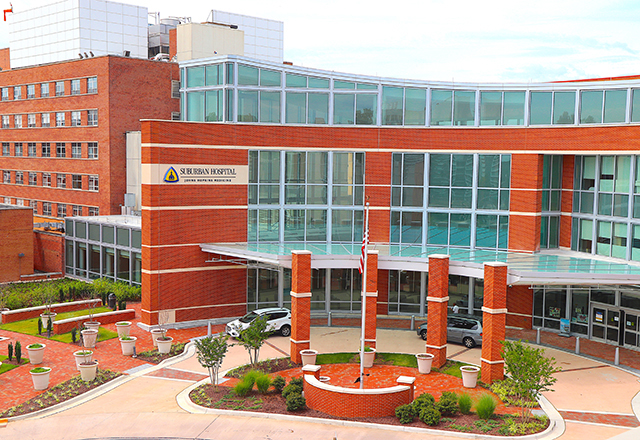 Suburban hospital entrance
When Burdette started having issues with a high heart rate again in 2023, he wound up in Suburban Hospital’s emergency department.
“You get a big dump of adrenaline,” he says. “It’s kind of like the feeling you see in the movies when they’re in a car chase.”
After a cardioversion procedure, in which his heart was shocked back into a normal rhythm, Burdette came under the care of Zeshan Ahmad, director of complex cardiac ablations for Johns Hopkins Medicine in the Greater Washington area. Ahmad successfully performed an ablation at Johns Hopkins’ Suburban Hospital to target the arrhythmia in Burdette’s heart.
In September 2024, Ahmad implanted a leadless pacemaker, an exciting new advanced device, in the lower chamber of Burdette’s heart to prevent it from beating too slowly due to an electrical conduction issue that was causing him to nearly pass out. This small leadless pacemaker, which only requires a minimally invasive outpatient procedure, is smaller than its traditional counterpart with leads (wires), is less invasive and its batteries can last 10–20 years.
Because it has no wires, the device reduces a patient’s risk of long-term infection and complications that can result from routing wires through veins. Those wires can cause veins to become blocked or narrowed, and can be difficult to remove.
These days, under Ahmad’s care, Burdette is back to living an active lifestyle, playing pickleball and lifting regularly.
“Dr. Ahmad has really supported me,” Burdette says. “After these procedures, I was very timid to get back to my everyday life, and he said, ‘If you need an OK from somebody, you have an OK from me.’”
A Perfect Candidate
When first diagnosed, Burdette was a student athlete worried about his ability to remain active.
“I played varsity football my junior year. When all this happened, I was more upset that I couldn’t play football my senior year than anything else,” Burdette says.
Ahmad says Burdette was a perfect candidate for the device, as a young man whose cardiac issues were preventing him from being active. Ahmad implants leadless pacemakers regularly, especially in younger patients and patients with long-standing atrial fibrillation, another arrythmia disorder.
“Patients should go to a place that has all the right tools to take care of them, and does quite a few of these procedures,” Ahmad says. “Volume matters, and we do a lot of these cases throughout the Johns Hopkins Medicine system, but especially in the Greater Washington area.”
Inspiring the Future
While it has been a bumpy road at times, Burdette’s trajectory with his illness inspired him to become a nurse. Currently, he is a student nurse extern on an intermediate care unit at a Baltimore hospital, and will earn his degree this December.
In the meantime, he feels confident that he’s in good hands with Ahmad.
“I’m super grateful for him, because he has taken a lot of stress out of my life,” Burdette says. “I’ve been in and out of care for a good seven years, and he’s definitely the best doctor who has taken care of me.”
Alec's Surgeon
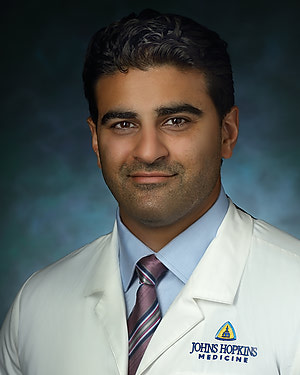
Specialized Electrophysiology and Arrhythmia Care in the Greater Washington Area
To schedule an appointment, call 443-997-0270. For more information, visit our website.