Car Seat Safety
Featured Experts
-
Creason Walter, M.P.H., C.H.E.S., C.P.S.T.

-
Justine Gately, M.A.T., C.P.S.T.-I.

Updated September 1, 2026
Motor vehicle accidents are the leading cause of death for children in the U.S., according to the Centers for Disease Control and Prevention. Thousands of children are at risk because they are not properly restrained in the vehicle.
Creason Walter and Justine Gately, certified child passenger safety technicians from Johns Hopkins Children’s Center, review key things to know about keeping your child safely restrained in the vehicle.
Key Points
- Children younger than 13 years old should sit in the back seat of a vehicle.
- All children are recommended to ride in a rear-facing car seat until they reach the maximum height or weight allowed by the car seat manufacturer.
- Booster seats, which raise children in the seat to allow a proper seatbelt fit, are recommended for children ages 5 to 8.
- Most car seats need to be replaced after a car accident, but you should refer to the car seat's guide or website for specific instructions.
Why are car seats important for children?
Many injuries to children can be prevented if car seats and lap and shoulder belts are installed and used correctly.
Car seats and seat belts must be used correctly to give the best crash protection, and children younger than 13 years old should sit in the back seat.
Recommended Car Seating by Age
The National Highway Traffic Safety Administration recommends best practices for proper seating of children in vehicles by age groups.
Child passenger safety (CPS) laws vary by the state you are in. To view your state’s CPS law, visit the Governors Highway Safety Association website, use the “By Issue” box to select “Child Passengers,” and choose your state.
Rear-Facing Car Seats (birth to age 3)
- Children from birth to 12 months old should always ride in a rear-facing car seat with a five-point harness.
- Children ages 1 to 3 years old should travel in a rear-facing car seat with a five-point harness for as long as possible until reaching the highest weight or height limit allowed by the car seat manufacturer.
This could be an infant car seat/rear-facing only (birth to 12 months) or a convertible/all-in-one car seat that can be both rear- and forward-facing (birth to 3 years old).
For best and safest use of rear-facing car seats:
- Refer to the car seat manufacturer’s instructions for proper installation in the vehicle.
- The car seat’s five-point harness must be at or below the child’s shoulders.
- The harness should be snug with no slack.
- The chest clip should be placed at the child’s armpit level.
- Never use accessories that did not come with the car seat, as these could pose safety risks.
The American Academy of Pediatrics (AAP) recommends that children ride in a rear-facing car seat until they reach the maximum height or weight allowed by the car seat manufacturer. Once the child outgrows the rear-facing maximum height or weight, the child is ready to travel in a forward-facing car seat.
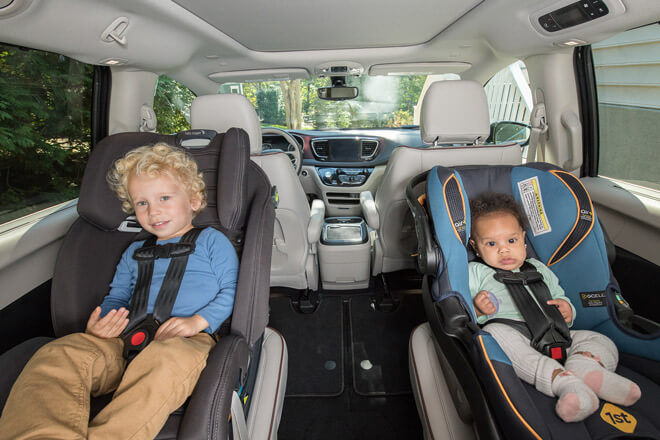 Example of children in a rear-facing car seat. Image courtesy of the National Highway Traffic Safety Administration.
Forward-Facing Car Seats (ages 4 to 7)
Children ages 4 to 7 years old should ride in a forward-facing car seat with a five-point harness until reaching the highest height or weight limit allowed by the car seat manufacturer.
- Refer to the car seat manufacturer’s instructions for proper installation.
- The harness should be at or above the child’s shoulders.
- The harness should be snug with no slack.
- Chest clip should be placed at the armpit level.
- Using the tether is necessary for forward-facing car seats to secure the top of the car seat to the vehicle.
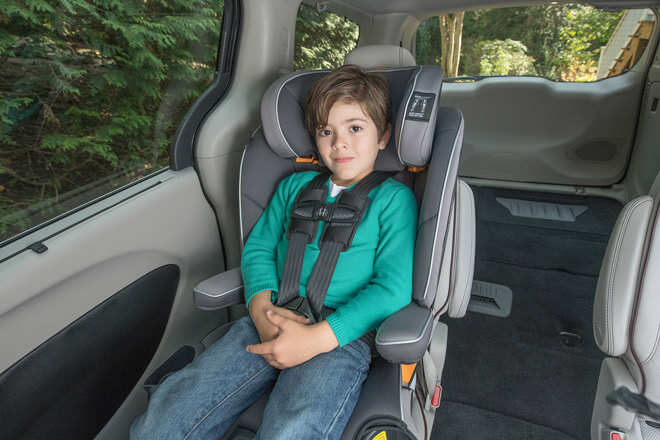 Example of a child in a forward-facing car seat. Image courtesy of the National Highway Traffic Safety Administration.
Booster Seats (ages 8 to 12)
Booster seats are designed to support children and raise them in the vehicle seat to properly fit the vehicle’s lap and shoulder belt. Children ages 8 to 12 should travel in a booster seat until they fit the seat belt correctly.
Most children don’t properly fit the vehicle seat belt until around age 10–12.
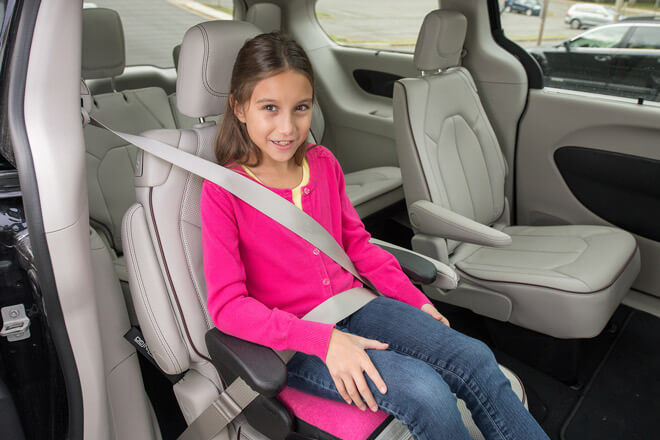 Example of a child in a booster seat. Image courtesy of the National Highway Traffic Safety Administration.
Vehicle Seat Belt (age 8 and older)
Once the child outgrows a booster seat by meeting the maximum height or weight, they are ready to use the vehicle’s seat belt. A five-step test can be used to see if your child is ready for seat belt use:
- Does the child sit all the way back against the vehicle seat?
- Do the child’s knees bend comfortably at the edge of the vehicle seat?
- Does the seat belt cross the shoulder between the child’s neck and arm?
- Is the lap belt as low as possible, touching the thighs?
- Can the child stay seated like this for the whole trip?
If the answer is yes to all of these questions, the child is ready to use the seat belt.
Proper use of the seat belt for children
The vehicle’s shoulder belt keeps the child from moving forward if you are in a head-on crash. Never place the vehicle’s shoulder belt behind them or under their arm. The lap portion of the vehicle’s seat belt should sit low on the child’s hips, never on their bellies.
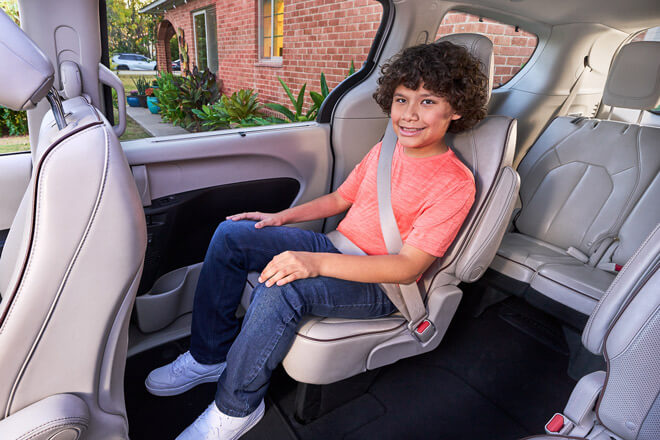 Example of correct seat belt use for a child. Image courtesy of the National Highway Traffic Safety Administration.
How can I get assistance with car seat installation and making harness adjustments?
For assistance in using your car seat, consult the car seat manufacturer’s manual, website and videos.
In addition, you may find a fitting station or local child passenger safety technician (CPST) through Safe Kids Worldwide. CPSTs are nationally certified with expertise in car seat installation, harness adjustment and education, and they keep up with the latest technical information about child passenger safety. At a car seat check, CPSTs provide hands-on assistance to caregivers on how to use their car seat.
Do I need to replace my child’s car seat after a car accident?
Each manufacturer has specific guidelines and requirements. Refer to the manufacturer’s website or manual for guidance. However, most car seats will be replaced after being involved in a car accident.
Why might a car seat be recalled?
Sometimes child car seats are recalled for safety reasons, such as not meeting certain safety standards during post-manufacturing testing after being placed on the market. The National Highway Traffic Safety Administration offers a recall directory to find instances of recalls by car seat model. Follow the manufacturer’s guidance on use if the car seat has been recalled. Sometimes, the manufacturer will provide a free remedy or kit.
How do air bags keep my child safe?
Air bags are designed to work with seat belts, not replace them. When used correctly, air bags save lives with little risk, however they do pose some risks to children age 13 and younger.
To keep air bag use as safe as possible,
- Children under 13 should be restrained in the back seat.
- Do not put a rear-facing car seat in front of a passenger air bag, such as in the front seat.
- When no other arrangement is possible and an older child must ride in the front seat, move the vehicle seat back as far away from the air bag as possible.
Keep in mind that even with these precautions, the child may still be at risk for injuries from the air bag.
Medically reviewed by Creason Walter, M.P.H., C.H.E.S., C.P.S.T., and Justine Gately, M.A.T., C.P.S.T.-I.