
The Esophageal and Airway Treatment (EAT) Program provides care for infants, children and young adults with complex esophageal, airway and thoracic problems.
Our experienced, dedicated team in the Esophageal and Airway Treatment Program at Johns Hopkins All Children’s in St. Petersburg, Florida, combines deep understanding of esophageal, airway and thoracic conditions with compassionate care, innovative techniques and cutting-edge technology to treat babies and children with these conditions.
We believe every patient should have more than 80 years of good esophageal and airway function. That’s why we customize every patient’s care plan for the best results. For cases of esophageal atresia or esophageal strictures, we aim to maintain the patient’s native esophagus for the best long-term outcomes. For patients with problems of the airway, we seek to understand the problem thoroughly before making a plan. For other problems in the chest, after thoroughly understanding the problems, we design a solution and build the best team to maximize success for the patient and family.
Why Choose Johns Hopkins All Children’s Hospital
When your child has a complex esophageal, airway and/or thoracic condition, it’s important that they receive specialized assessment and treatment from an experienced, expert team. We are leaders in the diagnosis and treatment of these often rare and misunderstood complex conditions nationally and internationally, and we have developed, and even now are developing, new innovative techniques that are advancing treatment and improving lives.
Our patients have come from across the country and the world to receive treatment. At Johns Hopkins All Children’s you’ll find:
World-Class Expertise
Many specialists throughout the hospital have extensive experience in caring for children with these complex conditions, including nursing, radiology, administration and technicians. This wide experience facilitates a close working relationship at all levels to provide our patients with integrated synchronous multidisciplinary care.
-
Led by Jason Smithers, M.D., a leader in treatment and innovation for pediatric thoracic surgery, our team provides long experience and deep expertise in treating esophageal, airway and thoracic conditions. Along with Dr. Smithers, our team includes Russell Jennings, M.D., who pioneered many pediatric diagnostic and surgical procedures for malformations of the esophagus, trachea and chest, and Hester Shieh, M.D., whose clinical expertise and research focus is esophageal, airway and thoracic conditions.
-
Focused expertise in these conditions is essential to optimize patient outcomes. Carlos Munoz, M.D., is at the forefront of advancing pediatric anesthesia for airway conditions. He and our team of anesthesiologists including Richard Elliott, M.D., Frederick Kuo, M.D., Jibin Samuel, M.D., and Scott Watkins, M.D., provide safe, individualized care for children undergoing treatment for esophageal, airway and thoracic conditions.
-
Michael Wilsey, M.D., an internationally recognized expert in advanced therapeutic endoscopy, treats patients with conditions of the esophagus.
-
Alex Rottgers, M.D., and Jordan Halsey, M.D., provide advanced specialized care in pediatric plastic surgery and microsurgery for patients needing esophageal replacement.
-
James Quintessenza, M.D., and Kamal Pourmoghadam, M.D. provide leadership and advanced specialized care for complex vascular and cardiac reconstruction, including vascular rings and vascular compression syndromes.
-
Our highly skilled team of advanced practice providers and nurses work together to provide your child with seamless care before, during and after treatment. Our team’s critical care expertise – which includes the operating room, intensive care unit and floor nursing teams – means your child receives focused, specialized care from diagnosis through surgery, recovery and follow-up care.
Learn more about our specialized team.
Innovative Treatment
Our team is at the forefront of developing new procedures to treat esophageal, airway and thoracic conditions. These include recent development of minimally invasive procedures and open surgical treatments for conditions such as aberrant right subclavian artery, vascular rings with esophageal and airway compression, dilated esophagus, laryngeal cleft, laryngotracheo-esophageal clefts, asphyxiating thoracic dystrophy, tracheal agenesis and tracheal atresia, and subglottic stenosis.
We also perform nerve monitoring in all cases involving the neck and chest to minimize the risk of nerve injury, particularly to the recurrent laryngeal nerves, which are important components of the proper function of the vocal cords.
Leading-Edge Care
As part of the Division of Specialized Thoracic Surgery at Johns Hopkins All Children’s, our team is focused on providing expert, specialized care for children with esophageal, airway and thoracic conditions. We are also helping to advance care for children with these conditions around the world and share our expertise by teaching and operating with hospitals across the United States and internationally in Europe, Central and South America, and the Middle East.
Conditions and Procedures
Our team specializes in diagnosing and treating a variety of esophageal and airway concerns, including:
-
Bronchomalacia is a congenital problem caused by weak or poorly shaped cartilage in the walls of the bronchial tubes. There is often wheezing when breathing from the weakened cartilage collapsing during breathing. Learn more.
-
Esophageal atresia is when a baby is born without part of the esophagus, causing the esophagus to grow in two segments that do not connect. In some cases, so much of the esophagus is missing that the ends can’t be easily connected. This is known as long gap. Learn more.
-
A child’s esophagus can be injured by ingesting foreign objects or toxic substances such as detergents and drain cleaners. Depending on the severity of the substance ingested, children can develop burns, strictures or holes in their esophagus. Learn more.
-
We use jejunal interposition with microvascular enhancement for esophageal replacement in cases where esophageal salvage is not possible.
-
Esophageal strictures describe a narrowing of the esophagus. This can be present at birth or occur if the patient has gastroesophageal reflux or has had surgery on his or her esophagus or if the esophagus is damaged from an injury or trauma. Learn more.
-
In some cases, the muscles where the esophagus meet the stomach do not close tightly, leaving a large opening in the diaphragm. A hiatal hernia occurs when the upper part of the stomach bulges through this opening and into the chest. Learn more.
-
Laryngeal clefts typically involve the space between the vocal cords and sometimes the back of the larynx (voice box), allowing saliva and swallowed food to go into the airway and lungs. These are a shorter version of laryngo-tracheal esophageal clefts that are longer and involve the airway (trachea) itself with a slit-like connection to the esophagus. Sometimes this connection is relatively short in the neck region, while sometimes going longer all the way to the bottom of the trachea, and rarely going even longer into the bronchus, usually the left side. Learn more.
-
In tracheal agenesis, the trachea (or windpipe) does not develop properly. Some or all of the trachea may be missing, which prevents the baby from breathing normally. Few infants with tracheal agenesis survive the first week, so it is critical once a diagnosis is made that the child is referred to experts at an experienced care center. The team at Johns Hopkins All Children's is experienced in treating this condition. Learn more.
-
Tracheal diverticulum is esophageal tissue on the trachea. This pouch-like tissue is often from undergoing surgery to repair esophageal atresia with tracheoesophageal fistula (TEF). Left untreated, this tissue could trap secretions and increase the chances of lung infections, lead to recurrent TEF and could lead to collapse of the trachea. Tracheal diverticulum can also trap an endotracheal tube during anesthesia.
-
A tracheoesophageal fistula is an abnormal connection between the esophagus and the trachea. Learn more.
-
Tracheomalacia is when the airway collapses during breathing or coughing, causing a child to have breathing difficulties. A child with tracheomalacia may also suffer from recurring respiratory illnesses. Long-term tracheomalacia can lead to lung injury. Learn more.
-
Vascular rings refer to a variety of abnormalities in the chest that involve the heart’s major blood vessels and result in compression of the trachea and/or esophagus. Learn more.
Our team is specially trained in both open and minimally invasive procedures, including:
-
Stents and splints temporarily hold the trachea open and encourage tissue to grow around it.
-
This procedure provides immediate and permanent relief for some types of tracheomalacia. In this procedure, the child’s trachea is opened by moving the aorta toward the front and attaching it to the back of the sternum. Sometimes, in order to create more space between the aorta and the sternum, the thymus gland is removed.
-
A bronchoscopy is a common procedure where doctors use a tool called a bronchoscope to examine a child’s throat, larynx, trachea and lower airways. This procedure is used to diagnose problems with the airways, lungs or lymph nodes. We developed a technique for bronchoscopy called the Dynamic 3 Phase Bronchoscopy, which is much more accurate and effective at diagnosing airway anomalies and complications.
-
The Foker process is a procedure that encourages natural growth and lengthening of a child's existing esophagus.
-
Jejunal interposition is a procedure where the missing esophagus is replaced with a section of the jejunum (the middle part of the small intestine).
-
This procedure opens the trachea by suspending the front of the tracheal wall from the back of the sternum or the back of the trachea to the spine.
Type IV Laryngeal Cleft: Clara's Story
When a routine ultrasound showed that Tori and Josh's baby had congenital diaphragmatic hernia, a recommendation from their doctor brought them to Johns Hopkins All Children's. Once here, it was discovered that baby Clara also had a rare airway condition, necessitating care from the experts in the Esophageal and Airway Treatment Program. Read Clara's story.

Our Programs: Focused Expertise
The best outcomes happen when experience and excellent care meet attention to detail and innovation. Our world-class care from our experienced team is reflected in three specialized areas within the Esophageal and Airway Treatment Program. We often combine the experience of two or even all three programs to correct the problems.
Esophageal programs
The esophageal programs combine the expertise of our pediatric thoracic surgeons with expert gastroenterology, plastic and microvascular surgery, and anesthesia for the best outcomes possible today.
Airway programs
The airway programs similarly combine the experience and excellence of pediatric thoracic surgeons and anesthesia. This includes specialized treatment for:
Tracheobronchomalacia: We are pioneers in diagnosing and treating airway collapse. Patients come from around the world for the specialized care uniquely offered at Johns Hopkins All Children’s. Some of our newer developments are airway struts to support the airway, airway splints, and the TAPER procedure for excessively wide posterior membrane, as well as anterior and posterior tracheobronchopexy.
Laryngeal cleft program: Laryngeal clefts are complex and hard to correctly diagnose. Our experience and expertise help us identify and manage this congenital disorder where an abnormal opening forms between the larynx and esophagus. Learn more.
Laryngotracheo-esophageal cleft (LTEC) program: These clefts are very different from laryngeal clefts and are managed very differently despite their similar names. These require partial or complete separation and repair of the esophagus as well as repair of the airway and require correction of the severe tracheobronchomalacia and prevention of recurrent tracheoesophageal fistulas. Learn more.
Subglottic stenosis: The airway below the vocal cords can become narrow and unable to conduct enough air, requiring a tracheostomy for breathing. Sometimes this requires removal of the narrow portion to facilitate removing the tracheostomy.
Tracheal stenosis: There are many causes of tracheal narrowing, and we are experts at diagnosing the problem and treating the condition we identify with excellent outcomes.
Tracheostomy removal: A tracheostomy, which is a procedure in which an opening is created in the trachea (windpipe) from outside the neck to help oxygen reach the lungs, is designed to bypass the problematic airway. Often, we can understand and then correct the airway problems and remove the tracheostomy.
Thoracic programs
The thoracic programs combine the experience of pediatric thoracic surgeons, cardiovascular surgeons, EAT and cardiovascular anesthesia to optimize patient outcomes. These programs include:
Vascular rings program: Blood vessels that entrap and/or compress the airway and esophagus can cause trouble with breathing and swallowing. Accurate diagnosis of the problems and the correct treatment are critical, while avoiding injury to the nerves of the vocal cords. We are pioneers in the use of nerve monitoring for every operation in the space in the chest that houses the heart, trachea, esophagus and other vital structures to minimize vocal cord nerve injury, thus typically avoiding temporary or permanent tracheostomies. We have also recently developed new procedures to decrease complications, including esophageal uncrossing and minimally invasive thoracoscopic aberrant artery reimplantation, and others. Learn more.
Chest wall program: Sometimes the chest is too small for the heart and airway, and in these uncommon instances we have developed treatments to enlarge the chest and remove the pressure on the airways and the heart.
Learn more about our program
-
Meet Our Team
We take a whole-team approach to treating conditions. Our team works alongside specialists across our hospital, including pediatric surgeons, gastroenterologists, otolaryngologists, pulmonologists, critical care physicians, nutritionists and speech/swallowing specialists. Our program also specializes in transitioning pediatric patients to adult care and offers a long-term follow-up clinic.

-
Research
Our program maintains a database to closely track short-term and long-term clinical outcomes, and we are also helping to develop a national database registry to track and standardize outcomes across the United States. Additionally, our program is part of a consortium of esophageal referral programs studying the use of magnet-based esophageal growth and anastomosis for cases involving long gap esophageal atresia and severe esophageal strictures.

-
Information for Physicians
We provide information for physicians on making referrals to our program, as well as more about our multidisciplinary expertise in diagnosing and treating complex esophageal and airway conditions.
Contact Us
For more information about how our program can help your child or to make an appointment, please speak with the program's nurse coordinator by calling 727-767-3711.

You can also use our online contact form, and a member of our team will follow up with you to assist with your questions.

Read more:
-
Tracheomalacia: Vaida's Story
Vaida struggled with health issues all her life until she traveled half a world away for answers. Learn how the EAT team gave Vaida reason to dance.

-
Bronchopulmonary Dysphasia: Jahleel’s Story
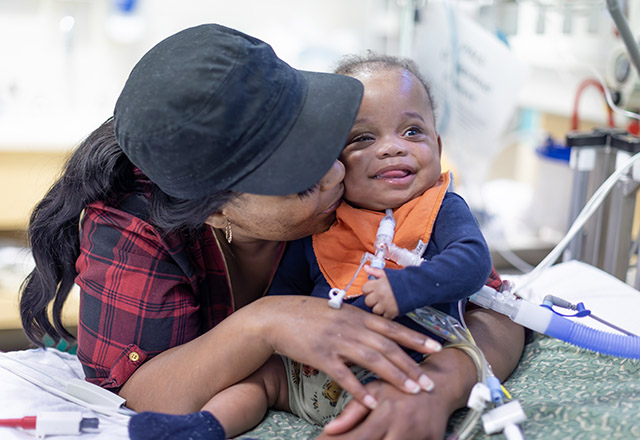
Jahleel, born prematurely at 24 weeks gestation, weighing 1 pound, 11 ounces, had a chronic lung disease called bronchopulmonary dysplasia. He received specialized care from the experts on the Esophageal and Airway Treatment team.
-
Esophageal Atresia: Wynter's Story
Diagnosed with an esophageal atresia, a condition where the esophagus is not connected properly the stomach, Wynter received care from Dr. Jason Smithers and the team in the Esophageal and Airway Treatment Program.