
The Chest Wall Deformity program at Johns Hopkins All Children's Hospital provides an innovative approach to the treatment of chest wall deformities, including pectus excavatum.
The Johns Hopkins All Children’s Chest Wall Deformity program diagnoses, evaluates and treats children with common and complex chest wall deformities, including pectus excavatum, pectus carinatum, slipping rib syndrome and congenital rib anomalies. Our surgeons use the latest surgical and care techniques and work closely with specialists across our hospital to provide patients and families with the highest quality of care.
Although chest wall deformities are fairly common, they can have a major impact on a child’s health. Whether the chest sinks in or protrudes out, the result can influence a child’s ability to breathe, exercise and even change how a child feels about his or her appearance. Our team is committed to our patients living a healthy and active lifestyle and provides each patient with the personalized care that best meets their needs.
Our Services
Our team offers surgical and non-surgical treatments tailored to our patients' needs and treats a wide range of chest wall deformities, including:
- Pectus excavatum: a sunken chest or funnel chest
- Pectus carinatum: the chest protrudes out
- Slipping rib syndrome: the cartilage on the lower ribs slips and moves
- Congenital rib anomalies: often associated with congenital deformities of the spine
- Jeune syndrome: the rib cage is smaller and narrower than usual
- Poland syndrome: the chest muscle is underdeveloped or absent
Why Choose Johns Hopkins All Children’s?
Our pediatric surgeons are trained in the latest treatments and offer:
- Advanced surgical experience. Our surgeons are leaders in the minimally invasive procedures used to treat some of the most complex chest wall deformities. Meet our team of pediatric general surgeons.
- Personalized care. Our surgeons take a whole-team approach to treating conditions. We work alongside specialists and subspecialists across our hospital, including cardiology, pulmonology, anesthesiology, pain management specialists and genetics, and are ready to meet a patient's needs all in one location.
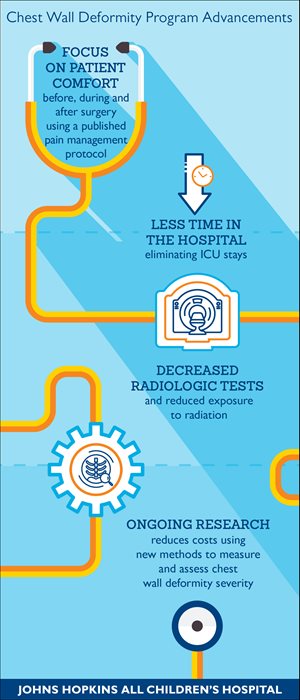
- An innovative approach to treatment. Our team is specially trained in minimally invasive procedures, such as the Nuss procedure, to repair some of the most complex deformities. We also use cryoablation, or freezing the nerves in the chest during surgery, which helps to decrease postoperative pain and discomfort.
- Multidisciplinary care. We work closely with the anesthesiology and pain management teams, radiologists, physical therapists and other specialists to provide your child with comprehensive care from diagnosis through recovery. We have access to additional pediatric specialists and subspecialists throughout our hospital and can provide a seamless transition for patients who need additional specialty care beyond our services.
- Excellent patient outcomes. Our team achieves a success rate that inspires families to travel hundreds of miles for care.
What to Expect
Chest wall conditions are typically diagnosed a clinic visit. We use special measurements taken externally during your child’s visit to determine the severity of the defect.
Patients are important members of their own care teams and it is important that your child is engaged in making the decision whether or not to pursue surgical correction.
Before surgery, your child may need some additional non-invasive testing before their operation, such as a CT or MRI of the chest, echocardiogram, or exercise pulmonary function test (which assesses lung function during physical activity).
Surgery for chest wall conditions is typically done during late adolescence once the majority of the child’s growth has slowed down. Recovery can take longer than other operations so often the patient’s surgery will be timed around longer school breaks (such as during the summer or a longer winter break).
Our team will guide you and your child through each step of the process. This includes your child’s pre-operative consultation, anything you need to do to prepare for your child’s surgery, and what to expect the day of. Learn more about what happens before and on the day of your child’s surgery.
We also offer a number of other resources and support services for families. Learn more about some of the resources available to your family.
After surgery, patients cannot participate in any strenuous activity, including sports, for about three months. Your child’s care team will discuss with you and your child what to expect during the recovery process.
Research and Publications
-
- Olbrecht VA, Nabaweesi R, Arnold MA, Chandler N, Chang DC, McIltrot KH, Abdullah F, Paidas CN, Colombani PM. Pectus bar repair of pectus excavatum in patients with connective tissue disease. J Pediatr Surg. 2009;44(9):1812-6. https://www.ncbi.nlm.nih.gov/pubmed/19735830
- Farach SM, Danielson PD, Chandler NM. The role of chest radiography following pectus bar removal. Pediatr Surg Int. 2016 Jul;32(7):705-8. https://www.ncbi.nlm.nih.gov/pubmed/27286887
- Litz CN, Farach SM, Fernandez AM, Elliott R, Dolan J, Nelson W, Walford NE, Snyder CW, Jacobs JP, Amankwah EK, Danielson PD, Chandler NM. Enhancing recovery after minimally invasive repair of pectus excavatum. Pediatr Surg Int 2017 Oct;33(10):1123-9. https://www.ncbi.nlm.nih.gov/pubmed/28852843
- Snyder CW, Farach SM, Litz CN, Danielson PD, Chandler NM. The modified percent depth: Another step toward quantifying severity of pectus excavatum without cross-sectional imaging. J Pediatr Surg 2017 Jul;52(7):1098-101. https://www.ncbi.nlm.nih.gov/pubmed/28189448
-
Oral/Podium
- Olbrecht VA, Arnold MA, Nabaweesi R, Chandler NM, Chang DC, McIltrot K, Abdullah F, Paidas CN, Colombani PM. Pectus Bar Repair of Pectus Excavatum In Patients With Connective Tissue Disease. American Academy of Pediatrics National Conference and Exhibition, San Francisco, California. October 26-30, 2007.
- Snyder CW, Danielson PD, Farach SM, Chandler NM. A Simple Caliper Measurement Technique to Quantify Severity of Pectus Excavatum. 10th Annual Academic Surgical Congress, Las Vegas, NV. February 3-4, 2015.
- Farach SM, Snyder CW, Danielson PD, Chandler NM. A simple caliper measurement technique to quantify severity of pectus excavatum. Talbert Lectureship, University of Florida, Gainesville, FL, March 2015.
- Litz CN, Farach SM, Snyder CW, Jacobs JP, Davis J, Amankwah EK, Danielson PD, Chandler NM. Practice variation in pectus excavatum repair within a single institution. 11th Annual Academic Surgical Congress, Jacksonville, FL. February 2-4, 2016.
- Litz CN, Fernandez A, Elliott R, Nelson W, Walford NE, Danielson PD, Chandler NM. Impact of a pain management protocol on outcomes after surgical repair of pectus excavatum. Talbert Lectureship, University of Florida, Gainesville, FL, March 25, 2016.
-
- Snyder CW, Danielson PD, Farach SM, Chandler NM. A simple caliper measurement technique to quantify severity of pectus excavatum. All Children’s Hospital 3nd Annual Research Seminar. St. Petersburg, FL, October 17, 2014.
- Litz CN, Farach SM, Danielson PD, Chandler NM. The role of chest radiography following pectus bar removal. 4th Annual All Children's Hospital Johns Hopkins Medicine Research Symposium. St. Petersburg, FL, October 16, 2015.
- Kauffman JD, Danielson PD, Chandler NM. Outcomes of Pectus Excavatum Repair Performed by Pediatric versus Non-pediatric Surgical Specialists. Southeastern Surgical Congress. Tampa, FL February 13, 2018.
Contact Us
Questions?
We know you want what's best for your child. We're ready to assist you with your questions. Call 727-767-4170.
Call toll-free 800-456-4543 , ext. 4170.

Request an Appointment