Research Lab Results
-
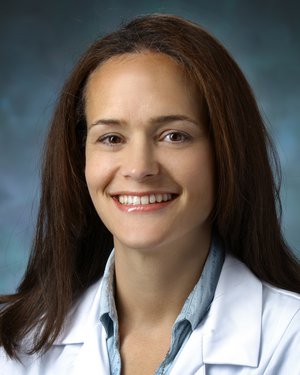
Vaninder Dhillon Lab
The Vaninder Dhillon Lab is currently researching 1) the role of voice outcomes in laryngeal dysplasia treated both in the operating room and clinic with the KTP laser; 2) Voice outcome pre and post thyroidectomy 3) Voice outcomes and technique in placement of Montgomery T tubes for subglottic and upper cervicotracheal stenosis.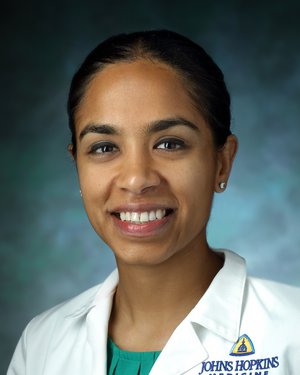
-
Krummey Lab
The Krummey Lab is a part of the Department of Pathology at the Johns Hopkins School of Medicine.
Our research prioritizes understanding the cellular mechanisms of alloimmunity, with a concentration on manipulating various cosignaling receptors and antigen recognition pathways to restrain the key lymphocytes principally involved in graft rejection. With the use of MHC tetramers, transgenic mouse models, and high-dimensional flow cytometry, we focus on mouse- and human-graft specific CD8+ T cells, CD4+ T cells, and B cells.
Transplantation is a life-saving procedure against a variety of diseases. Despite technical advances vastly improving early outcomes after transplant, long-term survival of transplanted organs has remained stagnant for the better part of three decades. A major cause of graft loss is immune-mediated rejection, which traditionally has be classified as acute or chronic based on its occurrence early or late after transplantation. Recently, this consensus has shifted to defining a graft rejection by its immunologic characteristics, either antibody-mediated or T cell-mediated (cellular rejection). This is because modern discoveries have identified the true major contributor to graft failures that occur many years after transplantation: not chronic rejection, but rather the cumulative impact of T cell-mediated acute rejection as a risk factor for later graft loss. Thus, original approaches to specifically prohibit and/or treat T cell-mediated acute rejection are of major significance for improving post-transplant outcomes.
HLA compatibility has also proven to be paramount for graft rejection. Originally, this was believed to be at the cellular level, then the single HLA protein level, and now at the epitope or molecular mismatch level. Specifically, HLA class II epitope-level mismatch has been identified as a risk factor for graft rejection, and multiple studies have identified specific epitopes within HLA class II peptides that are thought to be highly pathogenic. Few techniques directly measure antibody responses against specific regions of HLA proteins, but such measurements could provide both new information about the strength and character of alloimmunity and serve as an important new tool to study allogeneic B cells and antibody-secreting cells.

-
Karen Bandeen-Roche Lab
The Karen Bandeen-Roche Lab explores the application of underlying variable methods in epidemiologic and psychosocial research. Our team seeks to improve the ability to measure key outcomes like functional status and psychological disorders. Our other areas of statistical research include the study of classification and variance structure and multivariate survival analysis. We are deeply invested in the field of gerontology as well as ophthalmology and neurology.
-
Kristin Riekert Lab
Work in the Kristin Riekert Lab focuses on methods for improving health care quality and delivery, particularly among underserved and disadvantaged populations. Our research covers a range of important topics, including health beliefs, treatment adherence, doctor-patient communication, self-management interventions, mobile health initiatives, health disparities and patient-reported outcome methodology. We also work with the National Institutes of Health on multiple intervention trials focused on improving adherence and health outcomes in asthma, chronic kidney disease, cystic fibrosis (CF), sickle cell disease and secondhand smoke reduction.
-
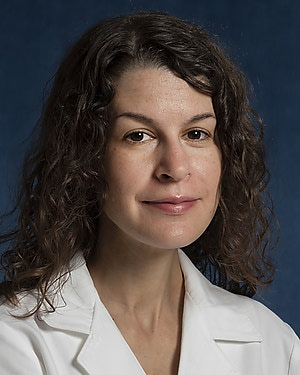
Lemberg Research Group
The mission of the Lemberg research group is to understand metabolism in childhood/young adult cancers in order to develop a better understanding of how these cancers develop, how they respond to treatments, and how children can go on to live healthy lives with or after a cancer history. We aim to investigate how tumors and the surrounding physiologic environments interact to drive nutrient use so that the tumor can grow and spread, and how the presence of a cancer affects the development of the whole child. Our ultimate goal is to improve outcomes for children and young adults with cancer.
-
Laboratory of Vestibular NeuroAdaptation
The Laboratory of Vestibular NeuroAdaptation investigates mechanisms of gaze stability in people with loss of vestibular sensation. A bulk of our research investigates motor learning in the vestibulo-ocular reflex (VOR) using different types of error signals. In addition, we investigate the synergistic relationship between the vestibular and saccadic oculomotor systems as trainable strategies for gaze stability. We are particularly interested in developing novel technologies to assess and deliver improved rehabilitation outcomes. We are validating a hand-held computer tablet for assessment of sensorimotor function and participating in a clinical trial comparing traditional vestibular rehabilitation against a device developed in our laboratory that can unilaterally or bilaterally strengthen the VOR. Members of the lab include physical therapists, physicians, engineers, statisticians and post-doctoral fellows. The laboratory is supported by generous grant funding from NASA, the NIH, the DOD and grateful patients -
Lisa Cooper Lab
The Lisa Cooper Lab is dedicated to researching patient-centered interventions for improving health outcomes and overcoming racial and ethnic disparities in health care. Our primary focus is on the factors of physician communication skills and cultural competence training, patient shared decision-making and self-management skills training. Recently, we have explored patient-centered depression care for African Americans, tactics for improving patient-physician communication about management of hypertension, and reducing ethnic and social disparities in health. In addition, we are currently researching racial disparities in cardiovascular health outcomes for patients living in Baltimore. -
Laura Hummers Lab
The Laura Hummers Lab participates in a number of clinical trials and clinical investigations at the Scleroderma Center at Johns Hopkins. We have a particular interest in the predictors of outcomes in scleroderma. We’ve established a prospective cohort of 300 scleroderma patients to identify incident vascular outcomes in the hopes of identifying new biomarkers for disease development and progression. -
Leucker Laboratory
The Leucker Laboratory is a translational cardiovascular research program dedicated to understanding the mechanisms underlying residual atherosclerotic cardiovascular disease risk and developing innovative strategies for cardiovascular prevention. Our work integrates human vascular biology, advanced cardiovascular imaging, epidemiology, and clinical trials to uncover the pathways linking inflammation, lipoproteins, endothelial dysfunction, and cardiometabolic disease to cardiovascular outcomes.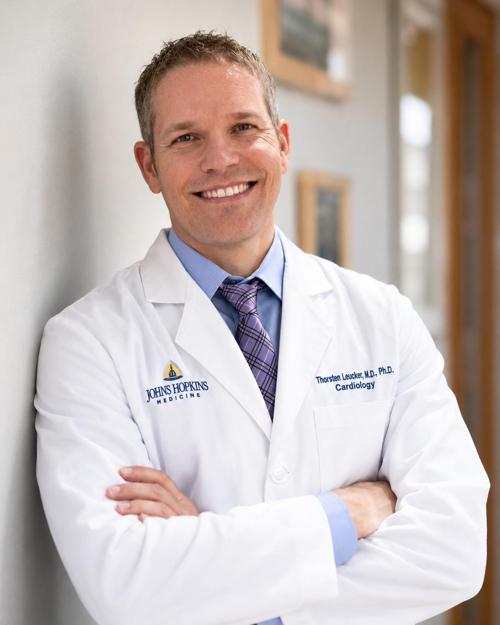
Principal Investigator
-
Nadia Hansel Lab
Research in the Nadia Hansel Lab investigates the clinical, pathophysiologic and public health aspects of pulmonary diseases, with a focus on asthma and chronic obstructive pulmonary disease (COPD). We have explored how environmental exposures, nutrition and diet, comorbidity and other factors influence the outcomes of diseases such as asthma and COPD.