Research Lab Results
-
Alain Labrique Lab
The Alain Labrique Lab conducts research on infectious diseases and public health. Our team studies the various factors that lead to maternal and neonatal mortality, particularly in underserved populations in South Asia, using the tools of infectious disease epidemiology, molecular biology and biostatistics. We work to better understand factors such as the interface of micronutrient deficiency and maternal/infant mortality and the prevention of nosocomial infections through mechanistic or nutritional interventions. We also have a longstanding interest in technologies that may enable early detection of disease.
Principal Investigator
-
James Knierim Laboratory
Research in the James Knierim Laboratory attempts to understand the flow of information through the hippocampal formation and the computations performed by the various subfields of the hippocampus and its inputs from the entorhinal cortex. To address these issues, we use multi-electrode arrays to record the extracellular action potentials from scores of well-isolated hippocampal neurons in freely moving rats. These neurons, or ""place cells,"" are selectively active when the rat occupies restricted locations in its environment and help to form a cognitive map of the environment. The animal uses this map to navigate efficiently in its environment and to learn and remember important locations. These cells are thought to play a major role in the formation of episodic (autobiographical) memories. Place cells thus constitute a tremendous opportunity to investigate the mechanisms by which the brain transforms sensory input into an internal, cognitive representation of the world and then uses this representation as the framework that organizes and stores memories of past events.
-
Jeremy Sugarman Lab
Research in the Jeremy Sugarman Lab focuses on biomedical ethics—particularly, the application of empirical methods and evidence-based standards to the evaluation and analysis of bioethical issues. Our contributions to medical ethics and health policy include work on the ethics of informed consent, umbilical cord blood banking, stem cell research, international HIV prevention research, global health and research oversight. -
Cardio-Obstetrics Research
Under the division of Maternal-Fetal Medicine, our Cardio-Obstetric research efforts seek to advance the field of gynecology through medical care and innovation. With a focus on the effect of heart conditions on pregnancy and the ways in which pregnancy can put stress on your heart and circulatory system, our goal in this multi-disciplinary research is that our findings may lead to the development of new treatments or preventative therapies for patients and their babies to better manage a heart condition during pregnancy. -
Cardiology Bioengineering Laboratory
The Cardiology Bioengineering Laboratory, located in the Johns Hopkins Hospital, focuses on the applications of advanced imaging techniques for arrhythmia management. The primary limitation of current fluoroscopy-guided techniques for ablation of cardiac arrhythmia is the inability to visualize soft tissues and 3-dimensional anatomic relationships. Implementation of alternative advanced modalities has the potential to improve complex ablation procedures by guiding catheter placement, visualizing abnormal scar tissue, reducing procedural time devoted to mapping, and eliminating patient and operator exposure to radiation. Active projects include • Physiological differences between isolated hearts in ventricular fibrillation and pulseless electrical activity • Successful ablation sites in ischemic ventricular tachycardia in a porcine model and the correlation to magnetic resonance imaging (MRI) • MRI-guided radiofrequency ablation of canine atrial fibrillation, and diagnosis and intervention for arrhythmias • Physiological and metabolic effects of interruptions in chest compressions during cardiopulmonary resuscitation Henry Halperin, MD, is co-director of the Johns Hopkins Imaging Institute of Excellence and a professor of medicine, radiology and biomedical engineering. Menekhem M. Zviman, PhD is the laboratory manager. -
Deborah Schwengel Lab
Research in the Deborah Schwengel Lab focuses on perioperative care of pediatric patients with obstructive sleep apnea as well as anesthetic care for patients undergoing ethanol embolization of vascular malformations. Our team also explores topics within graduate medical education. In this field, our work has involved evaluating both an educational curriculum and a disaster preparedness curriculum for anesthesiology residents. We also have a long-standing interest in international adoption medicine.
Principal Investigator
Department
-
Eberhart, Rodriguez and Raabe Lab
Utilizing a combination of tissue-based, cell-based, and molecular approaches, our research goals focus on abnormal telomere biology as it relates to cancer initiation and tumor progression, with a particular interest in the Alternative Lengthening of Telomeres (ALT) phenotype. In addition, our laboratories focus on cancer biomarker discovery and validation with the ultimate aim to utilize these novel tissue-based biomarkers to improve individualized prevention, detection, and treatment strategies. -
Eberhart, Rodriguez and Raabe Lab
Utilizing a combination of tissue-based, cell-based, and molecular approaches, our research goals focus on abnormal telomere biology as it relates to cancer initiation and tumor progression, with a particular interest in the Alternative Lengthening of Telomeres (ALT) phenotype. In addition, our laboratories focus on cancer biomarker discovery and validation with the ultimate aim to utilize these novel tissue-based biomarkers to improve individualized prevention, detection, and treatment strategies. -
Zachariah Foda Lab
The Foda lab conducts basic, translational, and clinical research on the early detection, prevention, and interception of gastrointestinal cancers. In collaboration with the other member of the Johns Hopkins Cancer Genomics Lab (https://cancergenomicslab.com/), the group develops and applies whole-genome sequencing-based liquid biopsy methods for the early detection and monitoring of gastrointestinal cancers. These approaches are tested and validated in large multi-national cohorts through international collaborations. Dr. Foda directs the Johns Hopkins Hereditary Colorectal Cancer Registry, which facilitates clinical research related to Familial Adenomatous Polyposis, Lynch syndrome, and other hereditary polyposis conditions.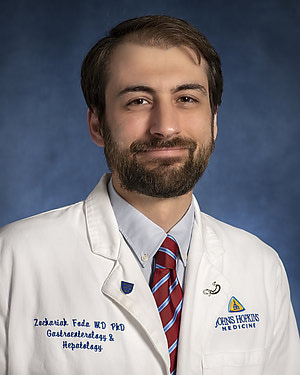
-
Zackary Berger Lab
The research mission of the Zackary Berger Lab is to bridge evidence-based medicine and shared decision-making in the context of patient-centered care. Lab studies investigate how to accomplish this in the common case of uncertainty, while seeking to clarify the ethics of decision-making and empirically describe how shared decision-making is and should be done. Zackary Berger, MD, PhD, is an assistant professor in the Division of General Internal Medicine at the Johns Hopkins School of Medicine. In addition to his work as an internist and primary care physician, Dr. Berger is an associate faculty member in the Berman Institute of Bioethics, and core faculty in the Evidence Based Practice Center as well as the Center for Health Services and Outcomes Research.