
Reminiscences of 14 Years as Director
1989–2003
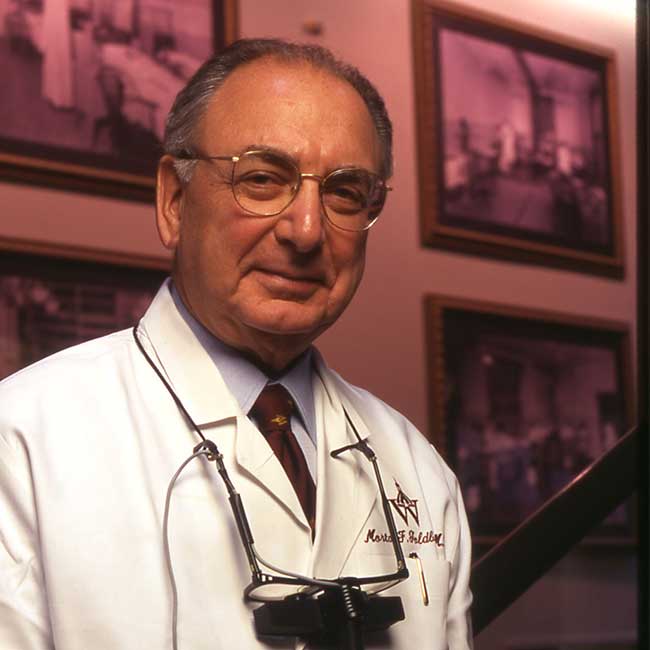
Morton F. Goldberg
In 1970, after completing my residency and serving as chief resident at both the Wilmer Eye Institute and Yale University, I joined the University of Illinois, where I spent 19 happy and productive years as a professor and chairman of the ophthalmology department. Despite my wonderfully gratifying experience in Chicago, the allure of the Wilmer directorship proved irresistible. Accepting an invitation from the Johns Hopkins dean and hospital president, I returned to my dear alma mater in 1989 for an action-packed and fulfilling 14 years.
Upon arriving at Wilmer, I experienced a series of unforeseen challenges that quickly became a “trial by ordeal.” Medicare and other insurers stopped reimbursing for overnight stays for eye surgeries, cutting our hospital income and compromising residents’ daily inpatient education. Moreover, managed care companies diverted patients to lower-cost practitioners, reducing patient volumes and reimbursements even further. Several senior surgeons left, taking their lucrative practices and creating a $2 million deficit in the Wilmer practice plan. The promised $5 million for a building expansion was pulled, forcing me to threaten immediate resignation to secure the funds. Then, during construction of two new Maumenee Building floors, a leaky roof caused water damage to brand new ceiling-mounted operating microscopes, with torrents cascading downward inside the ocular lenses’ support pieces. What a sight!
In 1990, we were in deficit mode. To stabilize the department and restore financial stability and faculty enthusiasm, a comprehensive strategic plan was needed that would expand patient volumes, cut costs, improve information systems, recruit additional faculty, raise private donations and complete numerous renovations.
To help reverse the tide, I hired a terrific chief financial officer, a billing/collections expert, an extraordinary development officer and an experienced departmental administrator. A full-court press ensued to reduce the number of personnel and programs, yet at the same time create new dollars from every conceivable private and public source. Although the cost-cutting measures were exquisitely painful, they were necessary for survival and, eventually, major new growth. With faculty support, the plan succeeded.
To generate new income, the faculty and I applied for many research grants. Soon, Wilmer had more major research grants than any ophthalmology department in the country. Individual philanthropic gifts also skyrocketed, enabling support of new programs and recruitments and renovations designed to attract new patients and increase faculty hires.
These efforts led to a turnaround of $2.7 million within two years. Between 1989 and 2003, fundraising activities resulted in 20 new endowed professorships and numerous large private gifts, increasing Wilmer’s endowment from $21 million to over $110 million and solidifying our financial stability and global reputation.
In the early to mid-1990s, with the two new floors in the Maumenee Building completed, we began to modernize all other patient areas and consolidate nursing units. Wilmer at Green Spring Station, with its ultramodern surgicenter (the first at Johns Hopkins), opened in 1994 and was followed by several other Wilmer satellites throughout Maryland. The Wilmer dome was transformed into a museum featuring the original examining chair that Dr. Wilmer used to care for eight U.S. presidents. By 1999, Wilmer had outgrown these expansions, and I was pleased to work with Dr. McDonnell to help build the spectacular Smith Building, containing both laboratory and surgical facilities.
Wilmer faculty earned numerous prestigious awards during this period, including the Lucien Howe Medal in Ophthalmology, the Helen Keller Prize for Vision Research and the Lasker Award. Many faculty members served as presidents of major national and international ophthalmic organizations, and several became chief editors of leading journals. Wilmer consistently ranked as the top U.S. eye department, earning recognition from Ophthalmology Times, U.S. News & World Report and others. Our peerless residency system continued its highly successful educational programs, and our residents continued to assume chairmanships of ophthalmology departments and medical deanships at more than 100 institutions.
Throughout my directorship, I was privileged to work with a dedicated team of highly skilled faculty and a superlative administrative, support and technical staff. Wilmer’s nurses deserve special recognition for their pivotal role in providing expert clinical care and in training residents in the intricacies of modern eye surgery. In addition, my wife, Myrna, provided invaluable advice, particularly in assessing residents and faculty members with uncanny insight.
The year 2000 marked Wilmer’s 75th anniversary, a milestone celebrated with record-breaking achievements. Wilmer secured more grant money for eye research than any other department globally, performed 11,000-plus laser surgeries, realized a 90% increase in major surgical procedures and provided outpatient care for over 110,000 people. These accomplishments led Florida Congressman Cliff Stearns to commemorate our achievements in the Congressional Record on Nov. 1, 2001.
Our 75th anniversary theme, “Expectation of Greatness,” epitomized Wilmer’s ethos and mission for the immediate and long-term future.