

Research Training Program
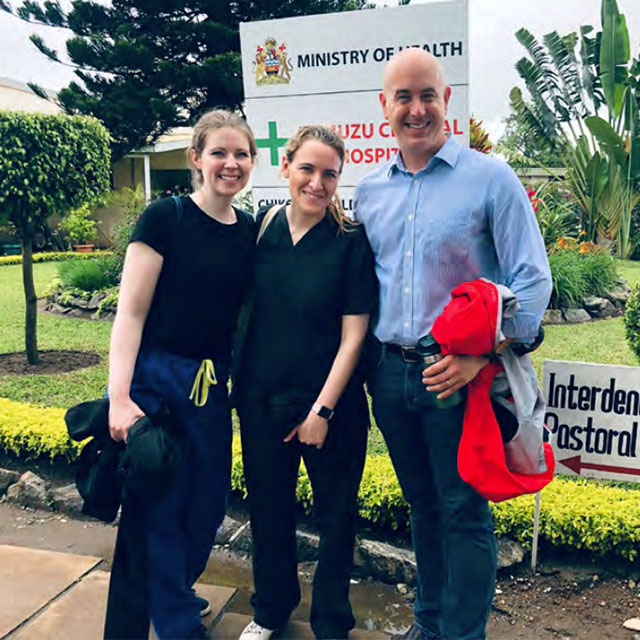
Eric McCollum with physicians Brittany Hunter and Chiara Bertolaso at Kamuzu Central Hospital in Lilongwe, Malawi.
Our fellowship program affords the opportunity to participate in clinical, translational, or basic science research. We also provide unique opportunities for projects in ethics, public health, and advocacy, as well as a pediatric pulmonary global health program with international sites. Prior research experience is not required. Our program is poised to provide resources and mentorship to undertake successful research projects to advance the field of respiratory sciences, regardless of the fellow’s previous research experience.
Year 1
Though some fellows enter the program with well-defined research interests and goals, most fellows are undecided about their desired research. In their first year, fellows participate in a Research Orientation Program to select a mentor and identify a research focus. Research mentors include members of the pediatric pulmonary faculty and faculty from other divisions, as appropriate for the project. The fellow will meet with 3-4 potential mentors in the late summer and early fall of the first year, typically spending one to two weeks with each potential mentor to become acquainted with the research team/environment, discuss potential research projects in more detail, and perhaps even assist with an ongoing project. By mid-fall, most fellows have chosen their primary mentor and by December, have selected a specific research project. Typically, fellows meet with their research mentors weekly.
Year 2
Fellows continue to work on their research project, including obtaining data and presenting preliminary results. With their primary mentor, fellows are also encouraged to identify secondary mentors inside and outside the division to provide complementary expertise for their project.
Year 3
To meet ACGME requirements for scholarly activity, fellows typically submit one or more first-authored papers during their fellowship and present their research as a poster or oral presentation at one or more national meetings.
Public Health Training
All fellows take two quarters of Biostatistics in their 2nd year of fellowship and one quarter of Epidemiology during their 3rd year of fellowship. Fellows seeking additional training have the opportunity to complete the Masters of Health Science (MHS) degree offered through the Johns Hopkins’ Graduate Training Program in Clinical Investigation (GTPCI) in their 3rd year of fellowship. All offerings are at no cost to fellows. Requirements are waived for fellows with an M.P.H. or similar degree. All fellows also have access to free biostatistics and epidemiology support for their research projects through the School of Public Health.