

Educational Program
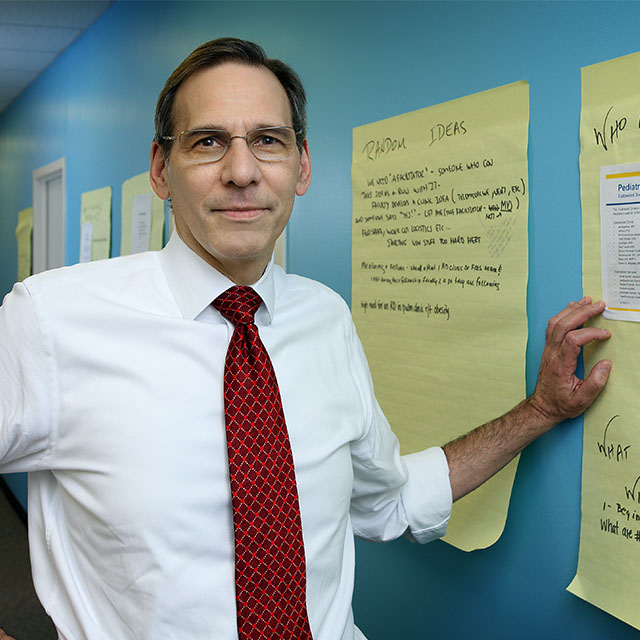
Dr. Peter Mogayzel in the CF clinic.
Our educational program draws on the depth of resources available at Johns Hopkins to provide personalized learning to meet the fellow’s needs. The educational program provides clinical and research expertise through a combination of didactics, interactive learning experiences, and individual mentorship.
- 1st Year Fellow Orientation: During the first month of fellowship, orientation lectures are provided by pediatric and adult pulmonary faculty. The series introduces fellows to key topics in pulmonary medicine and science.
- Clinical and Career Mentorship: Each fellow chooses their own clinical mentor in the Pulmonary Division to provide advice concerning research and clinical activities, career development, and networking. It should be emphasized that all of our faculty are happy to provide advice at any time.
- Simulation Center: Johns Hopkins has a state-of-the-art simulation center that is fully equipped with patient rooms and operating rooms in which pulmonary procedures, including virtual bronchoscopy, can be performed.
- Weekly Division Conference: The Division holds a weekly fellow-led educational conference, which is a venue for fellows, faculty, and guest speakers to present clinical topics and research findings. Fellows typically present their research progress once a year in this forum.
- Weekly Board Review for Clinical Fellows: A faculty member leads this interactive session with the fellows. Topics include pediatric pulmonology board questions, respiratory physiology, ethics, research methodology, the business of medicine, and career development.
- Monthly Radiology Rounds for Clinical Fellows: Fellows rotate in presenting 2-3 interesting cases to fellows and faculty to review the pertinent imaging findings.
- Annual National Scientific Meeting: All fellows are encouraged to attend one national scientific meeting/year during each of their three years of fellowship (e.g. American Thoracic Society, North America Cystic Fibrosis Foundation, etc.) funded by the Division. Fellows are encouraged to submit abstracts for posters and presentations.
- Personalized Training: Fellows also have additional opportunities to personalize their education with support from the division. Past fellows have undertaken teaching fellowships and ethics fellowships during their third year. Other elective coursework through the Johns Hopkins School of Public Health may be available for interested fellows at no cost to fellows through tuition remission.
- Teaching: Fellows have ample opportunities to teach medical students and pediatric residents both in formal (noon conferences and teaching sessions) and informal settings (bedside rounds). Fellows are encouraged to develop a teaching portfolio during their fellowship.
- Quality Improvement: As part of ACGME requirements, each clinical fellow must participate in a quality improvement (QI) project. Typically, fellows receive training in QI and participate in the annual Division QI project once during their fellowship.
- Additional Resources: Fellows have online and in-person access to the Johns Hopkins library system with access to information specialists. A library of pulmonary textbooks is available in the fellows’ office. Fellows also have access to the Biostatics, Epidemiology and Data Management (BEAD) Core services.