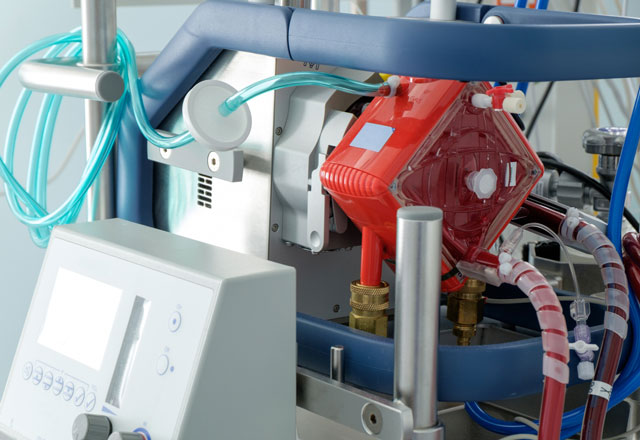
The Hopkins Education and Research for the Advancement of Life Support Devices (HERALD) Team, led by Dr. Glenn Whitman from the Division of Cardiac Surgery and Dr. Sung-Min Cho, an expert in NeuroCritical Care, is a multidisciplinary research team dedicated to enhancing outcomes for patients on ECMO (Extracorporeal Membrane Oxygenation) and other advanced life support devices. Our team comprises a diverse group of experts, including medical students, residents, clinical and research fellows, intensivists, cardiovascular surgeons, pulmonologists, perfusionists, biomedical engineers, and data scientists, each bringing unique expertise and perspectives. The primary objective of our research is to address critical clinical questions and develop innovative strategies that can be seamlessly integrated into personalized patient care protocols. By generating impactful findings, we aim to advance the field of extracorporeal support, ultimately improving patient survival rates and quality of life.
Our Team
Glenn J. R. Whitman, MD
Glenn Whitman, M.D., joined the Johns Hopkins Division of Cardiac Surgery in 2009 as associate professor of surgery. Dr. Whitman’s initial research interests were in cardiac ischemia-reperfusion injury and P31 nuclear magnetic resonance of cardiac bioenergetics, for which he received both National Institutes of Health and Department of Veterans Affairs funding. He has since become involved with quality outcome, and has presented at the American College of Surgeons and the Society of Thoracic Surgeons on the difficulties associated with performance improvement and quality assurance in the field of health care, particularly in the ICU.

Sung-Min Cho, DO, MHS
Dr. Sung-Min Cho joined the Johns Hopkins Division of Neuroscience Critical Care in 2019 as a faculty. Dr. Cho's research interests include neurologic outcomes in intracerebral hemorrhage, subarachnoid hemorrhage, ischemic stroke, cardiac arrest, infective endocarditis, cardiac surgery, and mechanical circulatory support devices such as LVAD and ECMO.

Core Team Members
- Trish Brown, RD-AP, Data Analyst for the HERALD Program
- Diane Alejo, Senior Manager of Cardiac Surgery IT
- Yaman Bilal Ahmad, MD, Postdoctoral Research Fellow
- Mingfeng Cao, MS, PhD Candidate
- Mike Wang, MS, Research Assistant
- Zoe Soule, MS, Research Assistant
- Hyun Yi (Jacqualine) Woo, MD, MPH, Postdoctoral Research Fellow
- Xiaoyan Zhu, MD, Professor
HERALD Team Members
-
- Daniel Brodie, MD
- Errol L. Bush, MD
- R. Scott Stephens, MD
- Steve Keller, MD PhD, MPhil
- Bo Kim, MD
- Marc Sussman, MD
- Christopher Wilcox, MD
-
- Leon Fan
- Amy Feng
- Andrew Kalra
- Holly Liu
- Winnie Liu
- Ernesto Marino
- Alessandro Ascani Orsini
- Logan Perkins
- Beichen Shen
- Sukethram Sivakumar
- Tony Zhu
-
- Albert Leng
- Andrew Geeza
- Arjun Kumar Menta
- Armaan F. Akbar
- Benjamin L. Shou, MD
- David Hager, MD, PhD
- David Zhao
- Hannah J. Rando, MD
- Harry Flaster, MD
- Ifeanyi David Chinedozi, MD, MBA
- Jaeho Hwang, MD
- Jiah Kim, MD
- Jin Kook Kang, MD
- Karlo Capili
- Pedro Alejandro Mendez-Tellez, MD
- Philip Sun, MD
- Ramon Riojas, MD
- Shivalika Khanduja, MBBS
- Shrey Kapoor
- Chengyuan Alex Feng, MD, PhD
- Zachary Darby, MD
HERALD Highlights


Ongoing Clinical Research
-
Main Goal: This study aims to understand how rapid changes in carbon dioxide levels during the first day of ECMO support affect the brain. Sudden drops in CO₂ can alter blood flow and oxygen delivery to the brain, potentially leading to acute brain injury. Using low-field portable MRI at the bedside, combined with daily blood tests for brain injury biomarkers, and cerebral blood flow monitoring, we will look for both visible and hidden brain injuries in the first 72 hours after ECMO starts. The goal is to identify safe thresholds for CO₂ changes and improve long-term neurological outcomes for patients on ECMO.
-
Main Goal: This study will investigate whether a simple, noninvasive eye exam using automated infrared pupillometry can help predict brain injury and recovery in ECMO patients. By measuring the Neurological Pupil index (NPi) every four hours during the first week of ECMO, we aim to detect early signs of neurological problems and link these findings to patient outcomes at discharge. The goal is to give clinicians a reliable bedside tool to spot brain injury sooner and guide care decisions.
-
Main Goal: This multicenter study evaluated the safety and diagnostic value of using an ultra–low-field (0.064T) portable MRI scanner at the bedside to detect acute brain injury (ABI) in patients receiving ECMO. Fifty patients were successfully scanned in the ICU without major safety concerns, with only 3 adverse events (two minor, one serious). Portable MRI identified ABIs in 44% of patients—most commonly ischemic strokes—and was more sensitive than head CT for detecting ischemic injury. These findings show that portable MRI can be safely integrated into neuromonitoring protocols, enabling earlier and more accurate ABI diagnosis without the risks of transporting critically ill ECMO patients.
-
Main Goal: This study will use a portable MRI machine at the bedside to look for small, hidden strokes in patients after heart surgery. These strokes often go unnoticed but can affect recovery and long-term brain health. Portable MRI makes it possible to scan patients safely without moving them out of the ICU. By combining these scans with checks for confusion or delirium, we aim to learn how often these strokes happen and how they might impact thinking and recovery after surgery.
-
Main Goal: In collaboration with the ASPIRE Lab, the proposed research seeks to establish the technical foundation of an advanced life support system capable of
- automated resuscitation of active hemorrhage and
- delivery and closed loop control of respiratory support via a novel extracorporeal gas exchange system.
The immediate goal of this project is to develop the following core components of the advanced life support system to enable future miniaturization and complete system prototype construction.
-
Main Goal: The purpose of this study is to develop pioneering technology and test its clinical impact in a pilot study: to develop a patient specific, minute to minute continuous assessment of EETOTAL using VO2 and VCO2 measurement from both the ventilator and the ECMO circuit to be displayed at the bedside in real time for nutrition assessment.
-
Main Goals: This proposed study aims to link acute brain injury (ABI) to behavior, specifically disorders of consciousness (DoC), through multisensor technology, long-term monitoring using cutting-edge integrated circuits and devices, and novel analytical algorithms. We propose to advance an innovative in-ear multisensor monitoring platform that unobtrusively captures critical brain, cardiac, and metabolic activities. This platform will leverage cortico-temporal auricular activity from the ear canal and adjacent auricular structures, as well as electrocardiography recorded using integrated sensors and ultra-low-power electronic circuits.
-
In collaboration with Samsung Medical Center and Korea University, we have a multicenter REDCap database to track key clinical, laboratory, and imaging markers in patients receiving ECMO. The goal is to harmonize data collection across centers, enable large-scale analyses, and advance understanding of patient outcomes in ECMO care.
-
This platform is a comprehensive database of ICU patients designed to power cutting-edge research and improve critical care. It integrates clinical data with AI and machine learning models to predict patient outcomes, enabling earlier interventions and personalized treatment strategies. By combining expertise from medicine, engineering, and data science, the platform supports a multidisciplinary AI pipeline for continuous ICU monitoring, advanced analytics, and innovative outcomes research.
Patient Resources