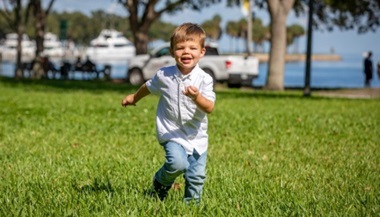
Patient Story
Epilepsy: Sydney’s Story
Pediatric Care in Florida

Patient Story Highlights
- As an infant, Sydney had up to 50 epileptic seizures a day.
- At 16 months, her seizures started to become more severe.
- The medical team at Johns Hopkins All Children’s Hospital pinpointed where in Sydney’s brain the seizures originated.
- A neurosurgeon removed the abnormal tissue, and she recently celebrated five years with no seizures.
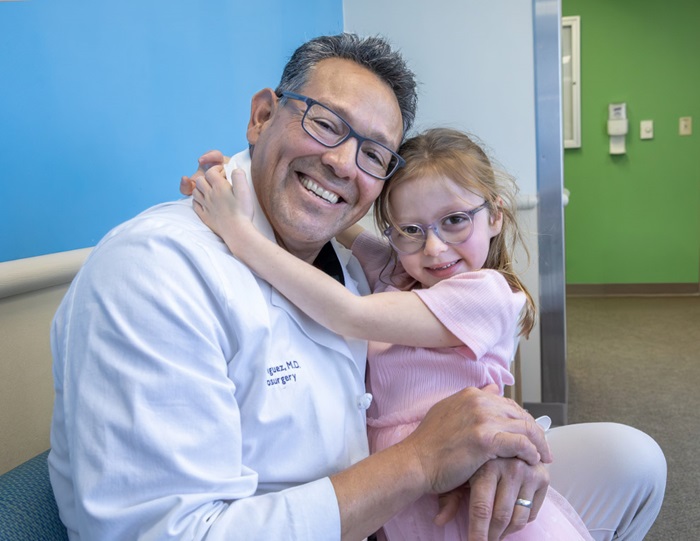
As Ansley and her twin daughters Sydney and Savannah walk into the Hough Family Institute for Brain Protection Sciences, Ansley has butterflies in her stomach. She has lived through so many emotions inside Johns Hopkins All Children’s Hospital in St. Petersburg, Florida, from heartbreak to hope to gratitude. Then comes a moment five years in the making. “Hi, Sydney!” Luis Rodriguez, M.D., M.A.S., says with excitement. He instantly bends on one knee to give the 6-year-old a hug. For Ansley, it’s a milestone moment. Sydney has just reached five years seizure-free, and she’s reuniting with one of the doctors who transformed her life.
“I truly believe Sydney is living her best life because of this wonderful doctor, Dr. Rodriguez, who gave her that opportunity,” Ansley says pushing back tears.
Sydney’s First Seizures
Sydney was just 4 months old when she started having epileptic seizures. Six months later, those seizures were happening between 20 and 50 times a day. Clinical leaders at another hospital recommended transferring Sydney to Johns Hopkins All Children’s where specialists might be able to pinpoint what was causing the seizures and focus on solutions.
“By that point, Sydney had already failed three or four medications,” Ansley remembers. “No medication seemed to be working for her.”
By January 2021, when Sydney was 16 months old, her seizures started becoming more severe, and Ansley made another appointment at Johns Hopkins All Children’s, which yielded some very important information. An EEG (electroencephalogram) diagnostic test, which measures and records the brain’s electrical activity, showed which portion of the brain Sydney’s seizures were coming from.
An MRI detected the seizures were likely a result of frontal cortical dysplasia. “What we look for are subtle little changes,” Rodriguez says. “In Sydney’s case, the MRI showed a small and subtle U-shaped lesion that correlated with the types of seizures she was having.”
From there, a large team of neurologists and neurosurgeons met in an epilepsy conference to determine the next steps.
A Surgical Solution
Ansley will never forget the two words she heard next: brain surgery. For most parents, it’s a scary thought ... but Ansley felt different.
“It was honestly the biggest relief to hear that my daughter was going to have brain surgery,” she explains. “I know that's so scary to think of, but at that moment, she wasn't living life, you know? She was having 30-minute seizures, two-minute seizures, her seizures were all over the place. So, when I had my first consultation with Dr. Rodriguez, I remember him saying after this surgery, her seizures could drop to one, and I started crying because I was like, ‘One a month?’ In my head that sounded like a major relief. He replied back, ‘No, one a year. Maybe less.’ It didn’t even cross my mind to think that was possible.”
“I’m in,” she remembers telling Rodriguez.
Rodriguez discussed the surgery with Ansley and her husband, DJ, answering all their questions. “He was so caring and respectful and gave us every reason to trust him with our daughter’s life,” Ansley remembers.
During the surgery, Rodriguez and his team used a computer navigation system to pinpoint the abnormal tissue, and electrophysiology, which acts as a neurosurgical GPS that monitors and maps the brain’s electrical signals in real time, helping them protect critical functions of the brain.
“It’s a very careful and delicate procedure because that's an important area of the brain, which carries motor function,” Rodriguez explains. “We must remove the abnormal tissue without impacting the parts of the brain that control so much of our body.”
Pathology results from Sydney’s surgery showed she had cortical dysplasia, a congenital brain abnormity where neurons in the cerebral cortex fail to develop and organize properly. It is the leading cause of hard-to-treat epilepsy in both children and adults.
Rodriguez says the surgery went perfectly. The next step would be the most important: seeing if the seizures stopped.
“With the condition Sydney had and the EEG, MRI and PET scan all pointing to the same lesion, the likelihood that she would be completely seizure-free was probably about 70%,” Rodriguez explains. “When you have a patient with a solid tumor or really well-defined lesion, the chance of rendering them seizure-free is 80% to 90%.”
Sydney ended up with the best possible outcome. She hasn’t had a single seizure since her surgery.
“I remember the day after her surgery, thinking this is the first full 24 hours that we have gone without a seizure in 13 months! I felt so emotional and like I could finally breathe,” Ansley says.
Sharing Their Journey
Ansley had first started sharing her parenting journey on social media, focusing on challenges and successes with infertility. When she learned she was pregnant with twins, her followers on Instagram rejoiced alongside her. Then, came the posts about Sydney’s seizures, surgery and recovery. She heard from other parents of children facing similar uphill battles.
“I was in mama bear mode thinking we must fight this,” Ansley says. “We must find out what's wrong. Along the way, other moms reached out to me and said, ‘Listen, my child has this too, and I've seen your stories and they’re helping me.’ That made me feel so good.”
She hopes to inspire other families to never give up hope.
Letting Twins Be Twins
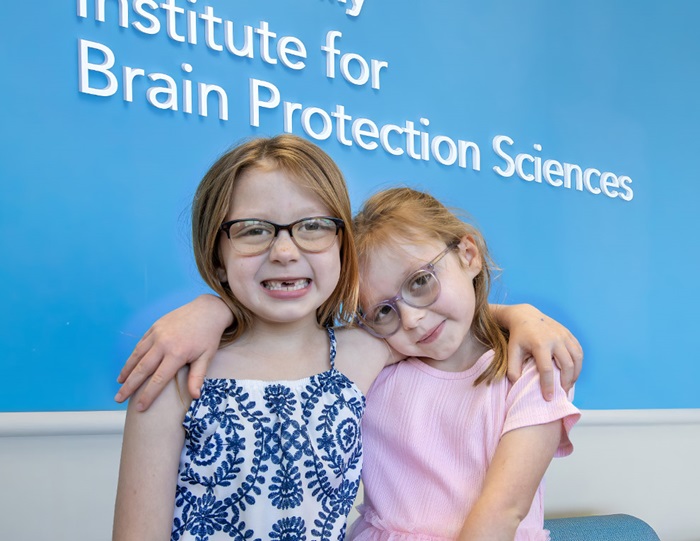
Ansley says the best thing about Sydney marking five years seizure free is watching her girls be together.
“When Sydney was sick, Savannah would put her forehead up to her sister’s as a way to remind her she wasn’t alone,” Ansley says with a smile.
Now, the girls can hardly sit still. They’re doing cartwheels, skipping and riding bikes. To celebrate Sydney’s five-year milestone, the family visited Universal Orlando Resort complete with Harry Potter themed outfits.
“Celebrating five years seizure free is like celebrating her rebirth. All you can want for your children at the end of the day, is for them to be happy and to know they are loved,” Ansley says through tears. “Sydney is going to drive a car one day. She's going to prom. That’s the biggest gift I’ve ever been given as a mom, and I’m just so grateful for the medical team who made that possible.”
A Well-Deserved Hug
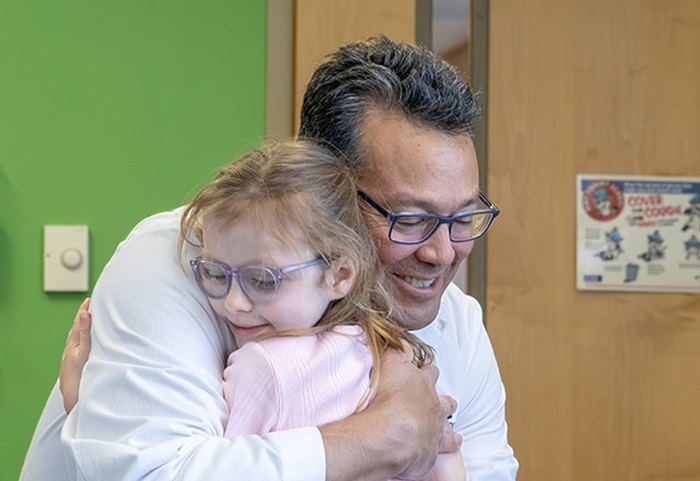
At the end of Sydney’s reunion with Rodriguez, the 6-year-old ran full speed at Rodriguez, jumping into his arms in the biggest, tightest hug you can imagine. The room erupted in giggles.
“I’m so humbled at this moment,” Rodriguez says with the biggest, brightest smile. “Boy, is it good to see you, Sydney.”
Sydney's Surgeon
Luis Felipe Rodriguez, MD MAS
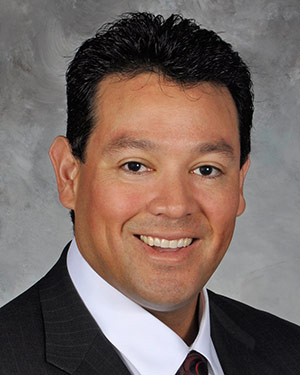
Expertise: Pediatric Neurosurgery
Primary Location: Johns Hopkins All Children's Outpatient Care, St. Petersburg, Saint Petersburg, FL
Treatment Pediatric Neurosurgery at Johns Hopkins All Children's
The team at Johns Hopkins All Children's Hospital in St. Petersburg, Florida, understands that children are not just miniature adults. They have their own unique physiology and problems. Pediatric neurosurgery is exclusively practiced by approximately 300 surgeons in the United States. Board certification in pediatric neurosurgery requires additional training and certification above that required for certification in general neurosurgery (adult and pediatric). We partner closely with neurology, neuro-oncology, neuropsychology, hematology and radiology.