
For Health Care Professionals
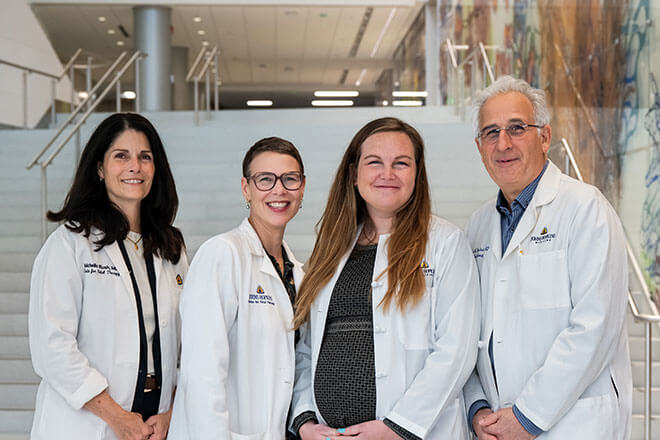
At the Johns Hopkins Center for Fetal Therapy, we offer rapid access to subspecialty consultation and advanced in-utero procedures for complex fetal conditions.
Our physicians collaborate closely with referring colleagues to deliver individualized care for mothers and babies with a suspected or confirmed complex fetal conditions. Whether through consultation or co-management, we provide the most advanced fetal therapies available—supported by multidisciplinary expertise, leading research, and continuous outcomes review that define our program.
Intervention Criteria
-
- Severe left CDH – observed to expected lung/head ratio <30%
- Severe right CDH – observed to expected lung/head ratio <45%
Gestational age:
- FETO at 27-29 weeks; balloon removal by 35 weeks’ gestation
Outcomes:
Additional information:
-
- For suspected fetal anemia with elevated MCA PSV
- Fetal hydrops
- Stage II-IV Twin anemia polycythemia sequence (TAPS)
Gestational age:
- 16-35 weeks’ gestation
Outcomes:
Additional information:
-
- For stage I-IV Twin–Twin Transfusion Syndrome (TAPS)
- Stage II-IV Twin Anemia Polycythemia sequence (TAPS)
Gestational age:
- 16-28 weeks’ gestation
Outcomes:
Additional information:
-
- Isolated MMC T-1 to S-1
- Hindbrain herniation
Gestational age:
- 22-26 weeks’ gestation
Outcomes:
-
- Critical aortic stenosis with preserved left ventricular function
Gestational age:
- 22-30 weeks’ gestation
-
- Lower urinary tract obstruction with preserved renal function and progressive oligohydramnios
- Fetal hydrothorax
- Severe fetal cystic lung malformations
Gestational age:
- 22-32 weeks’ gestation
-
- Anhydramnios due to early gestational fetal renal disease or renal agenesis
Gestational age:
- 22-32 weeks’ gestation
Outcomes:
-
- Fetal VOG at high risk for fetal or neonatal decompensation
- No brain parenchymal damage
Gestational age:
- 26 - 34 weeks’ gestation
Additional information:
-
- Amniotic bands
- Twin reversed arterial perfusion (TRAP)
- Placental tumors
- Fetal tumors
Gestational age:
- Varies by indication
-
- Type II or III vasa previa with 80% primary placental mass
Gestational age:
- 28-32 weeks’ gestation
-
- Fetal sacrococcygeal teratoma with fetal hydrops
- Giant CPAM with fetal hydrops unresponsive to conventional therapy
- Fetal tumors
Gestational age:
- 28-32 weeks’ gestation
-
- Fetal airway obstruction
Gestational age:
- 35-38 weeks’ gestation
-
- Antiarrhythmic treatment of fetal cardiac arrhythmias
- Sirolimus therapy for fetal tumors
- Trikafta for fetal cystic fibrosis
- Intravenous immunoglobulin (ivIG) therapy for:
- Severe hemolytic disease (HDFN)
- Alloimmune thrombocytopenia (fNAIT)
- Gestational autoimmune fetal liver disease (GALD)
- Nipocalimab for severe fetal hemolytic anemia (AZALEA trial)
- Risdiplam for fetal spinal muscular atrophy type 1
Download Intervention Criteria
General Exclusion Criteria
- Additional fetal anomalies or genetic abnormalities identified by invasive testing
- Fetal findings that are incompatible with long-term survival or quality of life
- Active infection, fetal demise risk, or nonamenable etiologies
- Maternal risks and significant preexisting conditions
- Increased and unmanageable preterm delivery risk
- Specific exclusion criteria for treatments offered under protocol
Refer a Patient

Consultations & Co-Managed Care
The Center for Fetal Therapy offers flexible models of collaboration to meet the needs of each patient and referring physician.
Collaborative Care Highlights
Our “all under one roof” approach unites maternal–fetal medicine specialists, fetal and pediatric surgeons, cardio-obstetrics, anesthesiology, neonatology, and our Level IV NICU — ensuring continuity from prenatal diagnosis through postnatal care.
- Integrated team of MFMs, fetal and pediatric surgeons, neonatologists, and specialty consultants
- Access to subspecialty expertise in fetal cardiology, neuroimaging, anesthesia, and critical care — all within a single system
- Genetic counseling and advanced prenatal diagnostic services available for early risk assessment and management planning
- Multidisciplinary case review and real-time care planning
- Seamless coordination from prenatal management through delivery and neonatal transition
Support and Coordination Services
For some cases, our role is consultative — providing expert review or second opinions through in-person or telemedicine visits. In others, we work more intensively in a co-managed care model, coordinating diagnostics, intervention, and delivery planning within an integrated system.
- Our coordination team oversees logistics and patient navigation to support efficient, coordinated care
- Insurance authorization and referral documentation
- Scheduling and coordination of diagnostic imaging
- Transfer and delivery coordination, if care at Johns Hopkins Hospital is required
- On-staff social worker provides family support services and assistance with accommodations
How to Refer
Contact Our Team Directly

Provide Records and Imaging

Additional Resources
GYNOB Clinical Trials
Find active clinical trials

Publications from the Center for Fetal Therapy
View our recent publications

Refer a Patient
Fetal Therapy: Call 1-844-JH-FETAL (1-844-543-3825)
MFM: 410-502-3200 (option 4)

Register for an Upcoming Webinar
Spina Bifida Before Birth: Decisions, Intervention and Care Beyond Delivery
Tuesday, November 10, 2026, 12-1 p.m. EST
