
The Herb Dankmeyer Scholars Program
The Herb Dankmeyer Scholars Program provides full tuition support for up to two DSc in Rehabilitation Science students each year whose scholarly work has strong potential to advance limb loss care through education, leadership or clinical research.
Scholars will demonstrate:
- A sustained commitment to the limb loss community
- A practice-based DSc project plan with a clear focus on limb loss
- Strong potential for impact on education/training, clinical research or leadership and systems of care related to limb loss
Qualified applicants seeking scholarship must include their scholarship application at the time of program application. To be considered for the Dankmeyer Scholars Program, your program and scholarship applications must be submitted by March 1. Awards will be announced in mid-April. View the essay prompt (PDF).
About Charles Herbert "Herb" Dankmeyer
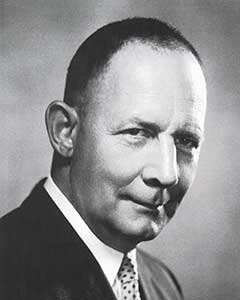
The Herb Dankmeyer Scholars Program is named in memory of Charles Herbert "Herb" Dankmeyer, whose life story and legacy continue to inspire.
Herb was born in Baltimore, Maryland in 1908. At age 10, while roller skating to a movie matinee that cost just five cents, he lost his balance and fell under a Baltimore Transit streetcar, an accident that immediately resulted in bilateral transtibial amputations. The prevailing attitude of the early twentieth century held that amputees—especially bilateral amputees—had little potential to become self-supporting, functional members of society. Disability was assumed; ability was not recognized.
Herb refused to let those attitudes hold him back. He played baseball on the local community team and ran just like everyone else. When he was old enough to get a driver's license, he was told that as a bilateral amputee, he would have to acquire a specially modified vehicle and would be restricted to driving only that vehicle, even if he passed the test. Determined to prove otherwise, Herb drove the family's unmodified car to the local police station, walked in, and asked an officer to ride along with him. He took the officer for a vigorous drive, all the while making his case that he needed someone in authority to attest that he could safely drive a standard vehicle. He got his license.
The company that made his prostheses invited him to train as a prosthetist. Herb worked hard and eventually became manager of the company's Baltimore office, building it over the course of two decades into the company's highest-performing branch. In 1954, he wrote to the company president requesting a $10-a-week raise. The president's response was devastating: "While the company recognizes your achievements, you should also recognize that as a handicapped person, you are fortunate to have a job." Herb quit that same day, started his own practice, and never looked back. That same year, he founded Dankmeyer, Inc., which he grew into the largest provider of prosthetic care in the State of Maryland—earning national recognition for a pioneering spirit that continues to drive the company's mission to improve the lives of the people it serves.
Throughout his career, Herb became a powerful advocate for recognizing ability rather than assuming disability. He worked closely to develop rehabilitation and return-to-work programs for injured amputees and returning veterans. He believed deeply in education, attending training programs at the University of California, Los Angeles; Northwestern University in Chicago; and New York University—and eventually teaching in those programs himself. He led seminars and lectured to local medical societies and associations, and he championed the credentialing of prosthetists and the accreditation of facilities providing patient care. Herb was the 13th person in the United States to become a Certified Prosthetist and Orthotist.
He believed his success depended on the support of his community, and that he, in turn, owed that community his own contributions. Organizations including the American Orthotic and Prosthetic Association, the American Board for Certification in Orthotics and Prosthetics, the Maryland Vocational Rehabilitation Association, Goodwill Industries, and the Disabled American Veterans all recognized his dedication and expertise.
The Herb Dankmeyer Scholars Program is made possible through the generosity of his son, Charles H. Dankmeyer, Jr., who has continued his father's legacy both personally and professionally. Through this program, up to two DSc in Rehabilitation Science students will be selected each year to receive full tuition support in recognition of scholarly work with strong potential to advance limb loss care through education, leadership, or clinical research—carrying forward Herb's enduring belief that ability, not disability, should define what is possible.