
At the Heart of Pregnancy
The cardio-obstetrics team at Johns Hopkins Medicine, one of just a few in the nation, offers coordinated care for women with cardiac issues in the weeks and months leading up to — and just after — birth.
Credit: Getty Images
Meagen Meise didn’t know she had a complicated heart until she was 28.
It was 2020 and, like so many others, she was sick with COVID-19. A computed tomography angiography scan at her local hospital revealed that she also had a rare heart anomaly known as a double aortic arch with a vascular ring.
Instead of a single arch at the top of the artery carrying blood from her heart to the rest of her body, Meise had been born with an aorta that divided into two arches that encircled her trachea and esophagus, constricting her airflow.
She was shocked and “didn’t really know what to think,” she recalls. A few years later, when she was getting her nursing degree, she got so out of breath walking across the Carroll Community College campus that her lips turned blue and she got disoriented.
She made it to her class, and later to a pulmonologist, who referred her to a cardiologist, who recommended surgery. The procedure would have to wait though, because Meise got pregnant, twice, with one sadly ending in miscarriage and the other an ectopic pregnancy.
Just as she was scheduling the surgery, she got pregnant again. For Meise, whose heart was already working at a disadvantage, this added hemodynamic stress required special attention.
She’s now getting that attention at Johns Hopkins Medicine’s Cardio-Obstetrics Clinic.
While many physicians are skilled at cardiac care, and many have devoted their careers to obstetrics, the cardio-obstetrics team, in the Division of Maternal-Fetal Medicine, is one of just a few in the nation offering this kind of coordinated care.
The Cardio-Obstetrics Clinic
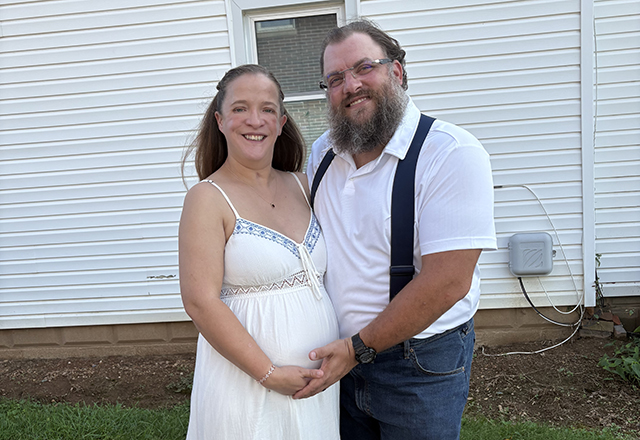 Meagen Meise with her husband, Joshua Meise
The clinic, which meets once a month in the Nelson wing of The Johns Hopkins Hospital, brings together cardiologists, obstetricians and other clinicians who collaborate on care for women with cardiac issues who are planning a pregnancy, are pregnant, or who have recently given birth.
This unusual collaboration makes it possible for patients like Meise — one of the estimated 1% to 4% of all pregnant women with heart-related challenges — to receive coordinated care and often see several specialists in one day.
“They work as a team, not only monitoring me but monitoring my baby as well,” says Meise, a patient care technician in the pediatric intensive care unit at The Johns Hopkins Hospital.
On this particular visit, Meise, at 13 weeks, meets with cardiologist Stacy Fisher, who specializes in congenital heart conditions, and first-year cardiology fellow Yaacoub Chahine.
Fisher had already prescribed a beta blocker to lower Meise’s resting heart rate, and it seemed to be working. “My husband noticed that I’m less short of breath,” she tells the doctors. Fisher and Chahine also talk with Meise about workplace protocols that could help her avoid getting out of breath, including seeking help when moving large patients and only performing CPR on babies, not on adults in cardiac distress.
Fisher recommends that Meise meet soon with her obstetric anesthesiologist to discuss her delivery. Chahine wants her to get an echocardiogram at 28 weeks, when her blood volume will be highest.
Meise is just starting to show. She tires easily, she says, but she’s thrilled that her pregnancy seems to be going well.
Pregnancy and Heart Strain
Pregnancy, when blood volume increases by about 40%, is tough on the heart, even for people without cardiovascular conditions.
“We tell our patients it's like a continuous stress test,” says Anum Minhas, the cardiologist who created the cardio-obstetrics program with Arthur “Jason” Vaught, maternal-fetal medicine specialist and surgical critical care physician. “It’s like you got on a treadmill and then you stay on it for nine months straight.” Labor and delivery cause cardiac stress to spike even more.
In 2019, Minhas was a third-year cardiology fellow, interested in both the clinical and research aspects of pregnancy and cardiac health.
“Pregnancy is one of the single most common experiences women will have,” says Minhas. “It was baffling to me why we lagged so far behind in knowing how to care for these patients and in researching how cardiac complications during pregnancy might impact women’s future heart health.”
With support from Steve Schulman, then director of the cardiology fellowship program, and Jeanne Sheffield, director of the Division of Maternal-Fetal Medicine, Minhas and Vaught started the clinic in October.
Minhas is also working to broaden clinical expertise in cardio-obstetrics. She created the first fellowship curriculum in the specialty area, which was published in 2021, and has mentored five fellows in the cardio-obstetrics pathway since she joined the Johns Hopkins Medicine faculty.
Alexandra Forrest, who recently completed her fellowship in maternal and fetal medicine and stayed at Johns Hopkins Medicine as assistant professor, is now taking on clinic leadership for Vaught.
“We are one of just a few that does it this way, where we see the patients at the same time in the same visit with the maternal-fetal medicine team, and we sit in the same room,” says Minhas. “In most places, the highest risk patients are seen by cardiology and then separately by maternal-fetal medicine, and they’ll do a Zoom call to talk about it. We decided internally that we learn a lot from each other from being there physically and talking about patients. The patients appreciate it, too, because we're all talking as a team.”
On a given day, the once-a-month clinic treats 20 or more patients, who have conditions ranging from congenital heart anomalies to arrythmias or heart failure that developed or worsened during pregnancy.
Some of these patients have been treated by Johns Hopkins Medicine cardiologists their entire lives. They and other women with known heart conditions work with the cardio-obstetrics team to prepare before they get pregnant, strengthening their hearts with strategies that might include medications, weight loss or surgeries. Some didn’t know they had a heart issue at all until the stresses of pregnancy brought it to the fore. And a few developed cardiac concerns during pregnancy.
On a recent Thursday at the clinic, Sbaa Syeda was the maternal-fetal medicine specialist in charge, working with third-year fellow Yanling Dong and second-year fellow Kedeja Williams. “It’s very helpful for us to be together to make real-time decisions,” Syeda says.
Fisher, who runs a clinic for adults with congenital heart conditions, is the cardiologist on duty along with cardiologist Chloe Duvall. She notes that the clinic is a logistical boon for patients, who see both their cardiologist and obstetrician in a single visit, often adding appointments on the same day for an electrocardiogram, fetal imaging or consultations with the obstetric anesthesiologist.
Fellows in adult congenital heart disease, cardiology and obstetrics rotate in the clinic, along with residents in anesthesia, surgery, medicine and obstetrics, and medical school students. They participate in direct patient care, learning hemodynamic effects of pregnancy while having opportunities to contribute to research projects, and benefiting from exposure and experience with a coordinated patient care model.
The clinic’s specialists are sensitive to cardiac stresses associated with labor and delivery, and sometimes advise patients to have their babies in the cardiac intensive care unit for better monitoring and quicker response to potential problems.
“What’s unique about our clinic is that both Dr. Vaught and I also practice as critical care intensivists, so we are very comfortable handling patients with high acuity,” says Minhas.
 Rachel Wilson, with her son, Liam
Patient Rachel Wilson, for example, delivered her son in the cardiac ICU with a pulmonary artery catheter placed into her heart through the neck to monitor her blood flow during delivery.
Starting in her second trimester, Wilson says, “I had really bad shortness of breath.” Just walking became a struggle, and stairs were almost impossible.
Her obstetrician diagnosed her with hypertrophic cardiomyopathy (HCM), an inherited condition characterized by thickened heart-muscle cells that don’t pump blood efficiently. Pregnancy is a particularly difficult time for people with HCM. Wilson, who is adopted, has probably had the condition her whole life, but it didn’t become apparent until her pregnancy.
“I was really scared,” says Wilson, now 39, who works in student services for The Johns Hopkins University. “Then I was told to see Dr. Minhas.”
Minhas and Vaught together cared for Wilson, prescribing medication to improve her blood flow, carefully monitoring her fetus’s health, and crafting a birth plan that involved inducing her in the ICU so they would be ready if anything went awry. The vaginal birth went well, and Wilson now has a healthy 4-year old son, Liam.
“They took really good care of me,” says Wilson, who had a defibrillator implanted about nine months after Liam was born. Minhas, who is still her cardiologist, has given her the green light to get pregnant again, which Wilson says she wants to do.
We tell our patients pregnancy is like a continuous stress test. It’s like you got on a treadmill and then you stay on it for nine months straight
Cardiologist Anum Minhas (at right), who created the cardio-obstetrics program with Arthur “Jason” Vaught, maternal-fetal medicine specialist and surgical critical care physician.
Research to Move the Field Forward
Cardiac complications during pregnancy are remarkably understudied because heart studies in general tend to focus on men, and clinical trials often exclude pregnant and nursing women.
“The field of cardiology research neglected women for a long time, and certainly pregnant women have traditionally not been included in research, so it’s time to expand the horizons of what we know,” says Minhas.
Minhas, Vaught and other Johns Hopkins Medicine researchers are providing crucial information to a population in desperate need of high-quality, coordinated care. Their ongoing work with Allison Hays, director of echocardiography programs at The Johns Hopkins Hospital, seeks to answer important questions about the long-term heart health implications of preeclampsia during pregnancy, which is characterized by dangerously high blood pressure and the potential for organ damage.
Minhas is also studying subtypes of the condition. “I found that there’s a cardiometabolic phenotype,” she says. “Those are the moms who had diabetes or obesity or hypertension. And then there’s a placental phenotype that probably has very little to do with the mom and a lot more to do with either the baby’s genetics or how the placenta is forming,” she says.
“That information is helpful for patients to know because they question themselves. They think that they did something wrong, and that they have preeclampsia because of one drink they had at four weeks. And it’s likely not. We don’t quite know what causes preeclampsia in some women and not others, but we hope to find out.”
She has also begun building a biobank, which will contain samples of blood and urine from pregnant patients treated at Johns Hopkins who are at risk of cardiac disease. The ultimate goal, she explains, is to develop biomarkers for different conditions that would allow clinicians to spot risks earlier on.
This research, like the clinic itself, is making a difference in the lives of women with heart conditions.
“Cardio-OB is such a small and niche and new field, we lack data,” says Minhas. “So the research that we do actually makes a clinical difference.”