
The Many Paths of Care: Precision, Partnership and the Stories That Shape Pulmonary and Critical Care Medicine

Cystic fibrosis was once defined by inevitability. First characterized in 1938 by Dorothy Andersen, a graduate of the Johns Hopkins University School of Medicine, the disease for decades carried limited treatment options and shortened life expectancy. For many years, care focused on managing infections, clearing airways and slowing decline. Today, the field stands in a markedly different place. New therapies are addressing the underlying cause of disease, allowing clinicians and patients to imagine different futures and, perhaps one day, a cure.
At Johns Hopkins, Christian Merlo, a pulmonologist specializing in cystic fibrosis and lung transplantation, has helped propel that evolution.
From Genetic Discovery to Targeted Therapy
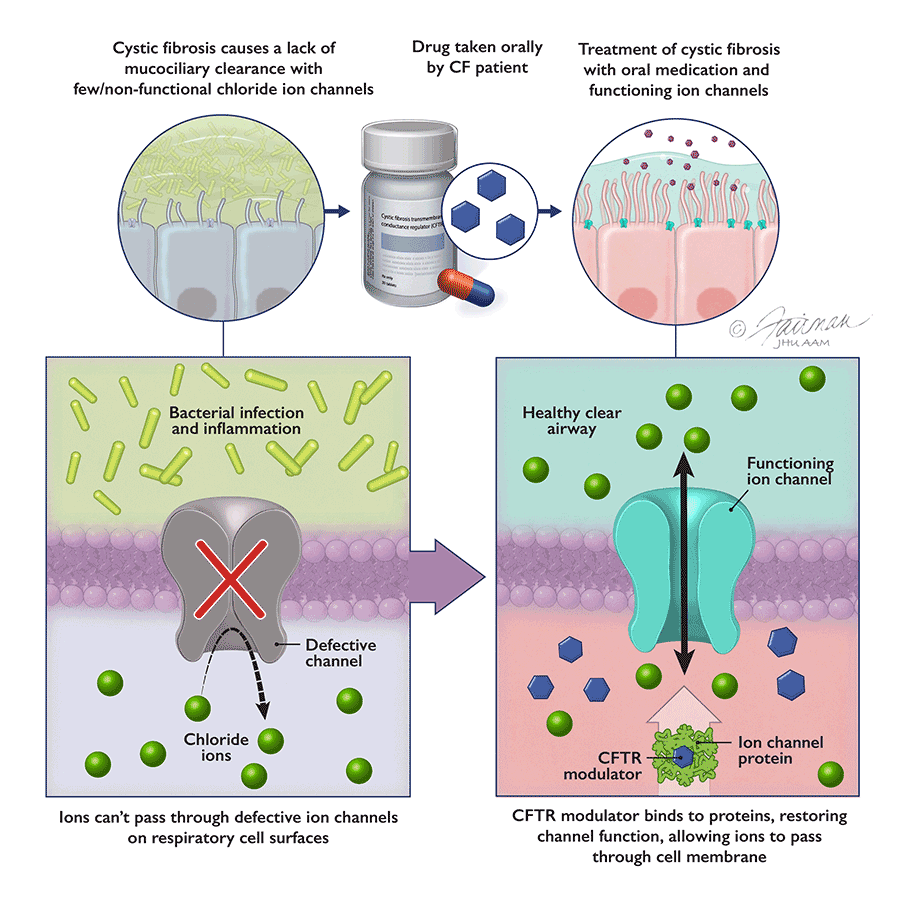
Cystic fibrosis is caused by mutations in the CFTR gene, which produces a protein responsible for regulating how salt and water move in and out of cells. When this protein does not function properly, mucus becomes thick and sticky, leading to breathing difficulties, repeated infections, inflammation and progressive lung damage, along with complications affecting other organ systems. While median survival has nearly tripled, now extending into the sixth decade of life compared to the early 20s less than a generation ago, important gaps remain.
The development of a new class of medications called CFTR modulators marked a turning point. Medications introduced over the past two decades, culminating in the triple combination therapy elexacaftor, tezacaftor and ivacaftor (Trikafta) approved in 2019, help the faulty protein function more effectively. Clinical studies and real-world data show average lung function improvements of approximately 10 to 15 percentage points, along with significant reductions in pulmonary exacerbations and hospitalizations. These advances have reshaped long-term expectations and contributed to a substantial decline in lung transplantation for cystic fibrosis, with annual transplant volumes in the United States falling from roughly 250 to 300 per year before widespread modulator use to closer to 40 to 60 in recent years.
Even with these advances, the impact has not been uniform. Access to these therapies has historically depended on whether a patient’s specific genetic variant was known to respond. As a result, approximately 10% of patients, particularly those with rare or less characterized mutations, were not eligible to be treated with the most effective medications because evidence supporting their use had not yet been established.
Thanks to meticulous precision medicine research, that boundary is beginning to expand. By studying how an individual patient’s cells respond to therapy, clinicians and scientists can move beyond genetic prediction alone. This approach allows treatment decisions to be guided by observed biologic response, creating new opportunities for patients who previously had limited or no clear options.
When Precision Medicine Changes a Family’s Future
In one case, a father from the Washington, D.C., area came to Johns Hopkins Medicine with advanced cystic fibrosis and worsening disease that was moving toward requiring lung transplantation. Existing standard genetic analysis could not predict his response to newer modulator therapies, which generally meant the medications could not be prescribed. The stakes extended beyond his own health, as his child shares the same diagnosis and genetic variant, underscoring the urgency of exploring every possible option.
Rather than accepting that limitation, Merlo and his colleagues pursued functional testing through the Johns Hopkins Precision Medicine Center of Excellence for Cystic Fibrosis. By growing the patient’s nasal epithelial cells in the laboratory and testing their response, the team demonstrated that the cells responded to the medication. The resulting laboratory data showed measurable improvement in CFTR function and provided evidence to support treatment.
After therapy began, the patient’s lung function improved from approximately 40% to between 60% and 70%. The dramatic clinical response provided real-world confirmation of what the laboratory testing had suggested. It also demonstrated the potential of functional testing to identify effective therapies for patients whose genetic results alone may not provide a clear path to treatment. This precision medicine approach can help close gaps in treatment eligibility and create new possibilities for patients who might otherwise have limited options.
The Power of Team Science and Compassionate Care
This progress became the foundation for clinical advocacy. Through coordinated efforts among pulmonologists, translational scientists, pharmacists, nurses, coordinators and the broader multidisciplinary cystic fibrosis team, treatment access was secured. Following initiation of therapy, the patient experienced sustained improvement in pulmonary function and overall clinical stability, ultimately allowing removal from the lung transplant waiting list. The outcome reflects the strength of a team-based model in which scientific discovery, clinical expertise and persistent advocacy move together.
The case illustrates more than an individual success. It represents a shift in philosophy. In Merlo’s shared model of care, eligibility is not defined solely by statistical expectation but informed by direct biologic response, rigorous translational science, and collaboration across disciplines willing to challenge assumptions when data support a different path.
Importantly, this work unfolds within the continuum of cystic fibrosis care. While some patients experience dramatic therapeutic response, others continue to navigate progressive disease, transplant evaluation or carefully supported end-of-life care. Excellence in this field therefore requires both scientific sophistication and acute clinical compassion. The cystic fibrosis team at Johns Hopkins Medicine integrates these elements, ensuring that innovation and humanity remain inseparable.
“It’s part of why I wanted to go into medicine,” Merlo said. “I always wanted to make a difference. And it’s not just me, it’s the team. That’s what makes it so powerful.”
As functional testing becomes more embedded in clinical practice, the definition of possibility continues to expand. Increasingly, the central question in cystic fibrosis care is not whether a mutation predicts response, but whether a patient’s biology demonstrates it.
Through leadership in precision medicine, translational collaboration and patient-centered advocacy, Christian Merlo and the cystic fibrosis team are helping redefine what is possible for individuals living with cystic fibrosis. In doing so, they are not only advancing science. They are reshaping futures.
For Clinicians Clinical Connection
Clinicians, discover the latest in research and clinical innovation from Johns Hopkins experts. Access educational videos, articles, CME courses and other resources from our world-renowned institution.