
Johns Hopkins Eye Surgeon and Sinus Expert Team Up on Tear Duct Repairs

Key Points
- Dacryocystorhinostomies to bypass clogged tear ducts can be performed either endoscopically or externally.
- Oculoplastic surgeon Nicholas Mahoney and otolaryngologist Andrew Lane perform endoscopic procedures together.
- The combined endoscopic approach is particularly helpful in revision cases where a previous dacryocystorhinostomy has failed.
- Pairing the surgeons is unusual and delivers high levels of expertise and success.
Clogged tear ducts can be treated through procedures called dacryocystorhinostomies (DCRs), which are performed endoscopically through the nasal cavity or externally through an incision under the eye.
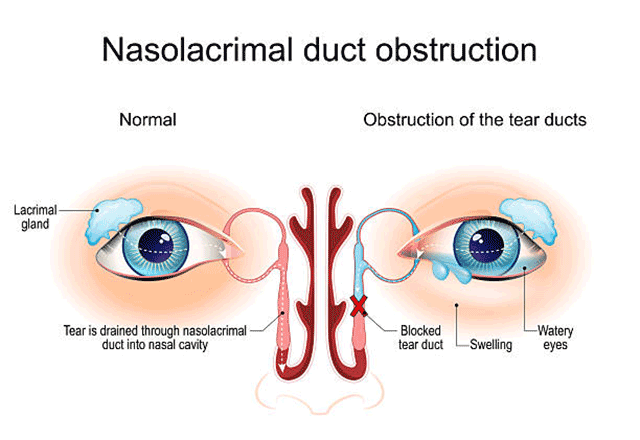
Most DCRs, internal and external, are performed by ophthalmologists alone, says Nicholas Mahoney, chief of the oculoplastics division at Wilmer Eye Institute, Johns Hopkins Medicine. Johns Hopkins Medicine is unusual in that it pairs two surgeons to work together on endoscopic DCRs.
Mahoney brings his expertise in eye care, while otolaryngologist Andrew Lane, director of the Johns Hopkins Sinus Center, provides detailed knowledge of the nasal cavity.
“It is rare to do it with two experts,” Mahoney says. “It’s a little more legwork for us, but that’s what Hopkins is about.”
Patients who are referred to Wilmer because of excessive tearing may require surgery to unblock one or both tear ducts, or may need a repair to a previous DCR when tearing continues.
The question then becomes whether to access the blockage externally from a small incision below the eye or internally, through the nose. Both are outpatient procedures under general anesthesia, calling for the surgeon to open the tear sac and place a stent to preserve the opening during healing.
The external approach leaves an almost imperceptible scar as well as temporary bruising. It can be less durable, requiring additional surgery in the future.
The endoscopic approach takes slightly longer, leaves no scar, and is the better choice for repairs of previous DCRs.
“Working with someone who has expertise with the sinus/nasal anatomy and surgery, we get great results on revisions,” says Mahoney. “We deal a lot with revisions, and we almost exclusively do the revisions with Dr. Lane because the results really are otherwise unachievable.”
With Lane as a partner, the endoscopic approach is not hindered by other otolaryngology issues, such as a deviated septum, which can block access to the duct. Another advantage of the team approach, says Lane, is that he can assess healing and remove stents in a couple of weeks, instead of the usual several months after the procedure.
The partnership has since grown to include primary DCR surgery as well, Mahoney says. “We started working together and I thought, ‘This guy can really visualize what we’re doing and is so delicate with these tissues.’ It seemed like we could use each other’s skills to do primary DCRs, too.”
Medically reviewed by Nicholas Mahoney, M.D., and Andrew Lane, M.D.
For Clinicians Clinical Connection
Clinicians, discover the latest in research and clinical innovation from Johns Hopkins experts. Access educational videos, articles, CME courses and other resources from our world-renowned institution.