
From Patient to Parent: A Sickle Cell Survivor Shares His Greatest Joy
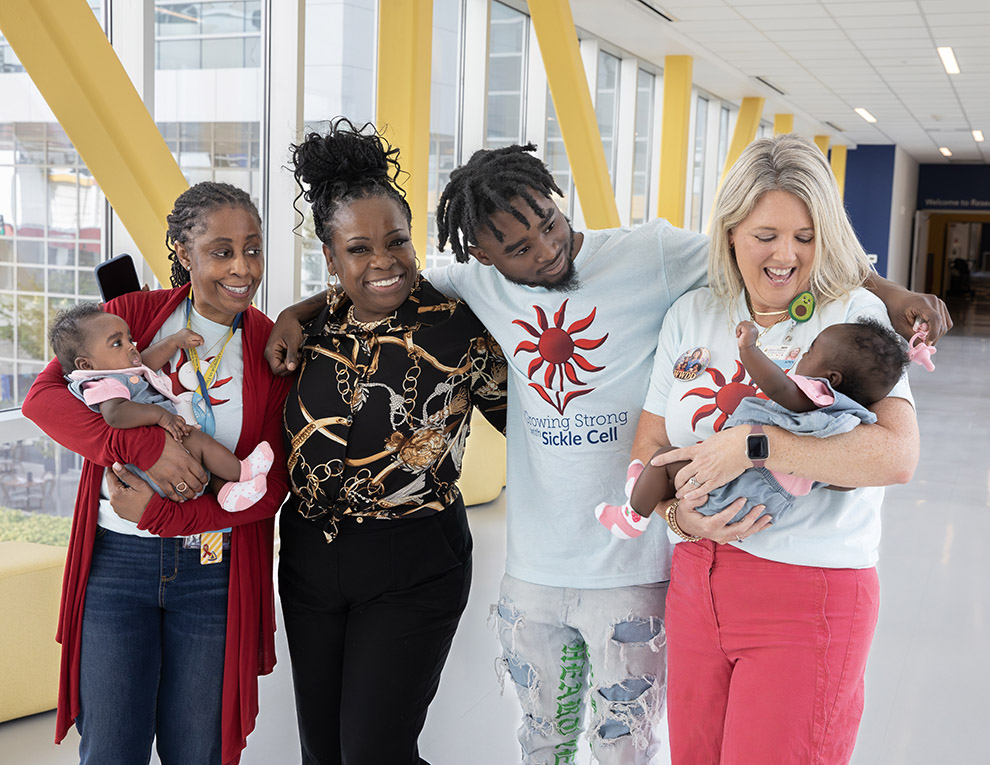
Twenty-four-year-old John Stephens III smiles as he pushes his identical twin daughters into the Research and Education Building at Johns Hopkins All Children’s Hospital in St. Petersburg, Florida.
He’s moments away from reuniting with a few of the doctors and nurses who helped him navigate sickle cell disease in his formative years and he has news he can’t wait to share with them at the annual Family and Friends Sickle Cell Symposium.
He embraces Tamara New, M.D., director of the Sickle Cell Disease Program at Johns Hopkins All Children’s Hospital and Carrie Gann, D.N.P., a nurse practitioner in pediatric hematology and oncology who treated him for years. Then comes the exciting introduction: “These are my 4-month-old daughters, Kahlani and Leilani. They were born without sickle cell disease,” he excitedly tells New and Gann.
John will never forget the relief he felt when his daughters' first pediatrician visit confirmed they wouldn't face the same struggles he did growing up with sickle cell disease.
“I knew, regardless, I was going to love them and take care of them, but, you know, knowing just how it feels dealing with the pain, with your own kids, you don't want them to go through what you did. They're healthy,” he says with relief.
“I almost cried when their pediatrician said they were carriers of the disease but did not have it,” he elaborates. “The only reason I was able to fight those tears back is because it was our first time seeing them, but when me and my fiancé, Theresa Jean, celebrated the news at home, we hugged. We were very emotional. Something told us that everything was going to be OK, and it was. They're my two biggest blessings.”
An Inherited Disease
Since Kahlani and Leilani are identical twins, they share the same DNA. This means that if one identical twin had inherited sickle cell disease, the other twin would’ve had the exact same genetic setup for the disease.
“So, it was an all or nothing chance,” John remembers.
Sickle cell disease is an inherited blood disorder. Normal red blood cells are smooth and flexible discs shaped like the letter O, which enables them to move easily through blood vessels. In contrast, sickle cells are stiff, sticky, and often shaped like the letter C. The sickle shape makes the blood cells cluster together and adhere to the lining of blood vessels. That can lead to blockages in small blood vessels, slowing the flow of healthy, oxygen-carrying blood to body tissues and causing pain.
Sickle cell disease results when a child inherits a defective gene from both parents. Because John has sickle cell disease, he would pass the defective gene on to his children. The mother of John’s fiancé also has sickle cell disease, so Theresa carries what’s known as sickle cell trait, giving her a 50% chance of passing the defective gene on. The couple weighed their odds but decided they wanted to start a family.
John’s Journey
John was born with the SC variant of sickle cell disease, which happens when one hemoglobin S gene is inherited from one parent and a hemoglobin C gene is inherited from the other.
“I remember early on having a lot of hospital trips for pain and having to miss school because of it. I didn’t know many people with sickle cell disease so that was hard too,” John adds.
Medicine provided comfort from the beginning, especially hydroxyurea, which helps reduce the frequency of pain crises and the need for blood transfusions by increasing hemoglobin levels, which can increase the size and function of red blood cells. L-Glutamine also helped by keeping his red blood cells round (versus sickle shaped), which allowed the blood cells to break down less frequently and flow easier through his body.
John says learning his triggers also helped him keep tabs on when he needed to hydrate more, keep his body warm, or get more rest.
Comfort and Care
He says he found the most comfort at Johns Hopkins All Children’s with a care team that understood how he felt. “My mom and I felt everybody at Johns Hopkins All Children’s was always very helpful. Sickle cell disease is unpredictable, but they were on my side,” John explains. “It made me, even as a kid, want to show up to my doctor's appointments.”
John also appreciated the sense of community Johns Hopkins All Children’s brought in helping him connect with other sickle cell families through family symposiums and a community connection with Camp Boggy Creek, a free and medically supervised camp for children with serious illnesses. There, the kids can boat, swim, ride horses and be themselves.
New has served as one of the camp’s volunteer doctors. “I think it's very important because a lot of our patients may not know somebody outside of their family who has sickle cell disease. I think it is important that they don't feel like they're alone and hopefully can form meaningful lifelong connections,” she explains.
“Those were core memories for me as a kid,” John recalls.
Reuniting with patients like John reminds New and Gann of the critical importance of the work they do.
“Right now, our hospital has three sites where we see patients [St. Petersburg, Lakeland and Tampa], so we're trying to bring care closer to where our patients live. It’s important because sickle cell disease is a chronic illness and requires very specialized care and we want to make it as accessible as we can,” New explains.
“It’s also the consistency of showing up for these patients and building their trust,” Gann adds.
New says the most difficult thing about treating sickle cell disease is its unpredictability. “We teach kids to avoid certain scenarios or conditions, like jumping into a cold pool, becoming dehydrated, or exercising at higher altitudes, because then they’re more likely to have an episode. And they may do that, and they still may have an episode,” she explains, “so that unpredictability brings a loss of sense of control.”
Looking Forward
Yet, New is excited about the future of sickle cell care, including new therapies, clinical trials and even gene editing technology that may be able to silence a gene in red blood cells, allowing normal hemoglobin to form and keeping cells from becoming sickle shaped. “It’s a great time to be in this very important field,” she adds.
John recently transitioned out of the care of Johns Hopkins All Children’s Hospital into an adult program.
Gann says she feels lucky to keep in touch. “With patients that transition to adult care, you never stop caring for them or wondering how they are, and we love seeing them achieve so much success in life. I remember growing up, John always wanted to play sports and despite his mom’s reservations, he was like ‘I’m doing it.’ He just has that nothing-will-stop-me, positive attitude,” she says with a smile. “It can be hard when our patients transition to an adult hematologist, but it also means we did our job. It’s hard, but it’s what we want them to do. It’s a sense of accomplishment,” Gann adds.
John has big plans for his future. One day, he hopes to launch a nonprofit, focusing on helping other children and young adults with sickle cell disease. He’s still developing ideas including mentorship, diet and exercise plans and outings, but says, “It’ll be meaningful because it’s coming from someone else who has sickle cell disease and knows what they’re going through. I mostly want to give others hope.”
John adds that living with sickle cell disease gave him courage. “It motivated me to still show up for myself and never give up proving that my body is still capable. Now, I have my own place, a career and a beautiful family. I’m a big advocate for never letting sickle cell stand in your way.”
Treatment Sickle Cell Disease Program at Johns Hopkins All Children's
The sickle cell disease program at Johns Hopkins All Children’s Hospital in St. Petersburg, Florida, provides comprehensive pediatric care to patients from birth to age 21. As one of the largest pediatric sickle cell programs on Florida’s west coast, we help families deal with challenges when their child has sickle cell disease. Since sickle cell is a chronic disease that lasts a lifetime, our experts also specialize in transitioning pediatric patients to adult care. Children with sickle cell disease still can live a healthy and active life.