
Advancing CDH Care with FETO Procedures at the Johns Hopkins Center for Fetal Therapy
Minimally invasive FETO procedures are part of the Johns Hopkins Center for Fetal Therapy's multidisciplinary approach to improving outcomes for pregnancies affected by severe congenital diaphragmatic hernia (CDH).
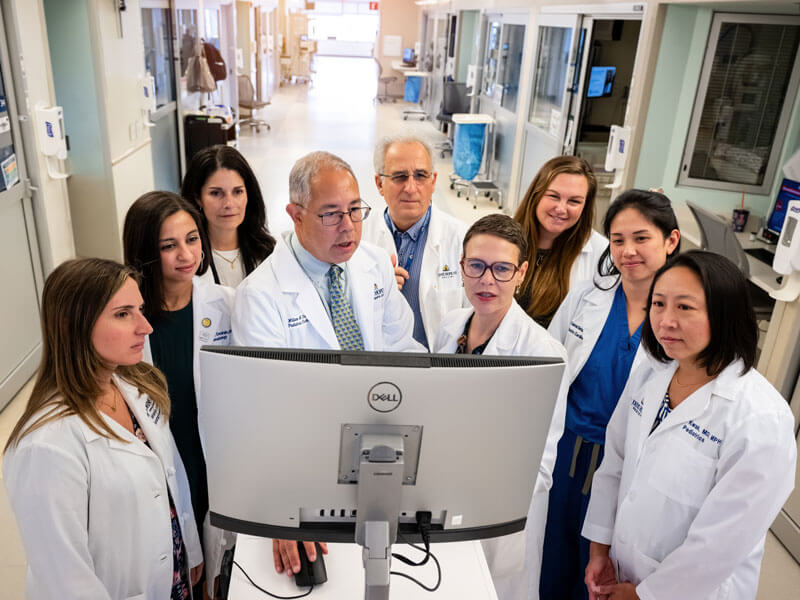
A multidisciplinary team reviews complex cases. (L-R: Alexandra Lazzara, Suneetha Desiraju, Michelle Kush, William Ravekes, Ahmet Baschat, Mara Rosner, Katelyn Uribe, Ashley Betancourt, Cecilia Kwak)
Over the past decade, Johns Hopkins Medicine has been pivotal in advancing care for severe congenital diaphragmatic hernia (CDH), a condition in which fetal organs move into the chest cavity through a hole in the diaphragm, preventing development of normal lungs.
The Johns Hopkins Center for Fetal Therapy at The Johns Hopkins Hospital in Baltimore and the Johns Hopkins All Children's Hospital Center for Congenital Diaphragmatic Hernia in St. Petersburg, Florida, offer specialized care for patients with congenital diaphragmatic hernia (CDH), with survival rates well above the national average of 65% to 70%.
The Baltimore program offers fetal interventions, including fetoscopic endoluminal tracheal occlusion (FETO), for carefully selected pregnancies, while the Florida center optimizes early repair of the diaphragm shortly after birth and expert ventilation care to maximize lung and brain development.
Each center uses the latest technologies to provide expert care for their patients. Both centers are regional and national referral centers for the most severe CDH cases.
Center for Fetal Therapy: Experts in FETO
The team at the Johns Hopkins Center for Fetal Therapy in Baltimore are pioneers in the fetoscopic endoluminal tracheal occlusion (FETO) procedure, which increases lung development in utero. The FETO program is integrated into a broader continuum of maternal-fetal and neonatal care. The center’s fetal therapy physicians, along with neonatologists and pediatric surgeons, work together to improve lung development and reduce reliance on extracorporeal membrane oxygenation (ECMO).
Babies who are born with CDH have breathing problems that can be life-threatening, explains Ahmet Baschat, director of the Center for Fetal Therapy, who brought the FETO technique to Johns Hopkins Hospital and the mid-Atlantic region about 10 years ago.
“One of the reasons I came to Hopkins was that I wanted to start this therapy here,” he says. “You can’t implement a high-quality program with just one component. You have to have an excellent neonatal intensive care and pediatric surgery team, all under one roof.
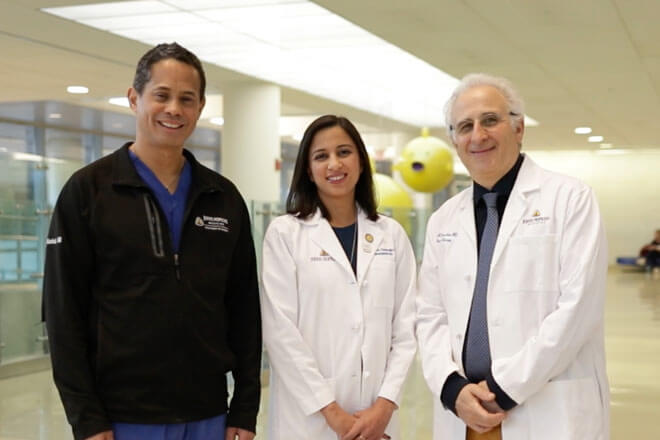 (L-R: Shaun Kunisaki, Suneetha Desiraju, Ahmet Baschat)
Baschat works closely with neonatologist Suneetha Desiraju and pediatric surgeon Shaun Kunisaki. Together with their teams, they offer a cohesive strategy to pregnancies diagnosed with CDH and the care needed after delivery.
This integrated model has been central to the Center for Fetal Therapy’s success and has helped establish them as one of the most experienced centers in the country for the FETO procedure.
The in-utero procedure is performed by using a fetoscope to place a balloon in the trachea then inflate it with sterile saline. This balloon achieves blockage of the trachea, which results in expansion of the lungs in the chest cavity.
FETO procedures are now done earlier in fetal development than previously, Baschat says, typically occurring at about 28 weeks with balloon removal at 34 weeks. Careful surveillance of patients for signs of preterm labor has allowed most mothers to carry to term after FETO.
Several innovations have improved FETO and post-FETO care at Johns Hopkins Hospital over the past decade. One, says Baschat, is the pediatric surgery team’s use of living muscle tissue to repair the diaphragm, instead of a biomaterial patch that does not grow with the baby.
Together, Johns Hopkins Medicine's CDH programs in Maryland and Florida reflect a broader principle in caring for complex fetal conditions: Innovation is most effective when paired with coordinated, multidisciplinary care that supports families before, during and after birth.
This article was updated on Aug. 7, 2026
For Clinicians Clinical Connection
Clinicians, discover the latest in research and clinical innovation from Johns Hopkins experts. Access educational videos, articles, CME courses and other resources from our world-renowned institution.