
From a Lab in New Jersey to working on HOPE, Michelle Prizzi Reflects on the Path to Her New Role
As senior research compliance monitoring specialist, she coordinates more than 80 subsites of multicenter transplant studies.
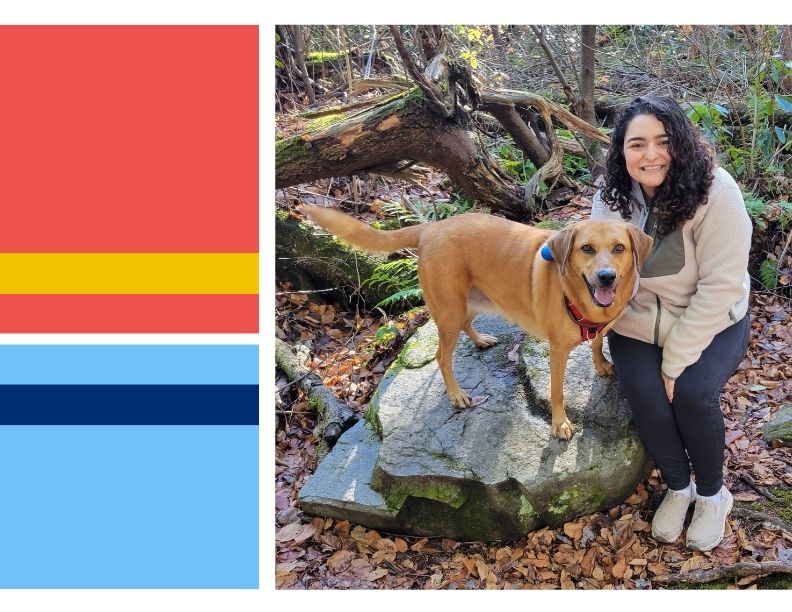
Michelle Prizzi with her dog, Maggie
Photo courtesy of Michelle Prizzi
The field of transplant and oncology infectious diseases wasn’t exactly top of mind for Michelle Prizzi as she was growing up in New Jersey. As a high school student with an interest in biology, she worked in a lab at Rutgers University. While in college at Seton Hall, where she majored in anthropology, she conducted lab and qualitative research. “I studied physical anthropology and biomedical anthropology in college,” she explains. She also loved people, communication and organization, and the intermingled interests of science and connection led her to the human side of clinical research. Following in her sister’s footsteps to Baltimore, Michelle joined The Johns Hopkins University in 2018. After a year with the Berman Institute of Bioethics, she settled into the Division of Infectious Diseases’ Transplant Oncology and Infectious Diseases group (TOID), which is affiliated with the Transplant Research Center.
“I knew I didn’t really want to work in a lab,” she says. “My skills really lie with people and communication. I felt like I could do a lot more and be happier working with people.” Six years after joining TOID — first as a senior research coordinator and later as program administrator and administrative manager — Michelle has just stepped into a new role: senior research compliance monitoring specialist.
Her new job involves supporting more than 80 subsites on multicenter transplant studies. “We currently have three multicentered studies, and are expecting our fourth any day now,” she says. “I work primarily with our subsites across the United States, reviewing data entry for safety and compliance.”
It’s the kind of work that requires both attention to detail and a strong sense of purpose — two traits Michelle developed on the job. With regard to her trajectory, she credits two leaders who believed in her capabilities. “When I was first hired in 2020 by the Division of Infectious Diseases, I was a completely different person,” she reflects. “I never saw myself as a leader until several years ago under Christine Durand and Diane Brown, who really helped get me there.”
Those supervisors mentored, encouraged risk‑taking and created a culture where mistakes became learning moments rather than reasons to blame. The environment shaped both Michelle’s professional skill set and the way she now supports colleagues and aspiring leaders. “Christine and Diane are always willing to give you a shot at something,” she says. “I’ve learned so many excellent skills and leadership from these two incredible women.”
A career highlight thus far for Michelle has been her work on research and policy changes associated with the HIV Organ Policy Equity (HOPE) Act, led by Durand, a director of the Transplant Research Center. That effort — more than seven years in the making — helped pave the way for safer organ transplantation across populations historically excluded from consideration, and it’s the kind of impact Michelle says reminds her why she does this work.
“It’s easy to lose sight of the fact that you can actually make some type of difference,” she says. “Being able to make sure that people are getting transplanted safely and contributing positively to this organ shortage — that really has been the most rewarding.”
Along the way, Michelle has confronted a challenge familiar to many women in the workforce: imposter syndrome. Her first real leadership role, in which she oversaw the work of a small team, brought hours of second‑guessing. “Filling big shoes and being unsure if you’re making the right decisions” was a learning curve, she says. With support from her mentors and hands‑on experience, she learned to trust herself, and now counsels colleagues to do the same.
Durand shares that Michelle actively works on enhancing her leadership skills. “One of the best parts of my job is watching team members take opportunities and develop into leaders. Michelle has grown tremendously over the years. She is a caring, confident and dynamic leader.” Durand adds, “And that growth didn’t ‘just happen’ — she made it happen through intentional learning, practice and perseverance.”
Michelle’s platform for measuring success in her life is simple and low-tech. Since college, she has kept a running list, folded into four quadrants marked personal, professional, physical and long‑term goals, in her wallet. The sheet gets updated every new year, and it serves as a “report card” she carries as a reminder of what her goals are. Old lists are keepsakes, serving as written testimony to what she’s achieved.
“That list has been with me for a long time,” she laughs. “Going back and seeing items — like adopting a dog, getting my master’s degree, being a homeowner — helps me see where I’ve come from.” In a few months, she’ll check off two long‑standing goals: graduating from Towson University with a Master of Health Science degree and a health leadership graduate certificate, and taking her first trip to France — the latter goal has been threaded through lists for seven years.
Outside the office, Michelle’s recreational pursuits are similarly tactile. She’s an avid crafter who enjoys painting, embroidery and sketching, and is a committed plant parent with plans to focus on her garden after graduation. At home, she and her husband enjoy the company of two dogs: Maggie, a “Velcro” pup who follows her everywhere, and Echo, a more independent spirit. “My dogs are my little pack,” she laughs. “They’re so much fun.”
She also really values her “human pack” of TOID colleagues. In TOID, the line between friend and co-worker is blended. “A lot of my co-workers are also friends and confidants,” she says. “That’s super unique — people don’t always get to experience that in the workplace. We have this culture of safety and learning where you don’t get reprimanded if you make a mistake. We always go in with ‘why?’ — and that’s a great skill to learn.”
Michelle’s story is one of growth and giving: a budding researcher who discovered that her strengths thrived outside of the lab, and a mentee who now works to inspire others. As she settles into compliance monitoring across an expanding network of transplant studies, she brings with her scientific curiosity, compassion for the patients at the heart of every protocol and, yes, a list of aspirations, divided in fourths, to keep her focused on what lies ahead.