
'No Limit to What We Can Do'
By partnering with Mt. Washington Pediatric Hospital, Children’s Center clinicians collaborate to provide seamless, well-coordinated care.
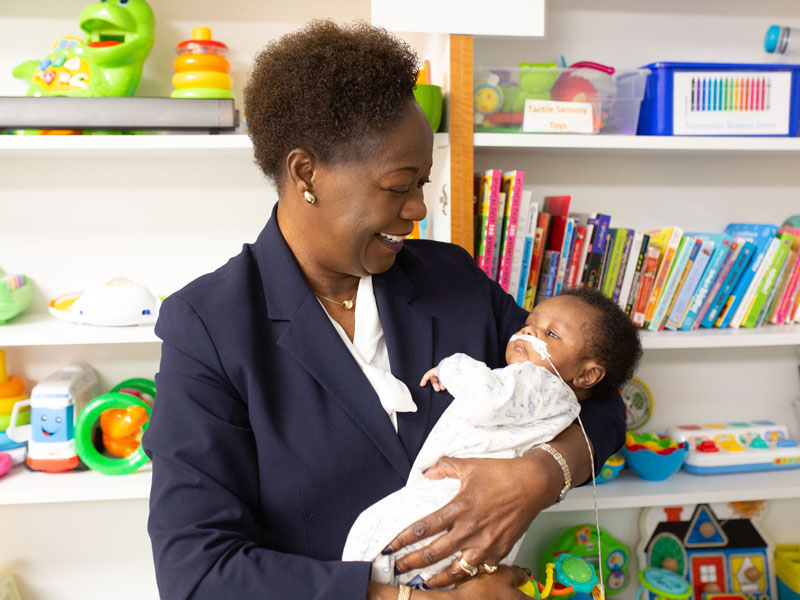
Ajoke Ajayi-Akintade, Mt. Washington’s assistant medical director, with a young patient.
Photos by Katharine Yeager
Born early, at just 31 weeks, twin sisters Brittany and Victoria Everett spent a month in the neonatal intensive care unit (NICU) of a local hospital before being discharged to their home in Baltimore County. But just after she turned 1, Victoria needed neurosurgery due to hydrocephalus. It would be the first of many surgeries at Johns Hopkins Children’s Center, and the beginning of a long, complex medical journey — stretching over decades — that affects her life to this day.
For feeding issues and acid reflux, Victoria was referred to Richard Katz, a Johns Hopkins pediatric gastroenterologist who at that time directed Mt. Washington Pediatric Hospital’s Comprehensive Program for Feeding Disorders. Victoria got a feeding tube after tests revealed that she was a silent aspirator — food was going into her lungs when she ate without triggering a cough reflex. Katz, now semiretired, helped the family navigate this and a variety of medical issues over the years. Victoria’s mother texts him to this day.
The feeding program is just one of many examples of formal collaboration between the Children’s Center and Mt. Washington Pediatric Hospital (MWPH). Through this partnership — celebrating 20 years in 2026 — Johns Hopkins clinicians provide acute treatment and Mt. Washington clinicians supply rehabilitation and meet other long-term needs in inpatient and outpatient capacities. For patients like Victoria, who went on to have additional neurosurgeries, open-heart surgery and Nissen fundoplication surgery (to treat chronic GERD), the seamless care inherent to this partnership is crucial.
Her twin sister, Brittany, was healthy until the age of 10, when she had a spinal stroke and wound up on life support. Through inpatient care at both hospitals, Brittany went from the possibility of lifelong paralysis to walking, eating and functioning independently within months.
“The team at Mt. Washington and the team at Johns Hopkins saved Victoria’s life more than once,” says Carye Everett, Victoria’s mother. “She and Brittany [now 24] are who they are today because of the work of Johns Hopkins and Mt. Washington.”
Meeting Complex Needs
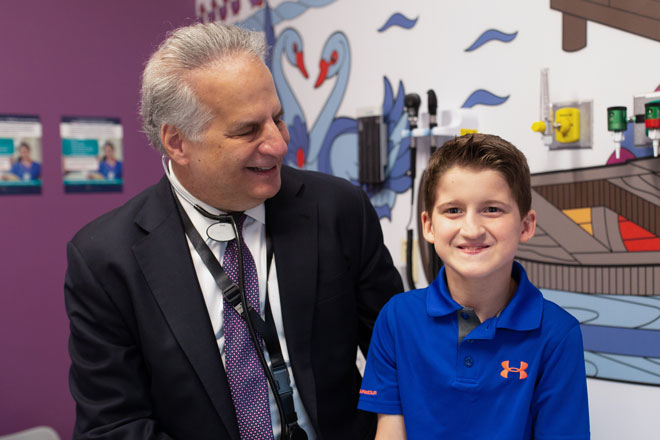 Pediatric gastroenterologist Richard Katz with patient Gregory Aurilio, age 10.
Set atop a hill in Baltimore’s picturesque Mt. Washington neighborhood, the 102-bed Mt. Washington Pediatric Hospital got its start in 1922 as the Happy Hills Convalescent Home for Children, thanks to the vision of Baltimore’s Hortense Kahn Eliasberg. She had observed that children who returned home after a serious hospitalization often fared poorly, frequently due to improper nutrition or their family’s poverty, and she set out to create a place where Baltimore’s children could convalesce safely. At just 22 years of age, Eliasberg gained support for her plan from a group of influential physicians, including William H. Welch, one of The Johns Hopkins Hospital’s four founding doctors.
Happy Hills became Mt. Washington Pediatric Hospital in 1975, and in 2006, the partnership agreement made the hospital a joint affiliate of Johns Hopkins and the University of Maryland Medical Center. Through the partnership, Johns Hopkins specialists — in areas including orthopaedics, pulmonology and endocrinology — work with the pediatric hospital’s clinicians to ensure young patients have the best possible outcomes.
Johns Hopkins physicians see patients on-site at Mt. Washington, and patients at the pediatric hospital needing procedures or urgent care can be transported to the Children’s Center.
“There’s no limit to what we can do now, because we have the expertise at Hopkins, and we are very good at what we do,” says Ajoke Ajayi-Akintade, Mt. Washington’s assistant medical director. “And what we are very good at is taking those children with complex medical diagnoses, involving almost all organs in their body, and getting them strong, working on rehab, working on [their] developmental trajectory, but most importantly, getting them home.”
Ajayi-Akintade, who completed a fellowship at Johns Hopkins and the Kennedy Krieger Institute, is a neurodevelopmental pediatrician. She works with patients — many who come from the Children’s Center’s NICU — to ensure they reach developmental milestones. Her efforts are enhanced by an array of clinicians at MWPH, including occupational and physical therapists, child life specialists, psychologists, dietitians, speech-language pathologists and respiratory therapists.
Katz served as Mt. Washington’s first full-time chief medical officer, a role he filled, in addition to being vice president of medical affairs, while remaining on the Johns Hopkins faculty.
He notes that the partnership helps the Children’s Center free up precious bed space, while also ensuring patients with complex needs get the support they will need after they are discharged to go home.
“Most of the kids who leave Mt. Washington need lots of help as they leave — many, many doctors’ appointments, nursing care, durable medical equipment,” Katz says. “At Mt. Washington, they get discharge [support] by knowledgeable people who do that all the time, every day.”
"There’s no limit to what we can do now, because we have the expertise at Hopkins, and we are very good at what we do."
Ajoke Ajayi Akintade
A Standout Sleep Lab
Complex patients can also face a variety of sleep disorders, including sleep apnea, narcolepsy and nighttime seizures. Many require CPAP or BiPAP (bilevel positive airway pressure) machines, or at-home ventilators.
Fortunately, these patients can get the follow-up care they need at Mt. Washington Pediatric Hospital, which houses a unique lab of the Johns Hopkins Pediatric Sleep Center. There, clinicians can perform sleep studies on a wider variety of patients than most sleep labs can, including those on ventilators, who are often sent to their local ICU to get their settings checked twice a year.
For children reliant on CPAP or BiPAP machines, the center can perform titration studies and make sure that as children grow, the settings on their machines are appropriate. The team can also perform neurologic studies to evaluate children for narcolepsy and assess their risk for having seizures at night.
“Mt. Washington’s expertise in caring for these chronically complex children has then spilled into the lab, and we welcome the same kids that they care for so excellently every day into specialized studies at the lab, with comfort,” says Laura Sterni, director of the Sleep Center. “So it really has made that lab in particular a top-of-the-line, cutting-edge place.”
The center performs sleep studies most commonly to diagnose obstructive sleep apnea, risk factors for which include obesity as well as being born prematurely and neuromuscular disorders such as cerebral palsy — the latter two types of patients Mt. Washington has expertise in treating.
Sterni says the lab’s setup — which can handle newborns to age 21, whereas most labs don’t see patients younger than 4 — is a result of Mt. Washington’s eagerness to partner with Johns Hopkins.
“It’s broader than most labs can handle,” Sterni says. “The Mount has really worked to be able to take care of a fragile population.”
Sterni and her team collaborate with Mt. Washington’s respiratory therapists and on-call doctors for sleep studies, as well as behavioral psychologist Timothy Billings, who helps patients and their families get used to using CPAP and BiPAP machines and counsel patients with insomnia and other sleep disorders.
Johns Hopkins’ sleep lab at Mt. Washington predates the formal partnership, going back about 25 years when the center was first certified by the American Academy of Sleep Medicine.
Multidisciplinary Feeding Program
Mt. Washington’s Comprehensive Program for Feeding Disorders first started as a way to help so-called picky eaters, and then the clinic started seeing kids who were not interested in oral feeding after having been tube-fed in the hospital. These days, the majority of patients are on the autism spectrum.
“Children with autism often start out eating fine, but as their other features of autism develop at about 18 months or 2 years, so do their feeding issues,” Katz says. “It becomes a crisis for these families.”
Like the Sleep Center, the feeding disorders program and its partnership with the Children’s Center predates the formal partnership between Mt. Washington and the Children’s Center by a few years.
Katz, who was recruited to Johns Hopkins in 1994, became the first full-time chief medical officer at Mt. Washington in 2002, and soon took over the hospital’s new feeding program.
The program offers a feeding clinic, where a multidisciplinary team assesses patients and makes recommendations; a six-week intensive feeding day treatment program that includes rehabilitation treatment, school services, a sensory motor group and visits from therapy pets; inpatient services for children with complex needs including postsurgical care, burns, injuries or trauma; and outpatient treatment.
Katz, who still sees patients part-time at Mt. Washington, brought the feeding program to international prominence, and served as president of the International Association for Pediatric Feeding and Swallowing. The program is now managed by MWPH speech-language pathologist Rebecca Gorman.
One of the highlights of the partnership, Katz says, is the multidisciplinary teams that care for patients. The most common disorder the program works with is avoidant/restrictive food disorder, in which patients refuse food for behavioral, psychological and sometimes medical reasons — not for body image issues as is common in anorexia. Patients see a physician, a nurse practitioner, a dietitian, an oral-motor therapist (either a speech-language pathologist or occupational therapist) and a psychologist. For outpatients, this all happens in one visit.
"Mt. Washington’s expertise in caring for these chronically complex children has then spilled into the lab, and we welcome the same kids that they care for so excellently every day into specialized studies at the lab, with comfort."
Laura Sterni
Getting Back to Daily Life
The Johns Hopkins Pediatric Burn Program sees 350–450 patients a year, the majority of whom have minor burns. But some of the 20 to 50 kids the program sees annually for severe burns who need surgery also require extended rehabilitation and wound care, which is where Mt. Washington comes in.
“Our goal is to take them from the acute hospital level to getting back to school and their daily lives,” says Alejandro Garcia, director of the burn program. “Mt. Washington fills in that gap.”
His team includes nurse practitioners, dietitians and rehabilitative clinicians including physical and occupational therapists and speech-language pathologists. When patients need more intensive therapy, Mt. Washington can provide similar services and more.
“Some of these patients can’t even eat. Sometimes, depending on how big their burns are, they need extra calories to help with wound healing,” says nurse practitioner Kristin Wharton, clinical lead nurse practitioner for the inpatient burn unit. “So a lot of our patients not only go to Mt. Washington for wound care and rehabilitative issues, but we also send them there for feeding issues as well as medication management.”
The Children’s Center team works closely with Mt. Washington nurse practitioner June Beeman, a burn and wound expert. She stays in close touch with the Johns Hopkins team, and sends patients back for evaluation if they’ve had a skin grafting and may need scar management or a laser treatment.
“We’re talking six months to a year of working with June to figure out how to optimize these kids as they grow, because they can develop issues years later,” Garcia says.
On her Children’s Center partners, Beeman says, “They’re so caring and compassionate, and they’re so thorough when they transfer the kids over to us. … The thing that flows through is the compassion for the children, from there to here.”
For patients with severe burns and visible scarring, reintegrating back into their daily lives outside the hospital can be difficult and challenging. To help prepare them, child life specialists from Mt. Washington take kids out on a weekly basis to ballgames, movies, plays, shopping and the zoo, or to get yogurt or make pottery. When they get back to the hospital, they can talk to child life specialists and psychologists about what it was like being in public. Those specialists are also available to address patients’ concerns around reintegration after they’ve been discharged.
If patients or their families ask, child life specialists will go into schools to talk to teachers and students ahead of the patient coming back to prepare them for the student to look different and to be wearing compression garments or using medical devices.
Clinicians at the two hospitals also trade expertise on best practices. Beeman, for example, has presented at Johns Hopkins’ annual continuing education conference on burns.
“We rely on her expertise quite a bit for these kids,” Wharton says. “We have really open communication not just with June, but the providers over there at Mt. Washington. It goes back and forth. We’re learning from them, and they’re learning from us.”
Just a Phone Call Away
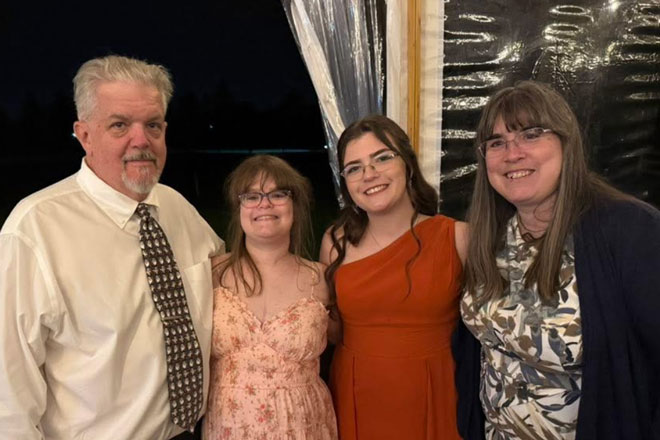 The Everett family, from left: Roan, Victoria, Brittany and Carye, at a family friend’s wedding in October 2025.
While there were ties between the two organizations prior to the formal partnership, Mt. Washington’s Ajayi-Akintade says the two decades of collaboration have drawn the institutions closer and created more direct lines of communication.
“Having the opportunity to be able to call on the expertise from Johns Hopkins, a hospital that has been ranked one of the best in the world over and over again, is a great thing,” she says. “I think the biggest difference is knowing that when you need help, it’s just a phone call away.”
Victoria and Brittany Everett, at age 24, are living proof that this partnership has resulted in lifesaving individualized care. Both live at the family home in southern Pennsylvania, where Brittany is now a college student studying education with hopes to become a teacher, and Victoria works part-time and creates art (she used to decorate Katz’s door when she was at the hospital). Their mother, Carye, is still close with many of their doctors and nurses, and has attended weddings and family funerals.
“They’re just family at this point. They were there to celebrate, they were there to cry with us,” she says. “I don’t know how we would have gotten through it without any of the doctors and nurses from both places.”