
A Lifechanging Food Allergy Treatment: Charlotte's Story
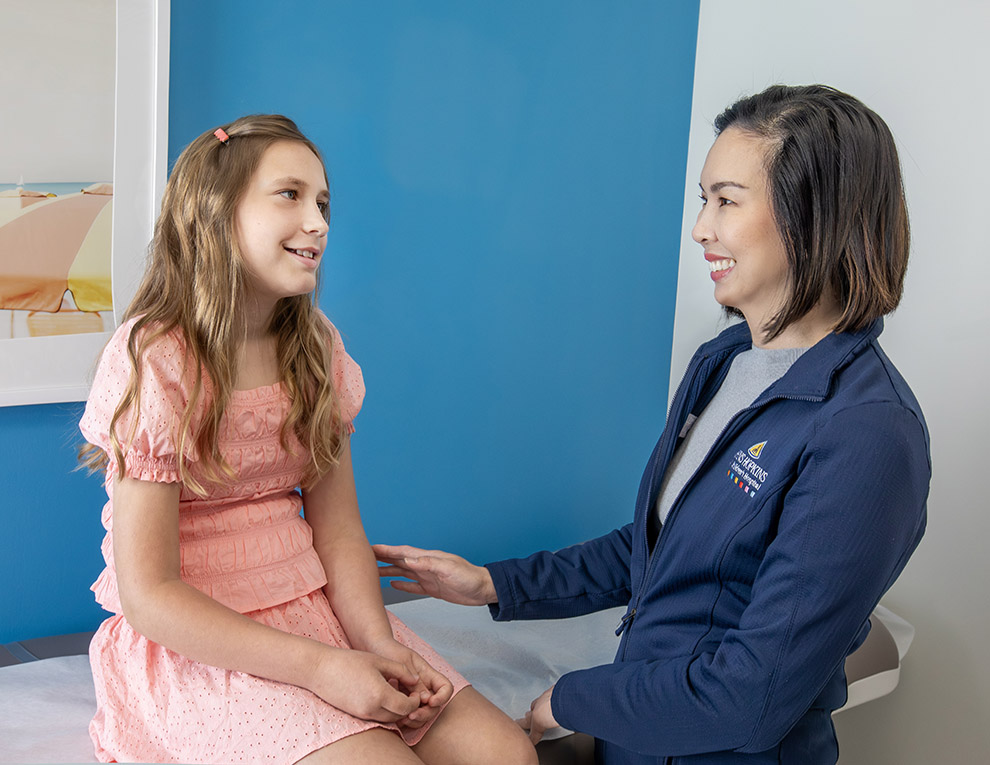
Eating school lunch, birthday cake and carnival food were just a few of the items on 9-year-old Charlotte’s “Wish List” of food and activities. Seems simple — so wholesome. But for kids like Charlotte with a severe allergy to peanut and tree nuts, the things that we think often go hand-and-hand with childhood, are potentially deadly.
“Some birthday parties made me cry because I couldn’t join my friends — they’d say ‘Mmm, this is so good,’ and I’d be sad I couldn’t have it,” Charlotte says.
Food allergies are lifechanging for families — from restricting the whole family from certain foods to constantly reading nutrition labels — and many times skipping going out to eat for fear of cross contamination.
“It changes your everything, it changes your world,” says Charlotte’s mom, Amy, who is also a registered nurse in the Johns Hopkins All Children’s Hough Family Institute for Brain Protection Sciences in St. Petersburg, Florida. “Unless your kid has allergy, or you do, it’s hard for people to understand how it affects your life.”
For their family, it all began when Charlotte was about 15 months old.
“She ate a raisin that was mixed in with trail mix that had cashews in it,” Amy explains. “She immediately had a rash on her face, swelling and she was vomiting. Although I'm a nurse, my emotions kicked into overdrive, and I just couldn't even think rationally of what to do for her. It was very scary to see my baby reacting to this.”
Charlotte recovered from the incident and was followed by an allergist who suggested carrying epinephrine autoinjectors and avoiding all nuts completely. That was the plan until Amy learned about the Food Allergy Clinic at her very own place of employment. By then, Charlotte was 8 years old. This is when they met Panida Sriaroon, M.D., who had a strategic plan of action — starting with narrowing down Charlotte’s food allergy profile through updated testing.
Testing Time
“Charlotte had already missed out on life events and activities because of her strict avoidance of peanut and tree nuts,” Sriaroon says. “So, her parents wanted to see if Charlotte would grow out of some of these allergies.”
They started with skin and blood testing, which showed she was still allergic to peanut, pecan, cashew and pistachio, but it remained unclear whether she was allergic to walnut and hazelnut. The next step would be a test called an oral food challenge.
“This is also known as an in-office, supervised feeding,” Sriaroon says.
Patients are given a small amount of food in question over a period of hours and are monitored for a reaction. Charlotte had reactions during her tests, with one even leading to an Emergency Department visit, confirming she is allergic to six different types of nuts in total.
“It is quite rare for someone to have so many nut allergies,” Sriaroon says. “We know for some food, like milk and egg, about 80% of kids will grow out of the allergy by age 4 or 5. On the other hand, for peanut and tree nut allergies, fewer than 20% will grow out of them. I told Amy, ‘I’m not going to sugarcoat this: I don’t think she’s going to outgrow these allergies.’”
But there was hope. A new treatment, resulting from the landmark OutMATCH study led by Robert Wood, M.D. at Johns Hopkins Children’s Center in Baltimore, Maryland, has given families a new option for coping with food allergies.
Lifechanging Medicine
Wood’s study found that omalizumab (brand name Xolair), previously approved to treat asthma and other allergic conditions, was highly effective in preventing reactions in patients with a severe food allergy. Sriaroon explained this option to Amy and Charlotte.
Xolair is an injection medication. The first three doses are given in the office, but after that they are doing it at home every two to four weeks. Once they’ve been on it for about four to five months, the patient can typically start oral immunotherapy, which for Charlotte means eating one of each nut she’s allergic to each day.
“Basically, we either avoid these foods strictly — or we expose her regularly to them in known, tiny amounts. This trains her body to not recognize these nut proteins as a threat, via a process called desensitization. But it only works if she remains on the treatment,” Sriaroon says. “This desensitization effect is achieved by oral immunotherapy alone, or oral immunotherapy coupled with Xolair.”
“I eat four peanut M&Ms, one tablespoon of Nutella, one pistachio, one cashew, one pecan and one walnut, all at once,” Charlotte says. “I really enjoy parties I can go to. I've gone to parties by myself, without my parents, but still acknowledging that I have to read labels.”
This maintenance treatment helps her in case she is accidentally exposed to nuts in her daily life, which is not a cure, and she will always have these allergies, but it could be lifesaving and allows her to live a more normal, carefree life. Now Charlotte can get back to being a kid and focus back on things like dance, and her favorite subjects — math and reading.
“I can’t even put into words how exceptional the staff is,” Amy says. “Charlotte is a very curious little girl and has a ton of questions. They were so patient with her, and I am just so appreciative of the time and energy they put into her.”
And as Charlotte now has fun checking off her Wish List by exploring new restaurants and trying new foods, with her eyes set on trips to Hawaii and Greece one day, she also hopes to one day be a dermatologist or work for NASA.
Allergy and Immunology at Johns Hopkins All Children's
Johns Hopkins All Children’s Hospital in St. Petersburg, Florida, provides a range of testing for children and teens with allergies and immunologic conditions. Common symptoms you might see if your child has an allergic or immunologic condition can include chronic runny nose, cough, itchiness or hives; reaction to certain drugs, insects or vaccines; or recurrent infections.