
Spotlight on Clinical Excellence at Johns Hopkins All Children’s
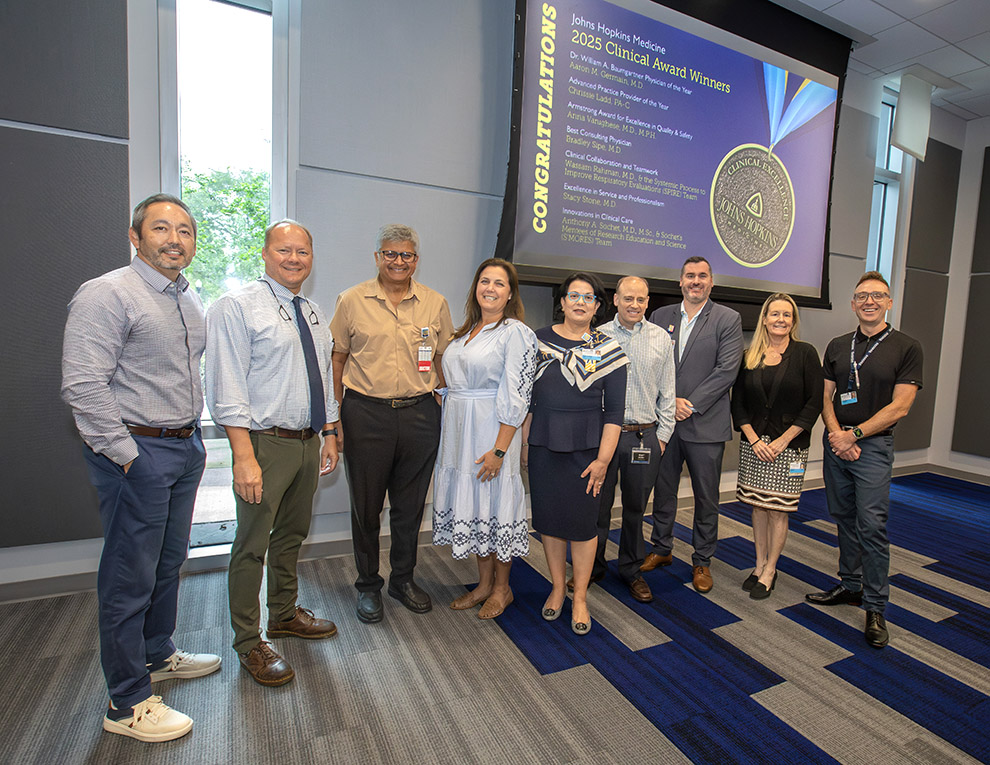
Johns Hopkins All Children’s clinicians and teams were honored during the 11th Annual Clinical Excellence Awards ceremony on April 7 on the St. Petersburg, Florida, campus.
“It is inspiring to celebrate your accomplishments in patient care and a privilege to witness your commitment to our patients and their families,” says President Alicia Schulhof before the announcement of award winners in seven categories.
“This is an exciting time at Johns Hopkins All Children’s,” she continues. “We are celebrating our 100th birthday, building a new hospital in Wesley Chapel, completing an expansion of our St. Petersburg hospital and growing the number of outpatient locations to reach new communities that need specialty pediatric care. Your excellence, expertise and innovation make these things possible.”
Chief Medical Officer Joseph Perno, M.D., and Communications Director Jourdan Bennett recognized the nominees before announcing the winning physicians, advanced practice provider and clinical teams, and thanked the selection committee for their thoughtful work in reviewing a record number of nominations and voting to determine the winners.
Advanced Practice Provider (APP) of the Year: Chrissie Ladd, P.A.-C.
Chrisse Ladd was one of the first physician assistants to practice in the Johns Hopkins All Children’s Emergency Department. Her exceptional clinical and leadership skills led to her being named manager for APPs in the EC, pediatric intensive care unit and palliative care program. Ladd played a pivotal role in building an APP-driven hospitalist service that set a new standard for collaboration and APP-led inpatient care. Through her vision and dedication to patient-centered care, she continues to manage these programs and strengthen the role of APPs across the organization.
In addition, Ladd demonstrated versatility and innovation by leading the launch of first APP-run urgent care center at a Johns Hopkins All Children’s facility. She led recruitment, onboarding, clinical training and protocol development while implementing the first Epic urgent care electronic medical record in the Johns Hopkins Health System. Ladd’s ability to balance visionary program development with hands-on clinical experience is a paradigm for what an APP can contribute to an academic pediatric health system.
Armstrong Award for Excellence in Quality and Safety: Anna Varughese, M.D., M.P.H.
As a professor of anesthesiology and critical care medicine and a pediatric anesthesia clinician-researcher, Varughese integrates frontline care with improvement science to embed safety-focused and evidence-based practices in the perioperative setting. This has led to measurable improvements in patient comfort and outcomes. Her efforts were key to obtaining Level 1 Pediatric Surgical Center verification for the hospital.
Varughese models excellence in daily clinical care — identifying safety considerations, mentoring junior staff and fostering psychological safety so that all team members feel empowered to voice concerns. As an educator, Varughese has integrated patient safety principles into residency electives, coordinated quality improvement seminars, and led the annual anesthesia patient safety and quality conference. She is also leading a patient safety and quality program in the neonatal intensive care unit that helps identify quality metrics, strengthen handoffs and improve discharge planning, an example of her impact in driving quality across the hospital.
Varughese’s ability to translate complex data into improvements has made her a respected voice in the field. She is the immediate past president of Wake Up Safe, the Pediatric Anesthesia Quality Improvement Initiative, and is the medical director of the American College of Surgeons’ child anesthesia verification program. A colleague notes, “I can think of no one more deserving of recognition for advancing the care of children, improving perioperative safety, and inspiring her colleagues to reach even higher.”
Best Consulting Physician: Bradley Sipe, M.D.
Sipe exemplifies excellence as he provides consultations to expectant parents in the Maternal-Fetal Medicine (MFM) clinics. Whether seeing a patient with few risk factors or a patient with a diagnosed complication of pregnancy, he has a remarkable ability to explain complex information in a way that is reassuring and easy to understand, helping patients feel supported and informed. He is exceptionally skilled at discussing genetics and managing high-risk pregnancies, providing clear, compassionate guidance. He balances evidence-based knowledge with empathy. Before leaving the room, he takes time to ask the patient and family once again if they have questions about the findings and explanations he shared. This deep connection with families is also evident in the operating room, as shared by a mother grateful for Sipe’s lifesaving actions.
Sipe collaborates seamlessly with other specialists, ensuring coordinated and evidence-based care. His consultations are often educational for the clinical team as he takes time to explain his reasoning and share insights that enhance collective understanding. A colleague notes, “Dr. Sipe walks into every consultation with the tools needed to answer the patient’s questions and concerns. He has transformed the standard of patient care within the MFM program through deep clinical insight, evidence-based practice and genuine compassion.”
Clinical Communication and Teamwork: Wassam Rahman, M.D., and the SPIRE Team
The Systemic Process to Improve Respiratory Evaluations (SPIRE) team is a collaboration of the Emergency Department, Pediatric Intensive Care Unit (PICU) and the hospitalist program, working together to ensure the right patient is placed in the right bed at the right location.
Under the leadership of Wassam Rahman, M.D., Nathan P. Dean, M.D., and Stephen Kennedy, M.D., the SPIRE initiative has established a streamlined and patient-centered approach to admission decision-making. Through effective communication, data-driven assessment and interdisciplinary coordination, the team has optimized the process of determining the most appropriate level of care for patients with asthma, bronchiolitis and pneumonia.
SPIRE has significantly reduced unnecessary PICU admissions, minimized patient transfers and prevented avoidable rapid response activations — leading to improved patient safety and resource utilization. This collaboration exemplifies the power of teamwork across departments, feedback and data management, highlighting how shared goals and unified processes can directly enhance clinical outcomes and patient experiences.
Excellence in Service and Professionalism: Stacey Levitt Stone, M.D.
Since joining the neonatology program in 2002, Stone has dedicated her career to the care of vulnerable newborn patients. As a key member of the Center for Congenital Diaphragmatic Hernia (CCDH) care team, the only ICU dedicated solely to the care of CDH patients, Stone manages the delicate balance of stabilizing critically ill infants. As a member of the extracorporeal membrane oxygenation (ECMO) team, she works alongside surgeons, guiding ventilation strategies that protect patients’ fragile lungs. Her efforts are essential to the unit’s superior outcomes and the care model based on early medical decisions that set the stage for lifelong health.
Stone’s years of service on the hospital’s Human Values and Ethics Committee reflect her integrity and commitment to doing what is right for patients, families and staff. Her experience as a neonatologist strengthens the committee’s culture of compassion, fairness and ethical clarity. Across all her roles — neonatologist, CCDH team member, ethicist, mentor and colleague — Stone models altruism, competence and collaboration and is a thoughtful presence during moments of crisis. Her impact is cultural as well as clinical, and she elevates the standard of professionalism for everyone around her.
Innovations in Clinical Care: Anthony Sochet, M.D., M.Sc., and Sochet's Mentees of Research Education and Science (S'MORES) Team
Sochet, a pediatric critical care physician and translational scientist, is fostering the academic mission of Johns Hopkins All Children’s through his comprehensive scientific mentorship and research program. This initiative provides a transdisciplinary approach including didactics, experiential learning, and structured accountability to a broad group of interested junior clinical scientists, attending peers, trainees and allied investigators.
Sochet’s efforts have ignited curiosity and passion for discovery, transforming research into an achievable and exciting career. With more than 50 S’MORES participants to date, the program has supported multiple funded investigators, peer-reviewed publications and presentations at conferences and consortia. The members have contributed to evidence-based practice, guidelines development, and innovative discoveries.
By providing a strong foundation for scholarly growth, Sochet’s leadership has transformed trainee and student engagement and expanded mentorship opportunities within the fields of critical care and beyond, creating a sustainable culture of innovation and excellence. Most importantly, the program instills a spirit of joy for academia in future health care professionals demonstrating the real-world impact of translational research on patient outcomes.
William A. Baumgartner Physician of the Year: Aaron Germain, M.D.
Germain is deeply committed to the care and outcome of our neonatal intensive care unit (NICU) patients. His steady presence, work ethic and humility elevate everyone around him, and families trust him implicitly. As medical director for neonatal transport for the LifeLine Critical Care Transport Team, he has improved coordination and delivery of care to the region’s most fragile infants by strengthening communication between referring hospitals and our NICU team. This has ensured safer and more compassionate transitions of care, leading to better outcomes for infants as well as stronger relationships across systems.
Germain also serves as associate program director for the Neonatal-Perinatal Medicine Fellowship Program. He has enhanced the culture of learning in the NICU by incorporating medical simulation, interactive learning, morbidity and mortality case reviews, and evidence-based teaching. He mentors fellows, residents, APPs and nurses with patience and authenticity. Germain’s research quality efforts continue to advance neonatal care, and his interests in patient outcomes and educational innovation have led to improvements in patient care and clinician training.
A colleague notes, “What stands out most is how he manages to do all of this — the long clinical hours, the leadership roles, teaching and clinical research — while maintaining genuine kindness, humility and joy in his work. Working alongside him makes each of us better at what we do, and more importantly, reminds us why this work matters.”
In closing remarks, Vice Dean and Physician-in-Chief George Jallo, M.D., noted that 81 nominations were received this year—a record number.
“Each one reflected the great work being done by our nominees and award winners,” he noted. “Your outstanding efforts help us push the boundaries of clinical care, and we thank you for all you do on behalf of our patients and their families along with learners and colleagues.”
Later this month, our award recipients will be recognized again at the Johns Hopkins Medicine Clinical Awards.