
Nurse’s History Inspires Her Care
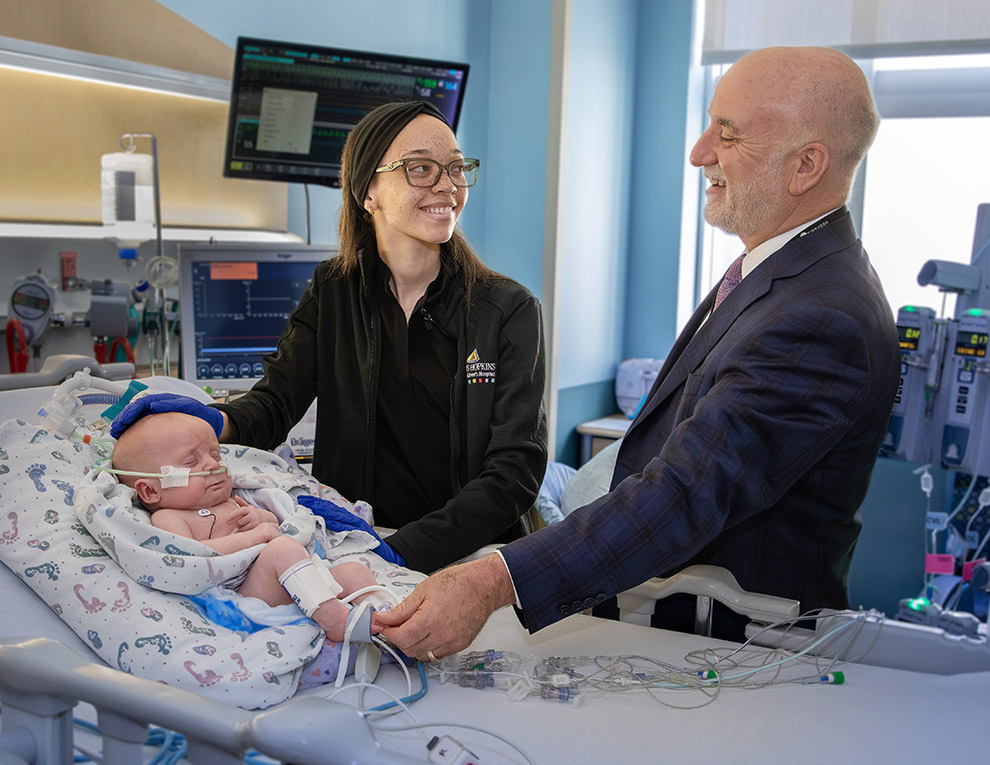
As the last of the early evening sunlight filters through the windows on the eighth floor of Johns Hopkins All Children’s Hospital in St. Petersburg, Florida, Angel Leverette, R.N., is beginning her nursing shift.
Her first patient, 15-week-old Jack, is restless. It’s not easy for a sick baby to express precisely what he may want or need. But Angel is determined to figure it out.
“What is it, Jack?” she coos softly, as she extends a comforting touch.
Angel has verified the baby’s medications, and she’s confirmed that his vital signs are stable. She focuses on his comfort. She doesn’t rush. The young nurse changes Jack’s diaper, swaddles him, and strokes his cheek as she talks to him.
She works in tandem with his mom and dad to move him into a new position he prefers, taking care not to disturb the various tubes, leads and wires that help monitor his progress and deliver medications. Slowly, Jack begins to relax and settle.
It’s a long road for these little ones. All of the babies in this highly-specialized unit were born with congenital diaphragmatic hernia (CDH), a birth defect in which the diaphragm – the muscle separating the abdomen from the chest — does not develop completely, allowing abdominal organs to fill the chest, impeding lung growth and threatening the baby’s life.
But these are lucky babies. The Center for Congenital Diaphragmatic Hernia at Johns Hopkins All Children’s is the first and only intensive care unit in the country dedicated solely to the treatment of CDH. Led by renowned CDH expert and medical director David Kays, M.D., the center offers the benefits of vast experience, innovative techniques and comprehensive, compassionate care that result in outcomes for these babies that far exceed the national benchmark.
“We start with the concept that these kids can survive, and so we fight for them,” Kays says. “We know it’s all about preserving and protecting the lungs they are born with. We do that every day at a very high level, again and again and again — and that’s what is different about us.”
That ethos is part of what makes nurses like Angel proud to be part of this exceptional team.
“I absolutely love being a nurse on this floor,” Angel says. “I want to keep these babies safe and comforted, and to give them the very best care I can, because they deserve it.”
Angel has just completed her first exhilarating year in the Pediatric RNResidency Program at Johns Hopkins All Children’s. But she brings something beyond compassion, enthusiasm and a growing mastery of skills to the Center for CDH. She brings her own special history.
Twenty-three years ago, Angel’s parents, Amanda and Robert, were devastated when a scan revealed that one of Amanda’s unborn twins had a life-threatening birth defect – something they had never heard of. What in the world was congenital diaphragmatic hernia?
Amanda began to learn more and searched desperately for doctors who could help save their child. They were not offered much hope.
Finally, Amanda learned about a talented young doctor who had already made a name for himself in the treatment of CDH at a major teaching hospital in Gainesville, Florida.
His name was David Kays, M.D.
“From the beginning, he was very positive and uplifting when I met him,” Amanda says. “He gave us hope. Ultimately, he saved our daughter.”
On a February day in 2003, the twins were born prematurely, at 33 weeks of gestation.
Angel had a highly severe diaphragmatic hernia, with only 2% of a developed diaphragm and a large amount of liver pushed up into her chest, choking off the growth of her left lung.
Kays performed Angel’s extensive repair surgery, took excellent care of her lungs and set her on a path to wellness. To her family, her survival and progress felt like a miracle.
As she grew into girlhood, each year, as she came back to Kays and his team for her clinic visit, she delighted them with a fresh, imaginative answer to the perennial question of what she wanted to be when she grew up.
“One year, I would insist I wanted to be a teacher. The next year, I was sure I wanted to be a lawyer,” she recalls with a chuckle.
It wasn’t until Angel had grown into a young woman that she fully grasped what she had overcome — and how fortunate she was. Her desire to give back in a meaningful way inspired her path to nursing — and perhaps by another miracle — to the very doctor who has continued to save babies born with CDH for all of these years — only now at Johns Hopkins All Children’s in St. Petersburg.
What better way to give back than to care for the very babies and families who are going through what she and her own family once endured?
“I know it sounds crazy, but I do feel such a connection with these babies,” Angel says. “I look into their eyes and I’m like, ‘I know exactly what you’re going through.’”
While Angel doesn’t share her medical history with every family on the CDH floor, once in a while, if she feels it may be encouraging to a parent who is having an especially tough day, she lets them know that there was a time, long ago, when she was that fragile infant in a hospital bed, fighting to overcome a congenital diaphragmatic hernia.
“I’m absolutely healthy now. I have nothing holding me back,” Angel says. “You would never know I went through all of that.”
The patients Angel cares for now have the benefit of more than two additional decades of innovation, knowledge and experience than when she was a newborn.
“What’s changed over time is really a refinement and increase in the depth of understanding of these children and their potential,” Kays says. “I remember being excited back then at the prospect of getting to an 80% survival rate — and now we’re in the high 90% survival range.”
It’s not easy being a CDH nurse. The clinical professionals on this unit are responsible for patients with a full spectrum of disease, from less severe to critically ill and on life support. They care for patients and their families, minute by minute, through good days and extraordinarily hard ones. It is a relentlessly demanding job.
Kays’ doctor-patient relationship with Angel has long since evolved into a professional one. There is no special treatment, save for a smile exchanged in passing. But they both know.
“I think Angel is incredibly inspiring,” Kays says. “I’m proud of what she overcame and the young woman she has become, and for her to have the opportunity to be a nurse in a unit that specializes in the very disease she had is amazing.”
Angel remains focused on meeting the high expectations the job demands, but sometimes, in fleeting moments of clarity, her perspective shifts and broadens.
“Once in a while, I’ll see Dr. Kays on the unit, and I’ll think to myself, ‘Hey, that man saved my life,” Angel says.
The golden colors of sunset are now fading as the night sets in on the CDH unit.
Angel steps quietly into the room of a tiny baby girl and checks her oxygen levels. She lays a soft, reassuring hand on the infant as she peacefully sleeps.
Angel takes a deep breath and mentally prepares herself to nurse her patients through the night.
“I know these babies can have such a beautiful life,” she says.
Whatever may come tonight on the CDH floor, this nurse is going to give it everything she has.