
New Center Will Expand Precision Medicine Rehabilitation to Younger Patients
Investigators with Johns Hopkins and Kennedy Krieger won an NIH grant to create the Precise Center for Precision Rehabilitation Across the Lifespan.
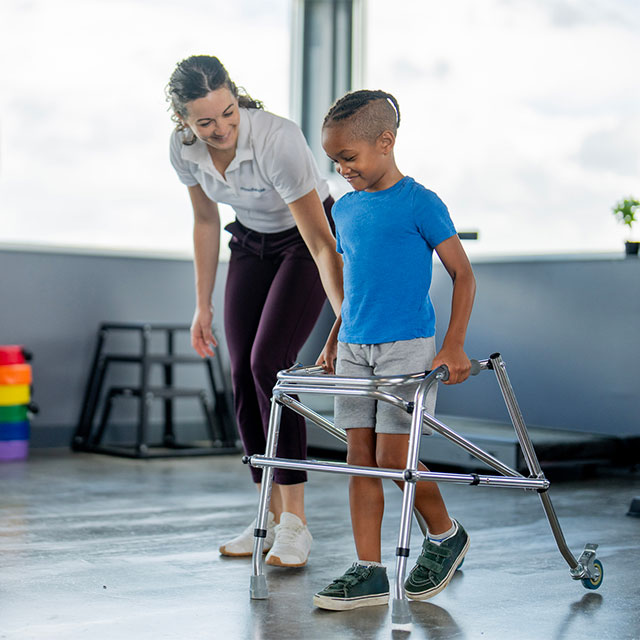
A new precision medicine center, supported with a five-year, $6.25 million National Institutes of Health grant, will expand the Rehabilitation Precision Medicine Center of Excellence (Rehabilitation PMCOE) to include pediatric patients.
The grant was awarded to faculty with the Johns Hopkins Department of Physical Medicine and Rehabilitation and the Kennedy Krieger Institute to create the Precise Center for Precision Rehabilitation Across the Lifespan, which will take a data-driven, individualized approach to helping patients improve function through rehabilitation.
“This grant is part of a broader movement within medicine to provide more personalized care,” says Stephen Wegener, co-founder of the Rehabilitation PMCOE — one of 22 such personalized medicine centers at Johns Hopkins.
He shares the grant with Ryan Roemmich, director of the Rehabilitation PMCOE and the Center for Movement Studies at the Kennedy Krieger Institute; Amy Bastian, chief science officer at the Kennedy Krieger Institute; Preeti Raghavan, director of the center of excellence for stroke treatment, recovery and rehabilitation and vice chair for research in the Department of Physical Medicine and Rehabilitation; and Stacy Suskauer, director of the Division of Pediatric Rehabilitation.
The investigators will collaborate to identify and develop a standardized clinical battery of measurements of function and share those metrics across five similar centers nationwide. The clinical measurements will be integrated with wearable data to identify subgroups of similar patients and inform the design of individualized care plans that are most effective for each patient.
“The core of what we’re trying to do is move from a one-size-fits-all model of rehabilitation to a precision medicine model, where all aspects of the person’s function are considered when they’re receiving care,” says Roemmich.
The center will build on — and use data from — the Rehabilitation PMCOE, founded in 2018, which uses measures of physical, cognitive and psychosocial function to fine-tune rehabilitation strategies for people who have had a stroke. The new center will broaden that approach to support patients of all ages, including pediatric patients at the Kennedy Krieger Institute, such as children born with cerebral palsy and adolescents recovering from concussions.
“We’ve taken what we developed for stroke as part of the collaborative work between the center of excellence for stroke treatment, recovery and rehabilitation and the Rehabilitation PMCOE and are broadening the horizon to include potentially all rehabilitation,” says Raghavan.
Raghavan describes rehabilitation as a “horizontal specialty” because it treats physical, cognitive and psychosocial dysfunction, often simultaneously, across diagnoses. As patients receive care across Johns Hopkins, data is added to their electronic medical records, creating a rich and continuously evolving source of information that can support personalized care. “The key is to ensure that we have the same measurements across the continuum of care, and that the measurements are meaningful to both patients and providers,” she says
The investigators are also creating new, more precise measurements of function. For example, clinicians have long measured gait speed in people who have had a stroke by clocking how long it takes them to walk 10 meters down a hallway. But that doesn’t say anything about how they are walking. Is the patient shuffling? Dragging one leg? Roemmich developed a video-based system that uses artificial intelligence to complement traditional measurements with granular details about each stride.
Patients are also outfitted with wearable devices that provide data about their activities, such as how many steps they are taking a day, and function, such as whether their active heart rate is getting lower over time.
“We can share trajectories of functional progress with our patients and the clinicians who are at the forefront of patient care, and educate them on what they can do to improve further,” says Raghavan. “Rehabilitation is slightly different from other fields because patients have to be motivated to participate, and that can depend on them knowing how far they have come and what they need to do to get to the next stage in their recovery.”
Bastian says she is thrilled that Kennedy Krieger and Johns Hopkins are collaborating on this project.
“It makes sense to have both institutions involved because we already collaborate extensively on clinical work. The Johns Hopkins Rehabilitation PMCOE is exceptional, and we are excited to customize their model for pediatric patients at Kennedy Krieger,” she says.
“By harnessing the power of both institutions, and making the resources available to other centers nationally, we’re going to be a rising tide that lifts all boats.”
For Clinicians Clinical Connection
Clinicians, discover the latest in research and clinical innovation from Johns Hopkins experts. Access educational videos, articles, CME courses and other resources from our world-renowned institution.