
A Happy Ending for a Complex Heart Transplant
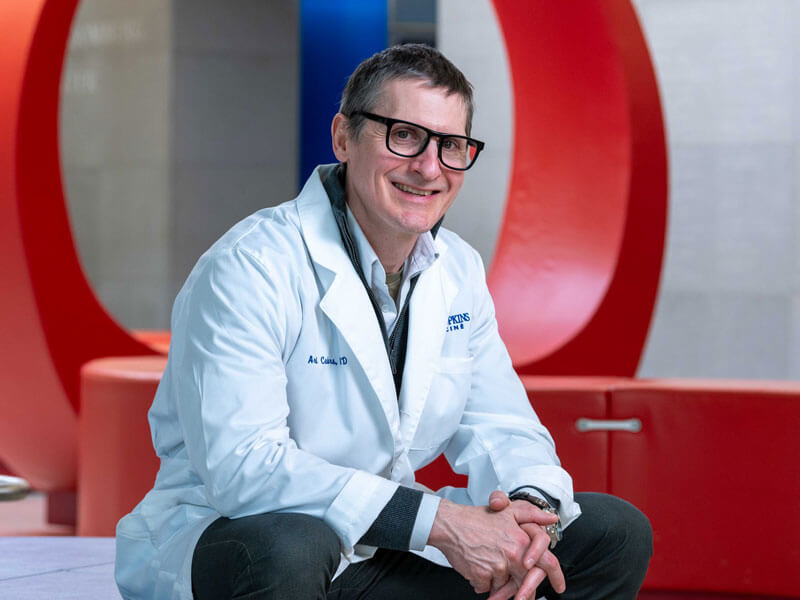
Ari Cedars
Surgeons at The Johns Hopkins Hospital have performed a technically challenging heart transplant on a 19-year-old patient with congenital heart disease who presented in shock, restoring health to the young adult.
During a 12-hour procedure in April, a surgical team led by cardiothoracic surgeon Chetan Pasrija and pediatric cardiothoracic surgeon Marcelo Cardarelli, removed the patient’s diseased heart and replaced it with a healthy donor heart.
A transplant after a Fontan palliation is considered one of the most advanced and complicated procedures. There are not that many institutions in the United States that do it, and there are even fewer who do it well.
Ari Cedars
The patient had been born with double outlet right ventricle, a rare disease in which his left ventricle — the part of the heart responsible for pumping blood to the body — wasn’t fully formed. “It falls in the spectrum of a larger disease process known as hypoplastic left heart syndrome,” explains Pasrija.
That required the patient to undergo a series of four palliative surgeries at Johns Hopkins in his infancy and as a young child, including a Fontan procedure, an operation done so the single ventricle only pumps oxygenated blood to the body.
“A transplant after a Fontan palliation is considered one of the most advanced and complicated procedures,” notes cardiologist Ari Cedars, director of the Johns Hopkins adult congenital heart disease program. “There are not that many institutions in the United States that do it, and there are even fewer who do it well.”
During the transplant, the Johns Hopkins surgeons first disconnected the inferior and superior vena cavae from the pulmonary artery, closed the holes in the pulmonary artery and created a new hole to connect the donor heart pulmonary artery to the recipient. In this case, the patient had two superior vena cavae, a right and a left. The surgical team did an additional reconstruction to take the left-side superior vena cava, bring it to the right side, and create a new superior vena cava structure. Both heart donor tissue and bovine pericardium were used during these parts of the procedure.
“That’s one reason why a lot of institutions don’t offer this surgery, because it is quite complex and is known to have significantly increased likelihood of perioperative morbidity and mortality,” says Pasrija.
The patient did extremely well with the transplant, Pasrija says. After about a month, he was discharged home, where he continues to recover.
Noting the very positive outcome, Cardarelli observes, “It must be an incredible feeling transitioning from being bed ridden and connected to an assist device pumping the blood your heart can’t pump anymore, to suddenly — out of nowhere — the gift of a normal heart and a pretty normal life when you are just becoming an adult. All was made possible by a selfless donor, his family and a large team of great professionals.”
Adult Congenital Heart Disease Center
