
Blood Flow Restriction Therapy: Asher’s Story
A handshake can reveal a lot about a person.
Twelve-year-old Asher’s handshake is firm and confident. He looks you in the eye and is quick to offer a generous smile. Right away, you have a sense you’re meeting somebody special.
“OK, are you ready for this? We’re going to do three rounds of 20.”
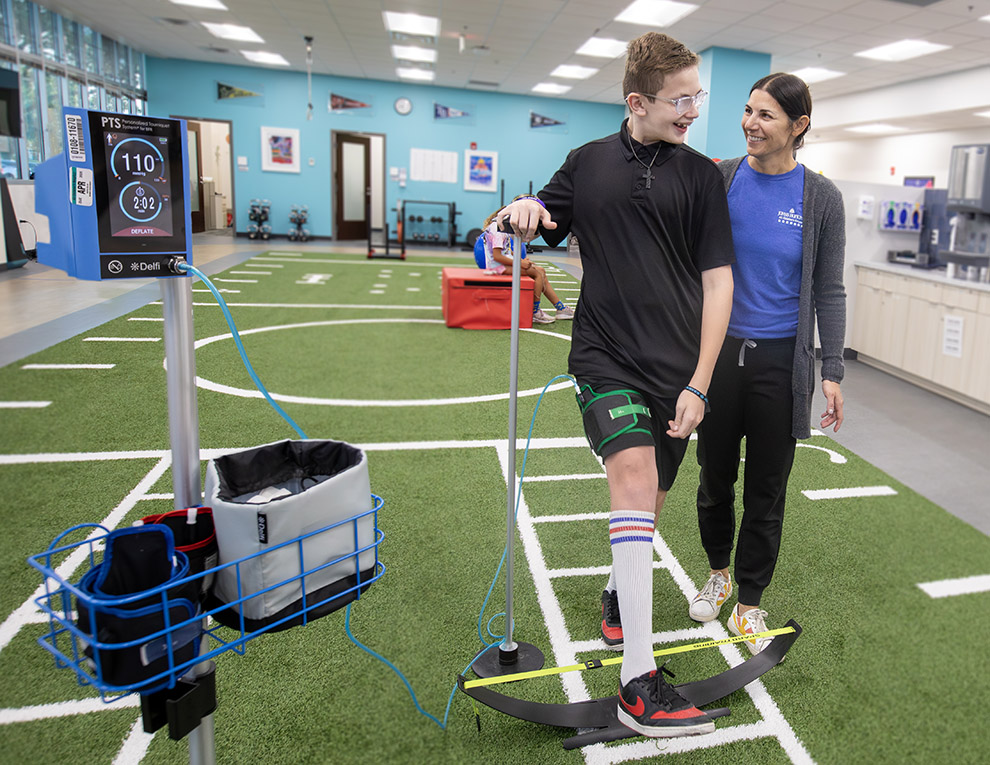
On this day, Asher has joined his physical therapist, Allie Benson, on the sports floor of the sparkling new Johns Hopkins All Children’s Rehabilitation Center in St. Petersburg, Florida.
It’s time for some serious PT, and true to form, Asher is ready to make the most of it.
“Asher is probably the hardest working kid I’ve ever worked with,” Benson says. “Even at age 5, he would ask to stay late and work on his core. He’s always been so dedicated.”
Benson, like so many of the clinical staff at Johns Hopkins All Children’s, is like family to Asher. The hospital has been a mainstay in his life since birth, starting with his time in the neonatal intensive care unit (NICU), then with a diagnosis of spastic diplegic cerebral palsy at age 2, and the many years of doctor visits, therapies and even surgery that followed — all designed to help Asher prevail over the physical challenges that come with his condition.
“His right side is much weaker than his left side,” says his mom, Jessica. “Asher is always looking for ways to get stronger.”
Today, Asher will perform some training exercises for strength and balance, but with a challenging twist. His therapist will add a technique called “blood flow restriction” (BFR) therapy.
Benson straps a device that looks like a large blood pressure cuff on Asher’s upper right thigh. She uses a small manual bulb pump to obstruct a precise portion of the blood flow, all while carefully monitoring the digital screen that reflects the pressure in the tourniquet on Asher’s leg.
It’s time to get moving.
Asher begins a series of exercises using a small box, stepping up onto the box, one foot at a time and then down again. A series of these steps would be enough to make a skilled athlete’s thighs burn. But given Asher’s weaker right side and now the restricted blood flow, he’s getting an extra intensive workout in less time, all without adding undue “load,” or stress to his lower limb.
“It’s a pretty tight squeeze,” Benson says. “Your leg feels numb and tingly, heavy and a little bit hot. It’s much, much harder to move.”
The difficulty is evident on Asher’s face as he wills his right side to adapt to the challenge. But he keeps at it.
“I try to be the best person I can be,” Asher says. “I don’t want to look like a person that complains a lot.”
Blood flow restriction therapy has been used for several years in athletes as well as for some adult patients recovering from injuries or surgeries.
More recently, it has been introduced to certain pediatric patients, including neurological patients like Asher, for whom high intensity exercise might be more difficult.
“We strive to be innovators, leaders in our field,” says James Chinarian, M.D, chief of the Division of Pediatric Rehabilitation Medicine.
“It’s important that we have a variety of effective therapy modalities available because of what they offer to both the therapists and the families. Not every therapy is helpful for every child, but it might be right for the patient in front of you that day.”
Asher’s therapist began adding blood flow restriction therapy to his other intensive therapies to see if his outcomes would improve — and they certainly did. The comparative strength in Asher’s right leg began to catch up to his left, reducing the asymmetry that can challenge his mobility and impact his quality of life.
“I’ve seen it make a big difference for Asher,” Benson says. “It’s improved his gait pattern, his foot is a lot straighter, his steps are more even, and he’s walking faster.”
Asher has lived the difference.
“The therapy helps me a lot,” Asher says. “It makes things better for me.”
This honors student is certainly self-motivated. He is bolstered by the strength of his faith, a supportive family, and of course, physical therapy that works.
“Middle school is hard as it is,” Jessica says. “But with Asher being different and having to work harder than other kids have to work ... and yet he’s so resilient. I’m super proud of him.”
This wise 12-year-old remains humble and hopeful about all he is achieving.
“It’s not really hard,” he says. “It’s as easy as I make it.”