
How to Prepare for Your Child's School Bell to Ring
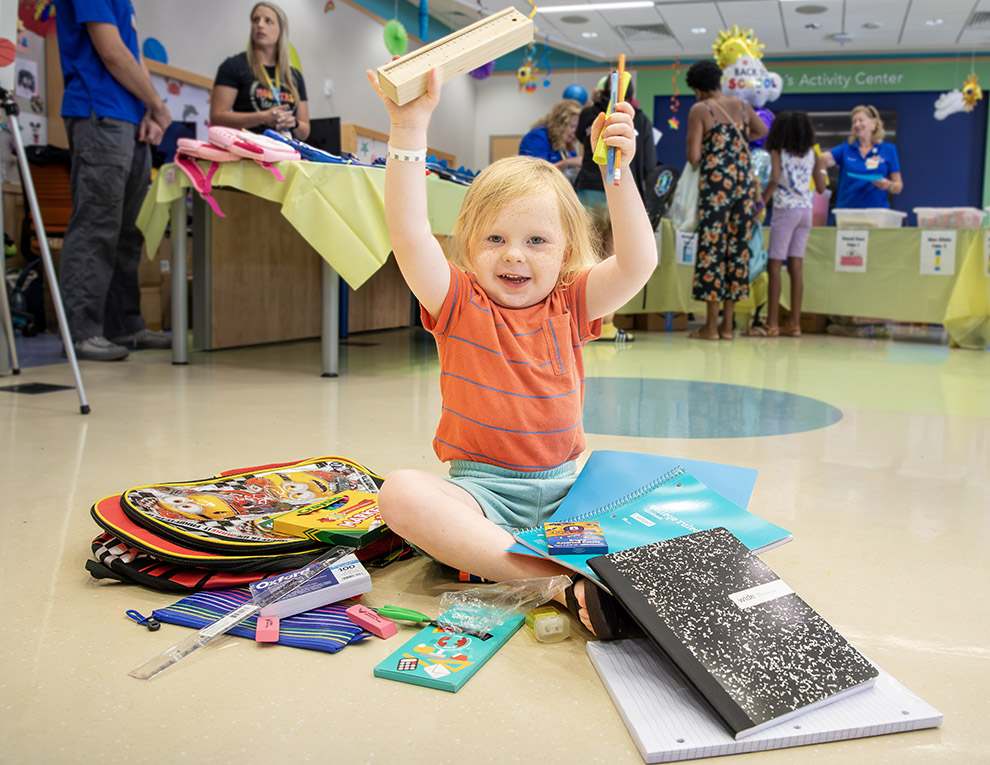
Back to school is one of the busiest times for parents and children. Between shopping for school supplies, back-to-school checkups and getting into a routine, it can take some juggling. At Johns Hopkins All Children’s Hospital in St. Petersburg, Florida, our doctors are always willing to help parents and kids adjust to all the changes.
A Good Night’s Sleep
Returning to school is a good opportunity to develop a good sleep routine, which is best to kick off a week or two before the beginning of the new school year. Luis Ortiz, M.D., a sleep medicine specialist in Johns Hopkins All Children’s Sleep Center, recommends pushing up your child’s bedtime by 15 minutes every other day until you reach what is optimal to start the school year. This is especially important, he says, if your child has been going to bed much later in the summer months compared to the school year. “During the summer, I see a lot of patients where their sleep schedule is wild,” Ortiz says. “We're talking about going to bed at 2, 3, 4 a.m., and not waking up until the afternoon. Obviously, that's not going to be compatible with school, and now is the time to get back on track. And so, what I normally recommend, is to figure out what time you need to wake up and slowly moving up the bedtime and wake up times until you’re back on schedule.”
Ortiz says kids often need more sleep than their parents or caregivers might realize. A 10-year-old child needs 10 hours of sleep each night. Younger children need more, and teens should aim for at nine hours each night. Ortiz suggests these bedtimes: elementary school ages: 7:30-9 p.m.; middle school ages: 8:30-10 p.m.; teens: 9-11 p.m. He says young adults actually don’t reach that recommended 7-8 hours of sleep milestone until they are in their mid 20s. Ortiz adds if your child routinely misses bedtime, don’t let them sleep in. This may allow your child to realize how tired they feel with inadequate sleep.
Ortiz also recommends optimizing the bedroom by making it a cool, dark place with minimal distractions. White noise machines can be a useful tool for children who are often distracted by noises outside of the bedroom. As for blackout curtains, they might not be as crucial of a tool. “If you really want to get sleep schedules back on track, you really need that early morning sunlight first thing in the morning to help you get back on schedule,” he says. “So, the blackout curtains can be a double-edged sword here. It may help you get to sleep, but it may hinder your ability to adjust your sleep schedule.” Ortiz also suggested turning off electronics an hour before bed, following a consistent bedtime routine and only using supplements like melatonin with a doctor’s close guidance and never as a long-term sleep aid for kids.
Checkups and Physicals
Other timely topics are back-to-school checkups and sports physicals. Rachel Dawkins, M.D., is a general pediatrician at Johns Hopkins All Children’s Outpatient Care Center in St. Petersburg. She said those checkups are crucial for a variety of reasons. “They are important to make sure your child is up to date on vaccines, to talk about growth and development, and if your child is ready for school, alongside any behavior concerns,” Dawkins says. “It’s crucial to set your child up on a great trajectory for the school year.” As for vaccinations, most children are vaccinated as babies and toddlers but need boosters around kindergarten and seventh grade. For college students, meningitis is an important vaccine because outbreaks are more common in settings like college dorms, where students live in close quarters. Dawkins recommended using the back-to-school checkups as an opportunity to get copies of all your child’s school physicals, shot records, sports physical forms and ask any questions that may have come up over the summer months.
Anxiety and Mental Health
Anxiety and mental health are two topics that sometimes arise during those back-to-school checkups. Jennifer Katzenstein, Ph.D., is co-director of the Center for Behavioral Health at Johns Hopkins All Children’s Hospital. “It’s incredibly important to prepare our kids to go back to the classroom and also to manage any of that additional stress and anxiety that can come with the return to the routine,” Katzenstein says. She adds a big part of that is eliminating any surprises so it’s important to take your child to their school campus and show them their classroom(s). She suggests contacting your child’s teacher to see if you can get into their classroom early to find their desk and cubby and help them navigate the walk from the drop-off point to class.
Katzenstein says that’s the perfect time to be on the lookout for any distress in your child. “Think about, ‘Is my child more irritable or easily set off? Are they having more worry or nervousness as they head into the school year?’ And have you seen any changes in sleep? For our younger kids, any changes in toileting?” Katzenstein asks. “If you’re starting to see these symptoms, it’s a great opportunity to check in with your pediatrician or a trusted psychologist or counselor to make sure that that anxiety isn’t going to impact them as they return to the school year,” she adds.
It's also a great time to do an electronics check. “Sometimes during summer, we let our kids spend a little bit more time on their electronics and on their devices than we do during the school year,” Katzenstein explains. “We need to bring that back to no more than two hours per day.”
Katzenstein said the most important advice she has for parents: Be there to listen. If your child opens up to you about something that’s bothering them, try not to dismiss it. If they trust you enough to come to you, lend them an ear and try not to pass judgment. Never be afraid to bring up these issues to your child’s pediatrician for guidance.
Backpack Issues
As you prepare your child’s gear for the first day of school, make sure you keep the weight of their backpack in mind, says Patrick Mularoni, M.D., who is a pediatric emergency and sports medicine physician at Johns Hopkins All Children’s. “We want something that fits on their body appropriately and can distribute the weight. You know nowadays, a lot of schools are going away from lockers, so kids are carrying around a ton of books, plus their computer inside their backpack,” he says. “So, one of the things that you're going to want to look at is where the backpack sits on their back. If the backpack sits just above their waist, that's a good thing. We also should instruct kids to tighten the straps so that it sits flush with the back. Encourage your child to wear it using both straps,” he adds. Mularoni says he treats kids who come in at the beginning of the school year complaining of back pain and a lot of it is associated with the amount of weight that they're carrying on their back. The rule of thumb is that a backpack shouldn’t weigh more than 10-15% of a child’s body weight. That means a child who weighs 75 pounds should only have a backpack as heavy as 11 pounds. Mularoni suggests if a backpack gets too heavy, having your child carry an item or two in their hands to better distribute the weight.
Safety Check
As your child gets ready to walk or bike to school, their safety equipment may be worth checking over as well. Petra Stanton, the Injury Prevention Program Manager at Johns Hopkins All Children’s Hospital, says reflectors are crucial. “Especially for the children walking to school in the dark before the sun comes up, they can make a big difference to ensure drivers see the kids,” she says. She also says before your child bikes or walks to school, they should be familiar with the route they are going to take ahead of time. Teach kids to look left, right and left again before crossing the road. It’s also important to remind them to make eye contact with drivers to ensure they see the child. Checking your child’s bike helmet could help to avoid serious injuries. Remember the two-finger rule: Only two of your child’s fingers should fit in the space between their eyebrows and the bottom of their helmet. Same goes for the chin strap. It should be tight enough to only allow two of your child’s fingers to slide under the strap at their chin. The straps should create a “V” right under the ear. Most bike helmets are adjustable on the back to ensure a snug fit. Stanton also suggests if your teen uses an e-bike or e-scooter, to use a helmet with a CPSC and NTA-8776 certification, which provides more protection at higher speeds. “Since those electronic bikes and scooters travel so much faster, you need a helmet with higher impact resistance,” she says. It’s also important to get a helmet inspected after any impact and to replace them about every three to five years depending on how often they are used. They should be replaced immediately if there are any cracks or other noticeable damage.
Healthy Lunches
As parents and caregivers gear up to pack all those back-to-school lunches, Maura Fowler, M.P.H., R.D.N., L.D.N., C.P.H., a dietitian at Johns Hopkins All Children’s, said balance is key. “Whenever I am talking to families about healthy lunches for their children, I always refer them to myplate.gov, which includes guidelines like having whole fruits and vegetables, sticking with whole grains and staying away from processed foods, trans fats and sugars,” she explains. Some ways to include those options are using whole wheat wraps and adding peanut butter (or sunflower butter for those who are allergic to nuts) and banana then dicing them into bite size pieces. Fowler also recommends whole grain-type chips or those made with sweet potatoes and low-fat cheeses and yogurts. She adds if your child is an athlete to pack additional carb sources for long-lasting energy like goldfish, crackers or low fat, low sugar granola bars.
“It’s important to help your child create a healthy relationship with food. Having your child help you pack their lunch is a great way to give them choices and autonomy. You can also write them sweet notes and put them inside the lunchbox. Be sure to switch up what you’re packing so it keeps it fun,” Fowler says. If you notice your child is more interested in their peers’ lunches that may not be as healthy, Fowler suggests allowing them to try those options in moderation. “That is totally OK and it’s important when you are building a healthy relationship with food to talk to them about why some foods are healthier than others and why a balanced diet is so important.”
As families prepare to head back to school, the experts at Johns Hopkins All Children’s Hospital are here to help. We are wishing all families a healthy, happy and successful school year.