
Harper’s Leaps and Bounds
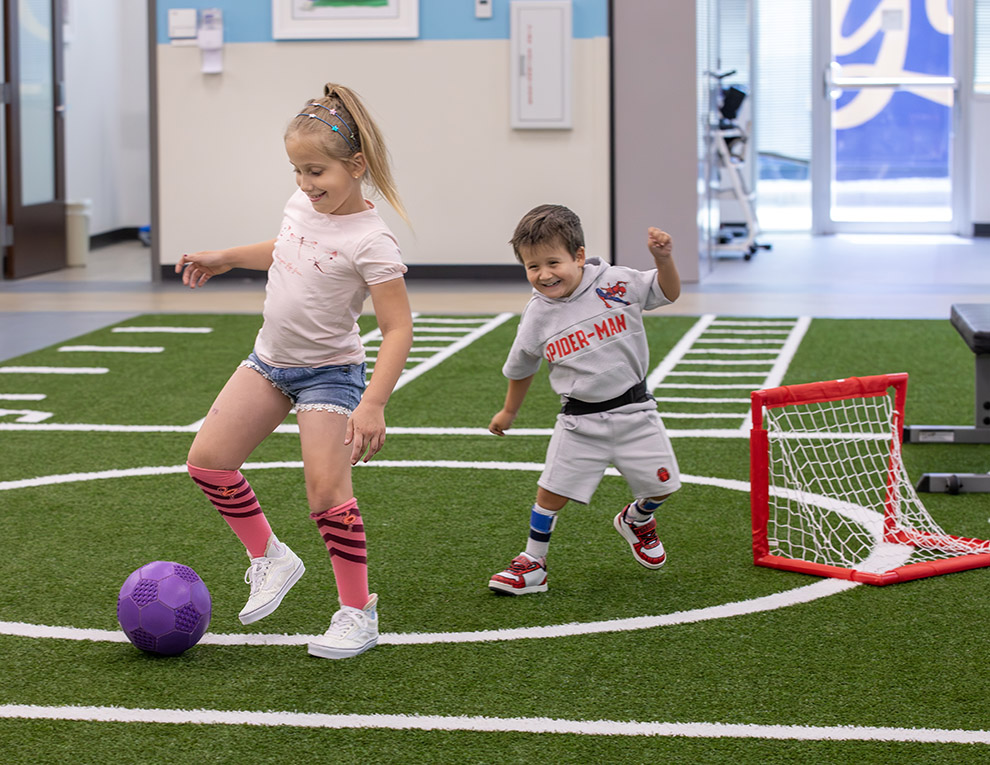
Afternoon sunlight streams into the expansive new physical therapy rehabilitation space of Johns Hopkins All Children’s Hospital, illuminating a hive of activity.
Kids of all ages and abilities are engaged with their physical and occupational therapists — building skills, bolstering confidence, busting boundaries.
Amid all the action, it’s hard to miss 8-year-old Harper.
Huddled on the sports floor with her therapist, Marissa Parker, PT, Harper is a focused ball of energy as she negotiates her next move.
Soon, there’s a plan.
As a favorite song plays, the little girl leaps into action, scaling an ascending pile of dense, colorful floor cushions, stopping just long enough to step on the lighted buttons placed along her path to raise the degree of difficulty. Each button changes color when Harper hits her target.
Full of purpose, she navigates her course and then leaps off the last cushion to stick the landing.
“Great! Let’s do it again,” Parker says.
Harper is solid. She looks more like a young athlete than a child who is living with a major birth defect.
Spina Bifida
Harper was diagnosed before birth with spina bifida, a condition in which the neural tube fails to develop or close properly, leading to a range of disabilities. Harper underwent fetoscopic surgery in Texas before she was born, which improved her outlook. But there is no cure for spina bifida.
“She’s dealt with a lot of different things that have caused her to have to work much harder than the average person,” says her mom, Erica. “Just to be able to walk, to run, to play … things we don’t think twice about doing.”
In the painstaking early years of therapy, Michelle Schultz, PT, worked diligently with Harper, helping to pave the way for her first hard-fought steps — an achievement that would alter the course of her life for the better.
It seems like only yesterday, Harper was a pig-tailed toddler in purple unicorn shoes, putting in her paces on the treadmill to the tune of “Baby Shark.”
An impossibly cute video clip of Harper doing this spread like wildfire across social media channels back then. “Baaa — byyy shark, doo-doo-doo-doo-doo-doo …”
“Oh, no. Please. So embarrassing!” Harper puts up a hand in dramatic protest when she’s reminded of her “Baby Shark” era.
To be sure, her music tastes have evolved as she’s grown. Harper has traded in “Baby Shark” for Taylor Swift.
At age 8, she’s in that twilight of early girlhood — with a budding fascination for make-up, but not ready to let go of her Barbies just yet.
With each stage of growth, her unique physical challenges change as well.
“Harper’s legs are always going to function differently from other kids, not only in strength, but in sensation,” Parker says. “As she grows, her body is going to feel different every time and her muscles will need to adapt.”
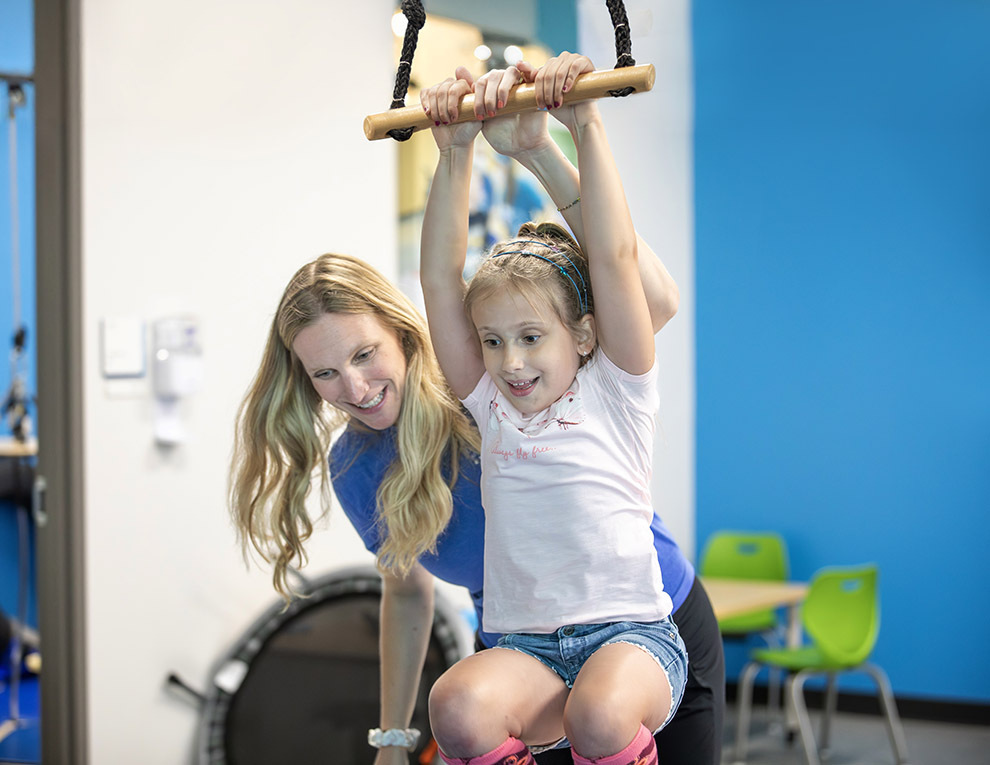
Parker works with Harper on strength, balance and endurance — things that will help give her the freedom to do all that she wants to do in her life.
“She’s fun, she’s nice, she’s kind,” Harper says. “She even lets me do some things I want to do sometimes.”
Commitment to Care
Harper and her family moved to Germany in recent years, but they haven’t found a physical rehabilitation program that compares to the one at Johns Hopkins All Children’s.
Twice a year, for several weeks at a time, the family travels from Europe to St. Petersburg, Florida, to receive the level of care that has been making a difference for Harper since she was a baby.
“I can’t say enough about what the rehabilitation center has been able to do for Harper,” Erica says. “The therapists here know what she needs. They’re innovative with everything they do. We travel halfway across the world for this. I think that should speak for itself.”
These days, Harper is self-motivated.
As one who loves adventure, she is determined to keep up with her siblings and her classmates, even though it can be more challenging for her.
She has a wheelchair and a walker she can use when needed, but most often, she prefers not to.
A recent milestone in her progress occurred when the family took a trip to Disneyland in Paris. Her parents brought along her walker, but Harper conquered the entire theme park on her own two feet for a full 10-hour day.
“When I see my daughter today, I see so much confidence and determination,” Erica says.
“I’m so proud of her. She’s going to go far in life.”
Treatment Pediatric Rehabilitation Medicine at Johns Hopkins All Children's
At Johns Hopkins All Children’s Hospital in St. Petersburg, Florida, our pediatric rehabilitation specialists take a comprehensive approach to care, providing treatment that addresses the needs of the whole child. Pediatric rehabilitation medicine (PRM) focuses on the rehabilitation and medical management of children with brain injuries, cerebral palsy, spinal cord injuries, neuromuscular disorders and a range of musculoskeletal conditions.