
According to the U.S. Bureau of Labor Statistics, there are about 66,000 ophthalmic medical technicians in the United States. At Wilmer Eye Institute, Johns Hopkins Medicine, there about 150 ophthalmic technicians, who work at the institute’s nine locations throughout Maryland. They range from novice to seasoned, with more than a century of experience among them. These former athletes, budding artists and aspiring medical school students form a a dynamic group of ophthalmic sonographers and photographers, ophthalmic scribes and assistants, low vision rehabilitation therapists and orthoptists.
During the last 20-plus years, the ophthalmic technician float pool has been a lifeline of sorts for the institute’s clinics. Float pool technicians often arrive at Wilmer with no prior experience but are vigorously trained to be adaptable and to have the skills to fulfill staffing needs no matter the division from which the request originates. Nearly a quarter of all Wilmer techs start their careers in the float pool.
For Allied Ophthalmic Personnel week, I visited some of Wilmer’s talented technicians in the float pool. The following is a day in their lives.
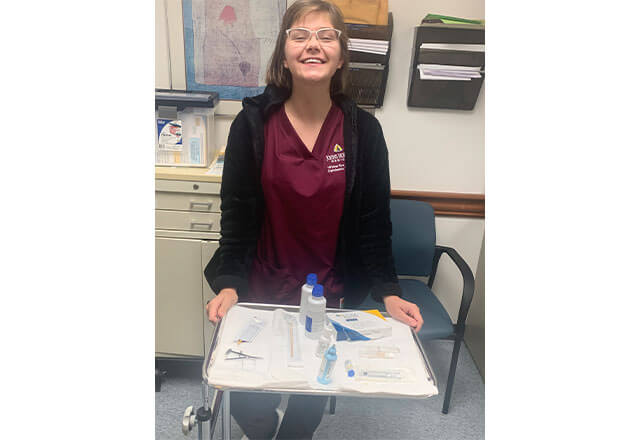
It’s Tuesday morning, Oct. 17, at the Wilmer Eye Institute at Johns Hopkins Bayview Medical Center. Breanna Soldatelli, ophthalmic technician in Wilmer’s float pool, is working with vitreoretinal surgeon J. Fernando Arevalo, chief of ophthalmology at Bayview and the Edmund F. and Virginia Ball Professor of Ophthalmology. As an extender, Soldatelli assists with the flow of Arevalo’s clinic: she documents patient medical history, escorts patients to testing, sets up sterile trays with medical instruments, administers numbing medications and supports both the doctor and patient during procedures.
“The float pool for us is very important,” Arevalo says. “The technicians coming to Bayview are outstanding and we really enjoy working with them. Breanna is amazing. She is very efficient, very likable and is resilient.”
Soldatelli has a naturally congenial personality. Working with patients, she explains the process of the procedure in a thorough manner and provides compassionate patient care.
Soldatelli’s mother is an optometrist, and Breanna, age 21, began her career about six years ago by filing patient records at an eye care practice. Later, she began shadowing the doctors, which eventually led to her promotion as a testing technician. In that role, Soldatelli performed visual field and optical coherence tomography tests.
Shortly after, she began scribing and screening patients for one of the practice’s glaucoma specialists. She joined Wilmer as a member of the ophthalmic float pool about two years ago, and she likens the position to that of a substitute teacher who is trained to instruct about many subjects.
“We don’t specialize to do one particular thing. We get experience on how to do neuro work-ups, how to do retina prep, how to do the high-speed work-ups in PACE,” says Soldatelli, referring to Wilmer’s Patient Access Center for the Eye. “You get to learn a whole lot of skills very quickly and become very adaptable depending on which clinic you are in.”
The benefits of being a float technician, says Soldatelli, are learning from the most experienced technicians and enjoying a good support system.
“You get to meet a lot of different patients, from all walks of life. You get experience with all sorts of eye conditions, and learning from technicians like Levy Silverio, who has been a technician for longer than I have been alive, is extremely beneficial.”
With over 30 years of ophthalmology experience, Silverio is lead ophthalmic technician at Bayview. He says that having float coverage in clinic is of paramount importance.
“We cannot survive with just two or three techs,” he says. “The float techs are very amazing and helpful.”
Bayview’s clinic manager Nicole Thornton agrees.
“It is very important that we have float tech coverage to keep our clinic running smoothly, to decrease patient delays and to ensure the practitioner’s schedule run on time,” she says.
Soldatelli is not only a talented ophthalmic technician but also a gifted artist who enjoys special effects makeup and designs and makes costumes for events such as the Maryland Renaissance Festival. A recent Johns Hopkins University graduate, she looks forward to starting the master’s program at the Bloomberg School of Public Health in the fall of 2024. From there, she plans to enroll in medical school with the goal of becoming a neuro-ophthalmologist.
---
It’s Friday Oct. 20. I decided to visit the float pool leadership, including Nidia Adames, ophthalmic technician training program manager; and Stephen Chott, technician training and compliance coordinator, at their office on Johns Hopkins’ East Baltimore campus. We talked about their excitement regarding Wilmer’s upcoming 25th annual technician course, what’s going on in the float pool and their hopes for the future.
This week has been a busy one for both Adames and Chott, included a stint for Adames at Wilmer’s location in Bethesda, Maryland, where she teched patients and trained technicians, participated in a day-long orientation and preparation for the tech course.
“On average,” Adames says. “about 40% of my times is spent in the clinic working up patients and training technicians, 30% is spent training technicians here in the office and the remainder of my time involves administrative duties such as managing requests for float techs, making sure technicians receive their study materials for certification and working with Stephen to facilitate the training program.”
Chott’s week included teching and training at both Bayview and in Odenton, as well as prepping for the tech course.
“Right now, I spend the most of my time in clinics as well as performing technician training,” he says. Additionally, as compliance coordinator, Chott is instrumental in facilitating clinic safety and compliance rounds at satellite locations as well as on the East Baltimore campus.
Adames and Chott are veteran technicians at Wilmer. Adames began working in the float pool in 2009, and she stayed in the float pool for a few years before moving on to a private practice. She later returned to Wilmer as a full-time technician at the Columbia location, and in 2021, she accepted a position at the PACE clinic. About six months later, she was promoted to ophthalmic clinical supervisor. In April of this year, Adames accepted her current role as training program manager.
A year after becoming a member of the float pool at Wilmer in 2018, Chott accepted a technician position at Wilmer’s White Marsh location, where he stayed for three years until managing an integrative wellness center. In May of this year, Chott obtained a leadership position in the float pool at Wilmer.
The pair have been working in concert to make sure this year’s technician course is a success. Technician training and education are vital to achieving Wilmer’s mission, and the tech course is a pillar of that mission. During the conference, ophthalmic technicians earn continuing education credits while learn from the foremost experts in ophthalmology.
This year, Adames and Chott expect at least 100 attendees — a 30% increase from last year — who will come from as far as Delaware.
“I am excited and nervous,” says Adames. This is both her and Chott’s first time steering the event. Nerves aside, Adames is happy about the opportunity for ophthalmic technicians to come together and learn.
Adames and Chott also have much else look forward to in the coming months. Two new ophthalmic technicians will join the float pool during the next two weeks, and Adames and Chott will conduct the Wilmerwide technician skills evaluation and assessment in November and December. They are also excited about the formation of new float pool, that will provide technician coverage to southern and western satellite locations such as those in Bethesda and Frederick, Maryland. For Adames, this is another opportunity to show prospective technicians the promise of a career in ophthalmology and at Wilmer.
“I’d like the applicants to see ophthalmology as a hopeful career, full of growth and opportunity,” says Adames. “This is a career opportunity that can take you places.”