
Open ALS Clinical Trials
Our program offers patients two types of clinical trials: ones that explore new ways to treat ALS, and ones that aim to learn more about the disease. Both types of studies are equally important to our mission to ultimately uncover pathways to prevent ALS in the first place.
Therapeutic studies for ALS
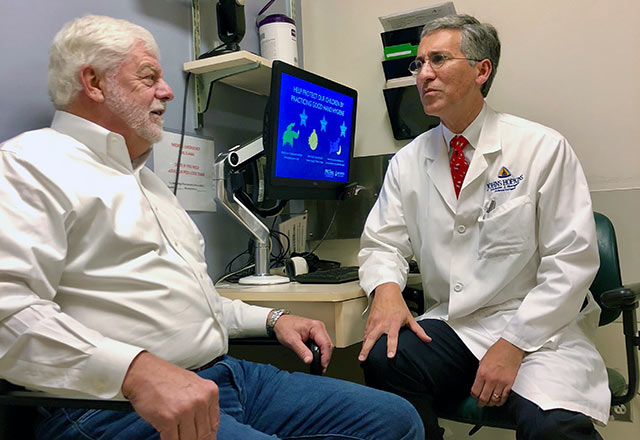
Bringing treatment to ALS patients is the main mission of this program’s efforts. Our goal is to enroll all potential ALS patients into clinical trials that could help slow, halt, and eventually improve ALS. These therapies can take the form of traditional medications taken in pill form or by injection, but have also included gene therapy studies and the study of medical devices.
Phase 2, Randomized, Double-Blind, Placebo-Controlled, Multi-Center, 24-Week Studywith Additional 24-Week Blinded Active Extension to Evaluate the Safety and Efficacy of COYA 302 for the Treatment of Amyotrophic Lateral Sclerosis (ALS)
Status: Active, Enrolling
Route of Administration: subcutaneous injection
Length of Study: 2 years
Principal Investigator: Nicholas J. Maragakis, M.D.
Contact: Delayna Willie ([email protected])
The ALSTARS trial will be conducted across 20-25 sites in the U.S. and Canada, and will evaluate the safety and efficacy of an investigational treatment called COYA 302 for adults with Amyotrophic Lateral Sclerosis (ALS).
COYA 302 is an investigational and proprietary biologic combination therapy with a dual immunomodulatory mechanism of action intended to enhance the anti-inflammatory function of regulatory T cells (Tregs) and suppress the inflammation produced by activated monocytes and macrophages. It is comprised of low dose interleukin-2 (LD IL-2) and DRL_AB (a biosimilar candidate for abatacept). Participants will be randomly assigned to receive one of 2 regimens of COYA 302 or placebo (an inactive substance) for 24-weeks in the double-blind (DB) period. Those who complete this part of the study may be eligible to receive one of the two regimens of COYA 302 for an additional 24 weeks in a blinded active extension phase (EXT).
CortiCom
Brain-Computer Interface (BCI) Implant for Severe Communication Disability
Status: Active, Enrolling
Route of Administration: Implanted Device
Length of Study: ~6 months
Principal Investigator: Nathan Crone, M.D.
Contact: 410-955-6772 or [email protected]
More information on clinicaltrials.gov: NCT03567213
A BCI allows individuals to operate a computer with their mind alone. Small electrodes on the surface of the brain carry signals to the computer, letting patients more easily communicate with family and friends.
For patients with significant motor impairment, a BCI system can potentially provide greater independence and quality of life. The study involves surgical implantation of electrodes on the surface of the sensory motor cortex involved in speech and upper limbs.
After surgery, participants will learn how to operate the BCI by traveling to the study site three times a week.
ALS Biomarker and Observational Studies
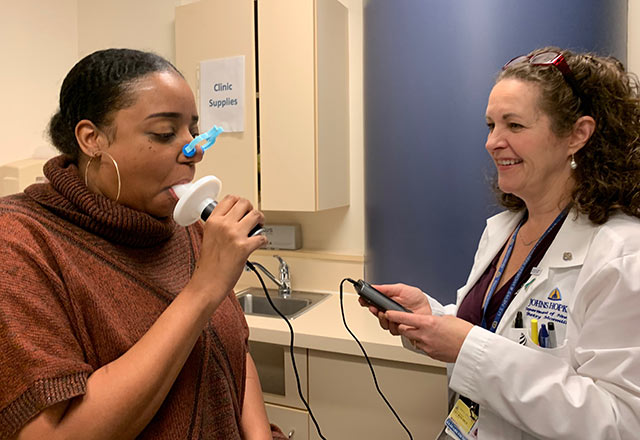
Our greatest limitation to treating Amyotrophic Lateral Sclerosis (ALS) is the lack of understanding what causes or enables sporadic ALS. However, Johns Hopkins researchers are uncovering powerful discoveries for this progressive disease. These discoveries start in research laboratories across the institution as well as collaborations with investigators across the globe.
ASSESS ALL ALS
Status: Enrolling
Length of Study: 24 months
Principal Investigator: Nicholas Maragakis, M.D.
Contact: Delayna Willie ([email protected])
Learn more about the ASSESS ALL ALS study.
This is an observational study for people with Amyotrophic Lateral Sclerosis that collects a wide range of samples, clinical information and measurements that will be used for future research into ALS and related neurological diseases.
PREVENT ALL ALS
Status: Enrolling
Length of Study: 36 months
Principal Investigator: Nicholas Maragakis, M.D.
Contact: Delayna Willie ([email protected])
Learn more about the PREVENT ALL ALS study.
This is an observational study for people with an Amyotrophic Lateral Sclerosis causative gene or those with a family history indicating the likelihood of being a carrier of an ALS causative gene. This study collects a wide range of samples, clinical information and measurements that will be used for future research into ALS and related neurological diseases.