

Project PROTect Programs
Outreach
Project PROTect centers on partnering with families to help protect children while they are being cared for in the hospital. All our programs look to find innovative ways to engage, educate, and involve families directly in infection prevention.
PROTect Cart
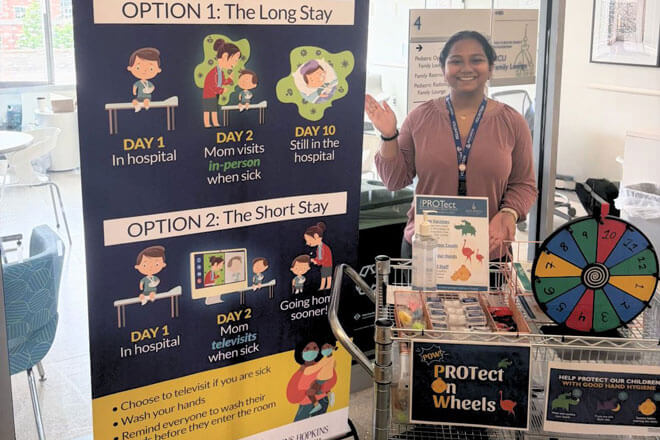 The PROTect on Wheels cart
An extension of the unit door-to-door outreach, the Project PROTect cart, is one of our most recent programs. A team of volunteers visit select units throughout the week to engage families and patients in conversations about infection prevention topics. Interactive activities make learning how to keep everyone safe from infections fun!
Units
A major initiative of Project PROTect is to bring infection protection awareness and engagement to families of patients in the JHCC. We accomplished this early on by selecting three high impact units and delivering messages of: hand hygiene, healthy visitation choices, and parent vaccine availability. PROTect staff visited each unit on a weekly basis, going door-to-door, speaking directly to parents and answering any questions about the topics and programs.
Front Desk
In September 2019 we joined the front desk staff to hand out hand sanitizer and share simple infection‑control tips; initially our team staffed two‑hour shifts every other day. Visitors responded positively to the active engagement. In January 2020 we met with hospital administration and front‑desk teams to formalize this approach. Following the pandemic, we shifted our focus to the development of a front desk video and signage to support healthy visiting habits.
Communication
Video - Healthy Visits Mean Healthier Kids: A Guide to Visiting Kids in the Hospital
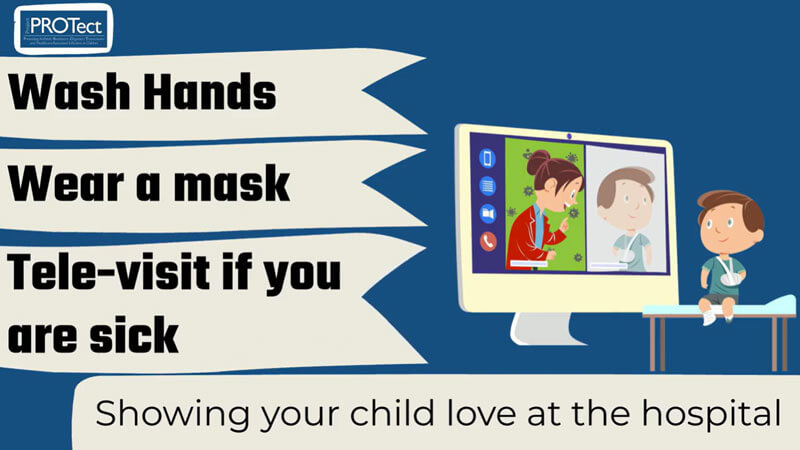 A scene from the PROTect video
Our vision for this video, which runs on the M level of Johns Hopkins Children's Center, is to educate and empower family members to make informed decisions about visiting their children in the hospital. The video also plays on a continuous loop at the front desk as people are signing in. The animation shows families the impact they have on their children’s health as visitors.
This video was truly a multi-disciplinary effort. We worked with HEIC and Parent and Family Education to develop the content and then instructional designers from the Armstrong Institute for Patient Safety and Quality. Together we were able to visually demonstrate the significant impact that infection control can have by showing side-by-side what happens if family members visit while being sick.
Our goal is to educate families about how infections can spread, allowing them to make informed decisions about how and when to visit their child. The PROTect video educates and empowers hospital visitors while serving as a powerful layer of protection for our vulnerable patient population.
Banner Bug
A stationary banner pulled from the animated messaging in our M level video allows visitors an additional opportunity to review our education on how best to visit admitted children safely. The banner greets visitors as they approach the entry of the JHCC, and reminds them to consider visiting remotely if they are showing signs of illness.
Screen Saver
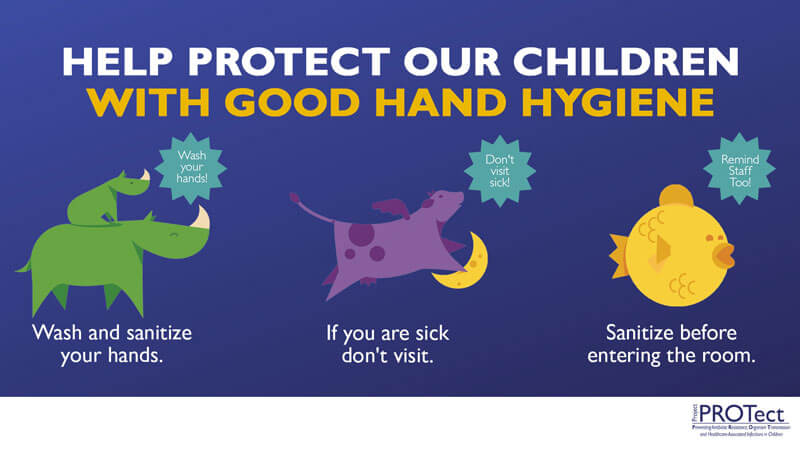 Project PROTect hand hygiene screen saver
This colorful screensaver can be seen across the Johns Hopkins Children’s Center by patients and their families in patient rooms, and nurses can see it on their workstation computers. The screensaver includes three important reminders: wash hands frequently, remind healthcare workers to sanitize, and to avoid visiting if sick or to wear a mask.
Parent Protections
Parent Vaccines
The Project PROTect vaccine program is our longest running program to-date. Since 2016 Project PROTect has run a free Flu and Tdap vaccine program for parents whose children are currently admitted to the JHCC.
The PROTect vaccine program initially started in the NICU. This early NICU program focused on unit staff education and awareness of the free vaccine offerings to parents. In October 2019 additional units were included, and project team members begin visiting the units and speaking directly to families about the free vaccines.
In 2024 we opened the program to the entire Children’s Center, allowing all family members with children currently admitted to the JHCC to take advantage of access to free Flu and Tdap vaccines.
TREAT PARENTS
The TREAT PARENTS quality improvement program aims to reduce parent-to-child transmission of S. aureus, a common bacteria that causes life-threatening bloodstream infections in babies in the neonatal intensive care unit (NICU). In 2026, Johns Hopkins Hospital and Johns Hopkins Bayview Medical Center implemented this parent‑directed treatment as standard practice. By partnering with the parents of NICU babies, and providing them with treatment, we can reduce the risk of S. aureus being passed to infants.